

532
M. V. L. BENNETT
. .
. *
. ’
&
. *- 1
:
.
N
0.2 msec
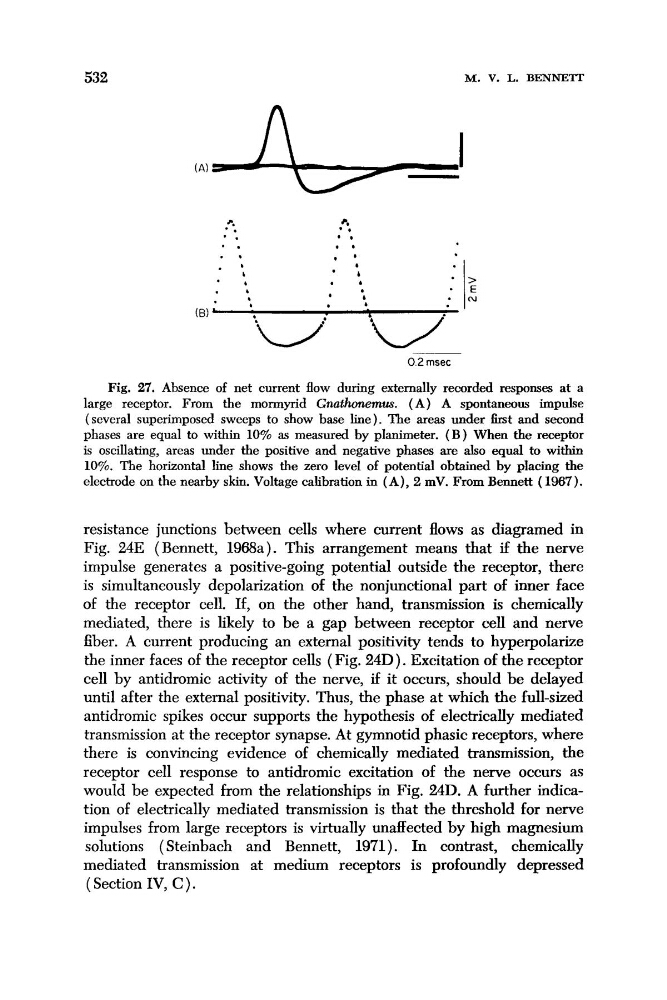
Fig. 27. Absence of net current flow during externally recorded responses at a
large receptor. From the mormyrid Gnathonemus. ( A ) A spontaneous impulse
(several superimposed sweeps to show base line). The areas under 6rst and second
phases are equal to within 10% as measured by planimeter. ( B ) When the receptor
is oscillating, areas under the positive and negative phases are also equal to within
10%. The horizontal line shows the zero level of potential obtained by placing the
electrode on the nearby skin. Voltage calibration in (A), 2 mV. From Bennett ( 1967).
resistance junctions between cells where current flows as diagramed in
Fig. 24E (Bennett, 1968a). This arrangement means that if the nerve
impulse generates a positive-going potential outside the receptor, there
is simultaneously depolarization of the nonjunctional part of inner face
of the receptor cell. If, on the other hand, transmission is chemically
mediated, there is likely to be a gap between receptor cell and nerve
fiber. A current producing an external positivity tends to hyperpolarize
the inner faces of the receptor cells ( Fig. 24D). Excitation of the receptor
cell by antidromic activity of the nerve, if it occurs, should be delayed
until after the external positivity. Thus, the phase at which the full-sized
antidromic spikes occur supports the hypothesis of electrically mediated
transmission at the receptor synapse. At gymnotid phasic receptors, where
there is convincing evidence of chemically mediated transmission, the
receptor cell response to antidromic excitation of the nerve occurs as
would be expected from the relationships in Fig. 24D. A further indication of electrically mediated transmission is that the threshold for nerve
impulses from large receptors is virtually unaffected by high magnesium
solutions ( Steinbach and Bennett, 1971). In contrast, chemically
mediated transmission at medium receptors is profoundly depressed
( Section IVY C ) .
M. V. L. BENNETT
. .
. *
. ’
&
. *- 1
:
.
N
0.2 msec
Fig. 27. Absence of net current flow during externally recorded responses at a
large receptor. From the mormyrid Gnathonemus. ( A ) A spontaneous impulse
(several superimposed sweeps to show base line). The areas under 6rst and second
phases are equal to within 10% as measured by planimeter. ( B ) When the receptor
is oscillating, areas under the positive and negative phases are also equal to within
10%. The horizontal line shows the zero level of potential obtained by placing the
electrode on the nearby skin. Voltage calibration in (A), 2 mV. From Bennett ( 1967).
resistance junctions between cells where current flows as diagramed in
Fig. 24E (Bennett, 1968a). This arrangement means that if the nerve
impulse generates a positive-going potential outside the receptor, there
is simultaneously depolarization of the nonjunctional part of inner face
of the receptor cell. If, on the other hand, transmission is chemically
mediated, there is likely to be a gap between receptor cell and nerve
fiber. A current producing an external positivity tends to hyperpolarize
the inner faces of the receptor cells ( Fig. 24D). Excitation of the receptor
cell by antidromic activity of the nerve, if it occurs, should be delayed
until after the external positivity. Thus, the phase at which the full-sized
antidromic spikes occur supports the hypothesis of electrically mediated
transmission at the receptor synapse. At gymnotid phasic receptors, where
there is convincing evidence of chemically mediated transmission, the
receptor cell response to antidromic excitation of the nerve occurs as
would be expected from the relationships in Fig. 24D. A further indication of electrically mediated transmission is that the threshold for nerve
impulses from large receptors is virtually unaffected by high magnesium
solutions ( Steinbach and Bennett, 1971). In contrast, chemically
mediated transmission at medium receptors is profoundly depressed
( Section IVY C ) .