

11. ELECTRORECEPTION
531
i
! r
>
E
N
>
E
N
I I - ___
2 rnsec
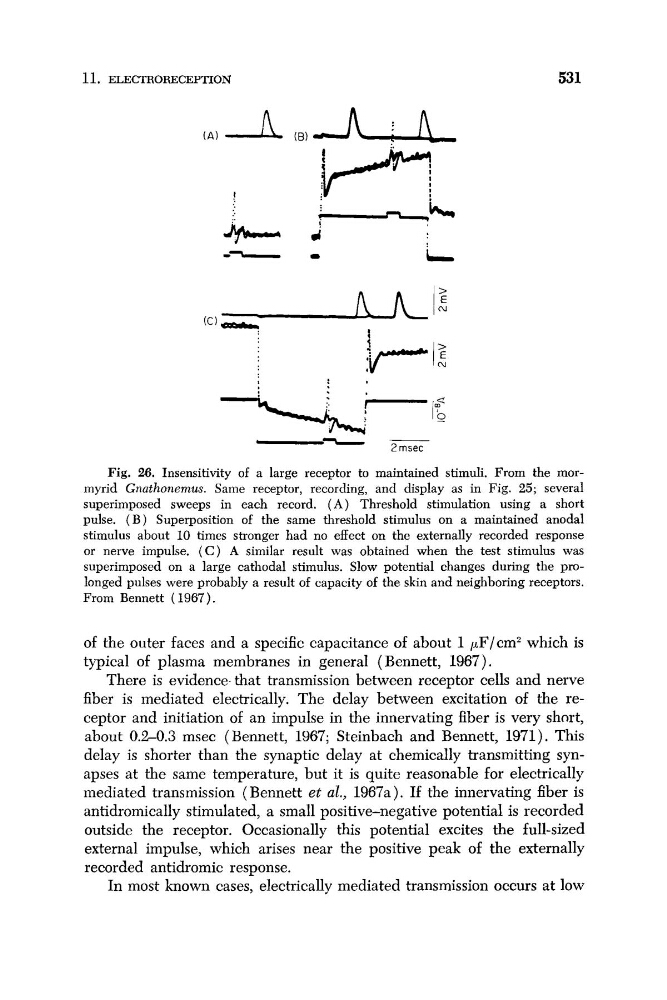
Fig. 26. Insensitivity of a large receptor to maintained stimuli. From the mormyrid Gnathonemus. Same receptor, recording, and display as in Fig. 25; several
superimposed sweeps in each record. ( A ) Threshold stimulation using a short
pulse. ( B ) Superposition of the same threshold stimulus on a maintained anodal
stimulus about 10 times stronger had no effect on the externally recorded response
or nerve impulse. ( C ) A similar result was obtained when the test stimulus was
superimposed on a large cathodal stimulus. Slow potential changes during the prolonged pulses were probably a result of capacity of the skin and neighboring receptors.
From Bennett ( 1967).
of the outer faces and a specific capacitance of about 1 pF/cm2 which is
typical of plasma membranes in general (Bennett, 1967).
There is evidence- that transmission between receptor cells and nerve
fiber is mediated electrically. The delay between excitation of the receptor and initiation of an impulse in the innervating fiber is very short,
about 0.2-0.3 msec (Bennett, 1967; Steinbach and Bennett, 1971). This
delay is shorter than the synaptic delay at chemically transmitting synapses at the same temperature, but it is quite reasonable for electrically
mediated transmission (Bennett et al., 1967a). If the innervating fiber is
antidromically stimulated, a small positive-negative potential is recorded
outside the receptor. Occasionally this potential excites the full-sized
external impulse, which arises near the positive peak of the externally
recorded antidromic response.
In most known cases, electrically mediated transmission occurs at low
531
i
! r
>
E
N
>
E
N
I I - ___
2 rnsec
Fig. 26. Insensitivity of a large receptor to maintained stimuli. From the mormyrid Gnathonemus. Same receptor, recording, and display as in Fig. 25; several
superimposed sweeps in each record. ( A ) Threshold stimulation using a short
pulse. ( B ) Superposition of the same threshold stimulus on a maintained anodal
stimulus about 10 times stronger had no effect on the externally recorded response
or nerve impulse. ( C ) A similar result was obtained when the test stimulus was
superimposed on a large cathodal stimulus. Slow potential changes during the prolonged pulses were probably a result of capacity of the skin and neighboring receptors.
From Bennett ( 1967).
of the outer faces and a specific capacitance of about 1 pF/cm2 which is
typical of plasma membranes in general (Bennett, 1967).
There is evidence- that transmission between receptor cells and nerve
fiber is mediated electrically. The delay between excitation of the receptor and initiation of an impulse in the innervating fiber is very short,
about 0.2-0.3 msec (Bennett, 1967; Steinbach and Bennett, 1971). This
delay is shorter than the synaptic delay at chemically transmitting synapses at the same temperature, but it is quite reasonable for electrically
mediated transmission (Bennett et al., 1967a). If the innervating fiber is
antidromically stimulated, a small positive-negative potential is recorded
outside the receptor. Occasionally this potential excites the full-sized
external impulse, which arises near the positive peak of the externally
recorded antidromic response.
In most known cases, electrically mediated transmission occurs at low