

>
E
n
z
E
1 0
N
2 0 mV
5 mV
519
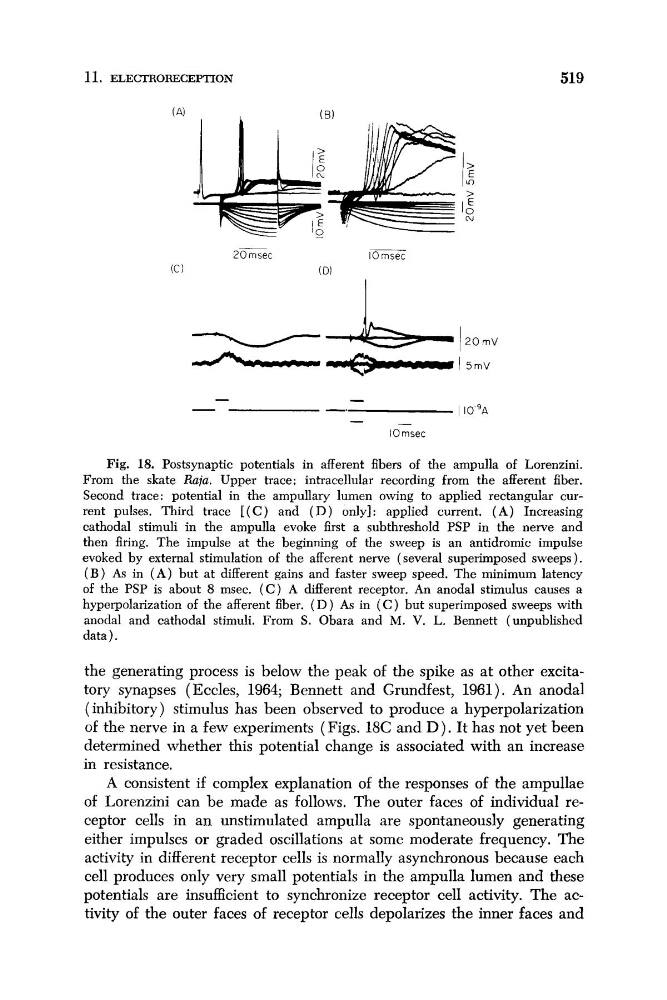
Fig. 18. Postsynaptic potentials in afferent fibers of the ampulla of Lorenzini.
From the skate Raja. Upper trace: intracellular recording from the afferent fiber.
Second trace: potential in the ampullary lumen owing to applied rectangular current pulses. Third trace [ ( C ) and ( D ) only]: applied current. ( A ) Increasing
cathodal stimuli in the ampulla evoke first a subthreshold PSP in the nerve and
then firing. The impulse at the beginning of the sweep is an antidromic impulse
evoked by external stimulation of the afferent nerve (several superimposed sweeps).
( B ) As in ( A ) but at different gains and faster sweep speed. The minimum latency
of the PSP is about 8 msec. ( C ) A different receptor. An anodal stimulus causes a
hyperpolarization of the afferent fiber. ( D ) As in ( C ) but superimposed sweeps with
anodal and cathodal stimuli. From S. Obara and M. V. L. Bennett (unpublished
data).
the generating process is below the peak of the spike as at other excitatory synapses (Eccles, 1964; Bennett and Grundfest, 1961). An anodal
( inhibitory) stimulus has been observed to produce a hyperpolarization
of the nerve in a few experiments (Figs. 18C and D). It has not yet been
determined whether this potential change is associated with an increase
in resistance.
A consistent if complex explanation of the responses of the ampullae
of Lorenzini can be made as follows. The outer faces of individual receptor cells in an unstimulated ampulla are spontaneously generating
either impulses or graded oscillations at some moderate frequency. The
activity in different receptor cells is normally asynchronous because each
cell produces only very small potentials in the ampulla lumen and these
potentials are insufficient to synchronize receptor cell activity. The activity of the outer faces of receptor cells depolarizes the inner faces and
E
n
z
E
1 0
N
2 0 mV
5 mV
519
Fig. 18. Postsynaptic potentials in afferent fibers of the ampulla of Lorenzini.
From the skate Raja. Upper trace: intracellular recording from the afferent fiber.
Second trace: potential in the ampullary lumen owing to applied rectangular current pulses. Third trace [ ( C ) and ( D ) only]: applied current. ( A ) Increasing
cathodal stimuli in the ampulla evoke first a subthreshold PSP in the nerve and
then firing. The impulse at the beginning of the sweep is an antidromic impulse
evoked by external stimulation of the afferent nerve (several superimposed sweeps).
( B ) As in ( A ) but at different gains and faster sweep speed. The minimum latency
of the PSP is about 8 msec. ( C ) A different receptor. An anodal stimulus causes a
hyperpolarization of the afferent fiber. ( D ) As in ( C ) but superimposed sweeps with
anodal and cathodal stimuli. From S. Obara and M. V. L. Bennett (unpublished
data).
the generating process is below the peak of the spike as at other excitatory synapses (Eccles, 1964; Bennett and Grundfest, 1961). An anodal
( inhibitory) stimulus has been observed to produce a hyperpolarization
of the nerve in a few experiments (Figs. 18C and D). It has not yet been
determined whether this potential change is associated with an increase
in resistance.
A consistent if complex explanation of the responses of the ampullae
of Lorenzini can be made as follows. The outer faces of individual receptor cells in an unstimulated ampulla are spontaneously generating
either impulses or graded oscillations at some moderate frequency. The
activity in different receptor cells is normally asynchronous because each
cell produces only very small potentials in the ampulla lumen and these
potentials are insufficient to synchronize receptor cell activity. The activity of the outer faces of receptor cells depolarizes the inner faces and