

518
, -
M. V. L. BENNETT
n
w
h 5mV
5 mV
IO-*A
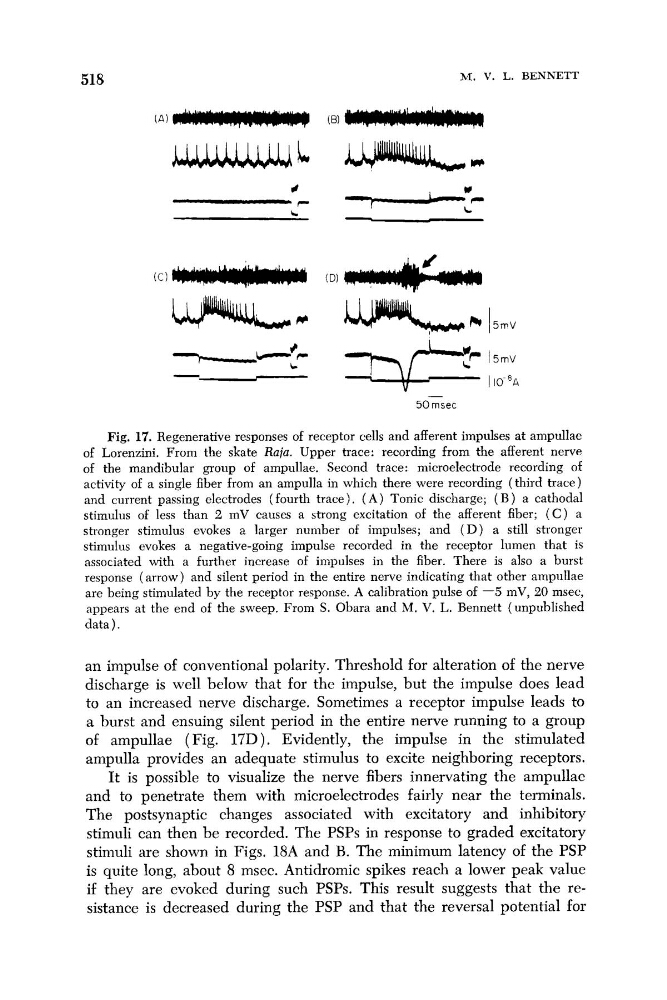
Fig. 17. Regenerative responses of receptor cells and afferent impulses at ampullae
of Lorenzini. From the skate Raja. Upper trace: recording from the afferent nerve
of the mandibular group of ampullae. Second trace: microelectrode recording of
activity of a single fiber from an ampulla in which there were recording (third trace)
and current passing electrodes (fourth trace). ( A ) Tonic discharge; ( B ) a cathodal
stimulus of less than 2 mV causes a strong excitation of the afferent fiber; ( C ) a
stronger stimulus evokes a larger number of impulses; and ( D ) a still stronger
stimulus evokes a negative-going impulse recorded in the receptor lumen that is
associated with a further increase of impulses in the fiber. There is also a burst
response (arrow) and silent period in the entire nerve indicating that other ampullae
are being stimulated by the receptor response. A calibration pulse of -5 mV, 20 msec,
appears at the end of the sweep. From S. Obara and M. V. L. Bennett (unpublished
data).
an impulse of conventional polarity. Threshold for alteration of the nerve
discharge is well below that for the impulse, but the impulse does lead
to an increased nerve discharge. Sometimes a receptor impulse leads to
a burst and ensuing silent period in the entire nerve running to a group
of ampullae (Fig. 17D). Evidently, the impulse in the stimulated
ampulla provides an adequate stimulus to excite neighboring receptors.
It is possible to visualize the nerve fibers innervating the ampullac
and to penetrate them with microelectrodes fairly near the terminals.
The postsynaptic changes associated with excitatory and inhibitory
stimuli can then be recorded. The PSPs in response to graded excitatory
stimuli are shown in Figs. 18A and B. The minimum latency of the PSP
is quite long, about 8 msec. Antidromic spikes reach a lower peak value
if they are evoked during such PSPs. This result suggests that the resistance is decreased during the PSP and that the reversal potential for
, -
M. V. L. BENNETT
n
w
h 5mV
5 mV
IO-*A
Fig. 17. Regenerative responses of receptor cells and afferent impulses at ampullae
of Lorenzini. From the skate Raja. Upper trace: recording from the afferent nerve
of the mandibular group of ampullae. Second trace: microelectrode recording of
activity of a single fiber from an ampulla in which there were recording (third trace)
and current passing electrodes (fourth trace). ( A ) Tonic discharge; ( B ) a cathodal
stimulus of less than 2 mV causes a strong excitation of the afferent fiber; ( C ) a
stronger stimulus evokes a larger number of impulses; and ( D ) a still stronger
stimulus evokes a negative-going impulse recorded in the receptor lumen that is
associated with a further increase of impulses in the fiber. There is also a burst
response (arrow) and silent period in the entire nerve indicating that other ampullae
are being stimulated by the receptor response. A calibration pulse of -5 mV, 20 msec,
appears at the end of the sweep. From S. Obara and M. V. L. Bennett (unpublished
data).
an impulse of conventional polarity. Threshold for alteration of the nerve
discharge is well below that for the impulse, but the impulse does lead
to an increased nerve discharge. Sometimes a receptor impulse leads to
a burst and ensuing silent period in the entire nerve running to a group
of ampullae (Fig. 17D). Evidently, the impulse in the stimulated
ampulla provides an adequate stimulus to excite neighboring receptors.
It is possible to visualize the nerve fibers innervating the ampullac
and to penetrate them with microelectrodes fairly near the terminals.
The postsynaptic changes associated with excitatory and inhibitory
stimuli can then be recorded. The PSPs in response to graded excitatory
stimuli are shown in Figs. 18A and B. The minimum latency of the PSP
is quite long, about 8 msec. Antidromic spikes reach a lower peak value
if they are evoked during such PSPs. This result suggests that the resistance is decreased during the PSP and that the reversal potential for