

11. ELECTRORECEPTION
509
nerve fiber and causes its tonic discharge. Stimuli that depolarize the
inner face of the receptor cell, i.e., make its cytoplasmic surface more
positive, increase the rate of transmitter secretion and hence the discharge frequency in the nerve. Stimuli that hyperpolarize the inner face
decrease the rate of transmitter secretion and thereby decrease the discharge frequency in the nerve.
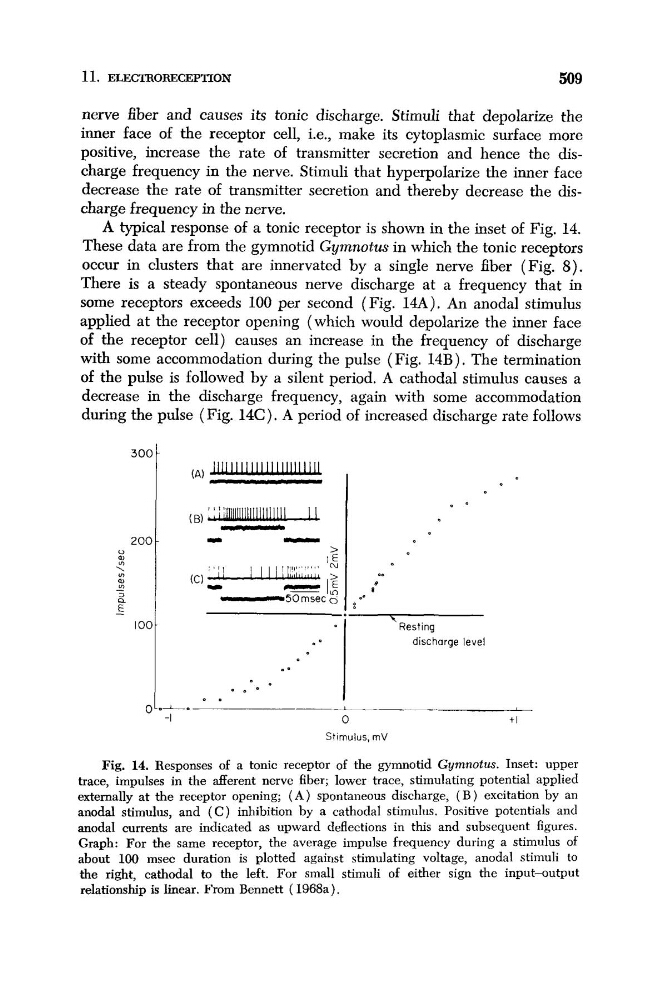
A typical response of a tonic receptor is shown in the inset of Fig. 14.
These data are from the gymnotid Gymnotus in which the tonic receptors
occur in clusters that are innervated by a single nerve fiber (Fig. 8 ) .
There is a steady spontaneous nerve discharge at a frequency that in
some receptors exceeds 100 per second (Fig. 14A). An anodal stimulus
applied at the receptor opening (which would depolarize the inner face
of the receptor cell) causes an increase in the frequency of discharge
with some accommodation during the pulse (Fig. 14B). The termination
of the pulse is followed by a silent period. A cathodal stimulus causes a
decrease in the discharge frequency, again with some accommodation
during the pulse (Fig. 14C). A period of increased discharge rate follows
I -
\
Resting
discharge level
- 0
s
o
-
*
D
O
-
-I
0
+I
Stimulus, rnV
Fig. 14. Responses of a tonic receptor of the gymnotid Gymnotus. Inset: upper
trace, impulses in the afferent nerve fiber; lower trace, stimulating potential applied
externally at the receptor opening; ( A ) spontaneous discharge, ( B ) excitation by an
anodal stimulus, and ( C ) inhibition by a cathodal stimulus. Positive potentials and
anodal currents are indicated as upward deflections in this and subsequent figures.
Graph: For the same receptor, the average impulse frequency during a stimulus of
about 100 msec duration is plotted against stimulating voltage, anodal stimuli to
the right, cathodal to the left. For small stimuli of either sign the input-output
relationship is linear. From Bennett ( 1968a).
509
nerve fiber and causes its tonic discharge. Stimuli that depolarize the
inner face of the receptor cell, i.e., make its cytoplasmic surface more
positive, increase the rate of transmitter secretion and hence the discharge frequency in the nerve. Stimuli that hyperpolarize the inner face
decrease the rate of transmitter secretion and thereby decrease the discharge frequency in the nerve.
A typical response of a tonic receptor is shown in the inset of Fig. 14.
These data are from the gymnotid Gymnotus in which the tonic receptors
occur in clusters that are innervated by a single nerve fiber (Fig. 8 ) .
There is a steady spontaneous nerve discharge at a frequency that in
some receptors exceeds 100 per second (Fig. 14A). An anodal stimulus
applied at the receptor opening (which would depolarize the inner face
of the receptor cell) causes an increase in the frequency of discharge
with some accommodation during the pulse (Fig. 14B). The termination
of the pulse is followed by a silent period. A cathodal stimulus causes a
decrease in the discharge frequency, again with some accommodation
during the pulse (Fig. 14C). A period of increased discharge rate follows
I -
\
Resting
discharge level
- 0
s
o
-
*
D
O
-
-I
0
+I
Stimulus, rnV
Fig. 14. Responses of a tonic receptor of the gymnotid Gymnotus. Inset: upper
trace, impulses in the afferent nerve fiber; lower trace, stimulating potential applied
externally at the receptor opening; ( A ) spontaneous discharge, ( B ) excitation by an
anodal stimulus, and ( C ) inhibition by a cathodal stimulus. Positive potentials and
anodal currents are indicated as upward deflections in this and subsequent figures.
Graph: For the same receptor, the average impulse frequency during a stimulus of
about 100 msec duration is plotted against stimulating voltage, anodal stimuli to
the right, cathodal to the left. For small stimuli of either sign the input-output
relationship is linear. From Bennett ( 1968a).