

504
M. V. L. BENNETT
Receptor External, interna1,and
cell
skin resistances
( b )
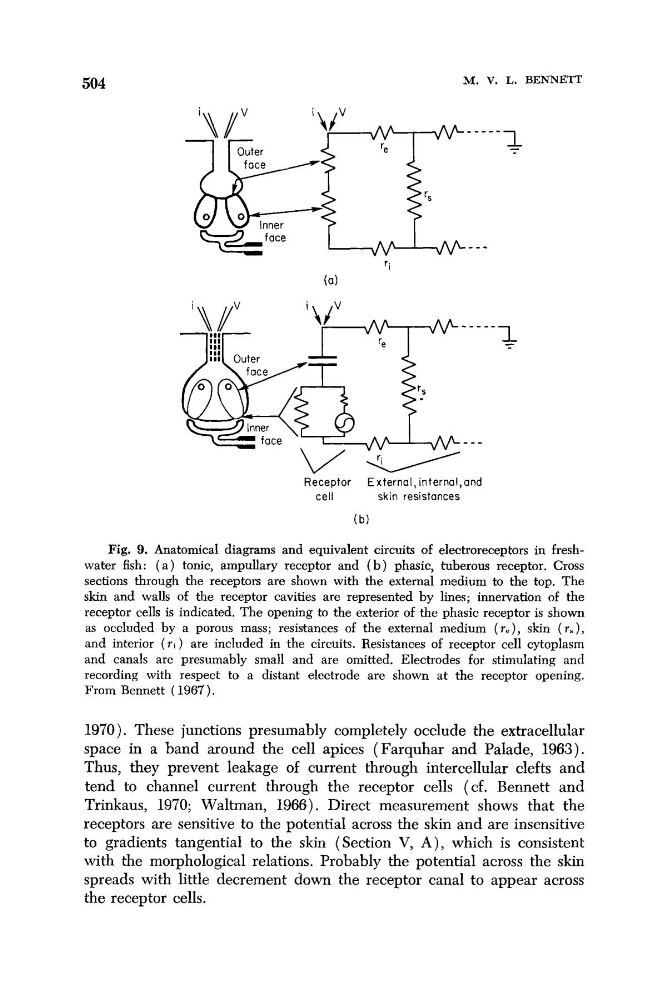
Fig. 9. Anatomical diagrams and equivalent circuits of electroreceptors in freshwater fish: ( a ) tonic, ampullary receptor and ( b ) phasic, tuberous receptor. Cross
sections through the receptors are shown with the external medium to the top. The
skin and walls of the receptor cavities are represented by lines; innervation of the
receptor cells is indicated. The opening to the exterior of the phasic receptor is shown
as occluded by a porous mass; resistances of the external medium ( r e ) , skin ( T ~ ) ,
and interior ( r i ) are included in the circuits. Resistances of receptor cell cytoplasm
and canals are presumably small and are omitted. Electrodes for stimulating and
recording with respect to a distant electrode are shown at the receptor opening.
From Bennett (1967).
1970 ) . These junctions presumably completely occlude the extracellular
space in a band around the cell apices (Farquhar and Palade, 1963).
Thus, they prevent leakage of current through intercellular clefts and
tend to channel current through the receptor cells (cf. Bennett and
Trinkaus, 1970; Waltman, 1966). Direct measurement shows that the
receptors are sensitive to the potential across the skin and are insensitive
to gradients tangential to the skin (Section V, A ) , which is consistent
with the morphological relations. Probably the potential across the skin
spreads with little decrement down the receptor canal to appear across
the receptor cells.
M. V. L. BENNETT
Receptor External, interna1,and
cell
skin resistances
( b )
Fig. 9. Anatomical diagrams and equivalent circuits of electroreceptors in freshwater fish: ( a ) tonic, ampullary receptor and ( b ) phasic, tuberous receptor. Cross
sections through the receptors are shown with the external medium to the top. The
skin and walls of the receptor cavities are represented by lines; innervation of the
receptor cells is indicated. The opening to the exterior of the phasic receptor is shown
as occluded by a porous mass; resistances of the external medium ( r e ) , skin ( T ~ ) ,
and interior ( r i ) are included in the circuits. Resistances of receptor cell cytoplasm
and canals are presumably small and are omitted. Electrodes for stimulating and
recording with respect to a distant electrode are shown at the receptor opening.
From Bennett (1967).
1970 ) . These junctions presumably completely occlude the extracellular
space in a band around the cell apices (Farquhar and Palade, 1963).
Thus, they prevent leakage of current through intercellular clefts and
tend to channel current through the receptor cells (cf. Bennett and
Trinkaus, 1970; Waltman, 1966). Direct measurement shows that the
receptors are sensitive to the potential across the skin and are insensitive
to gradients tangential to the skin (Section V, A ) , which is consistent
with the morphological relations. Probably the potential across the skin
spreads with little decrement down the receptor canal to appear across
the receptor cells.