

502
M. V. L. BENNETT
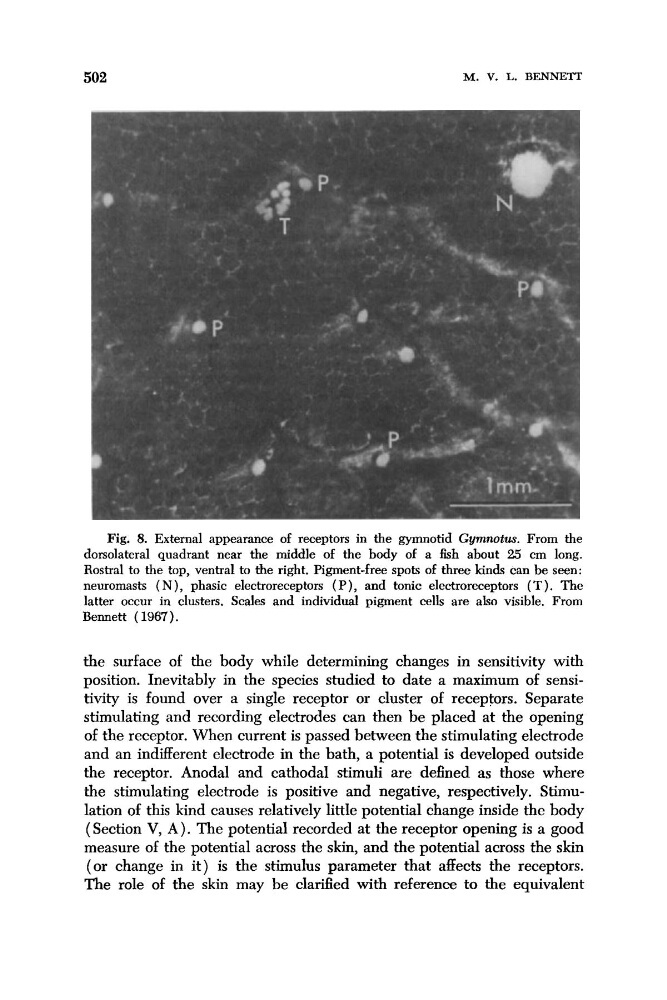
Fig. 8. External appearance of receptors in the gymnotid Gymnotus. From the
dorsolateral quadrant near the middle of the body of a fish about 25 cm long.
Rostra1 to the top, ventral to the right. Pigment-free spots of three kinds can be seen:
neuromasts ( N ) , phasic electroreceptors ( P ) , and tonic eledroreceptors ( T ) . The
latter occur in clusters. Scales and individual pigment cells are also visible. From
Bennett ( 1967).
the surface of the body while determining changes in sensitivity with
position. Inevitably in the species studied to date a maximum of sensitivity is found over a single receptor or cluster of receptors. Separate
stimulating and recording electrodes can then be placed at the opening
of the receptor. When current is passed between the stimulating electrode
and an indifferent electrode in the bath, a potential is developed outside
the receptor. Anodal and cathodal stimuli are defined as those where
the stimulating electrode is positive and negative, respectively. Stimulation of this kind causes relatively little potential change inside the body
(Section V, A ) . The potential recorded at the receptor opening is a good
measure of the potential across the skin, and the potential across the skin
(or change in it) is the stimulus parameter that affects the receptors.
The role of the skin may be clarified with reference to the equivalent
M. V. L. BENNETT
Fig. 8. External appearance of receptors in the gymnotid Gymnotus. From the
dorsolateral quadrant near the middle of the body of a fish about 25 cm long.
Rostra1 to the top, ventral to the right. Pigment-free spots of three kinds can be seen:
neuromasts ( N ) , phasic electroreceptors ( P ) , and tonic eledroreceptors ( T ) . The
latter occur in clusters. Scales and individual pigment cells are also visible. From
Bennett ( 1967).
the surface of the body while determining changes in sensitivity with
position. Inevitably in the species studied to date a maximum of sensitivity is found over a single receptor or cluster of receptors. Separate
stimulating and recording electrodes can then be placed at the opening
of the receptor. When current is passed between the stimulating electrode
and an indifferent electrode in the bath, a potential is developed outside
the receptor. Anodal and cathodal stimuli are defined as those where
the stimulating electrode is positive and negative, respectively. Stimulation of this kind causes relatively little potential change inside the body
(Section V, A ) . The potential recorded at the receptor opening is a good
measure of the potential across the skin, and the potential across the skin
(or change in it) is the stimulus parameter that affects the receptors.
The role of the skin may be clarified with reference to the equivalent