

1 1. ELECTRORECEPTION
497
Both tonic and phasic receptors are found in the gymnotids and the
mormyrids, and probably in Gymnurchus as well. These two groups
appear to have evolved electrosensory systems independently, and the
degree of convergence in the receptors is as remarkable as that in the
electric organs. Phasic receptors are absent in nonelectric and marine fish.
The electroreceptors in catfish are tonic as are the ampullae of Lorenzini
of electric and nonelectric marine elasmobranchs. The similarities are
SO great between the receptors of the same type in different species that
it is more convenient to discuss the receptors in terms of function rather
than phylogenetic relations.
In mormyrids the electroreceptors are of three kinds (Table I ) . They
have been termed large, medium, and small receptors although there is
some overlap in size of the different kinds. They are found over the entire
head and along the dorsal and ventral surface, but they are absent on
the sides of the body and caudal peduncle. The detailed distribution of
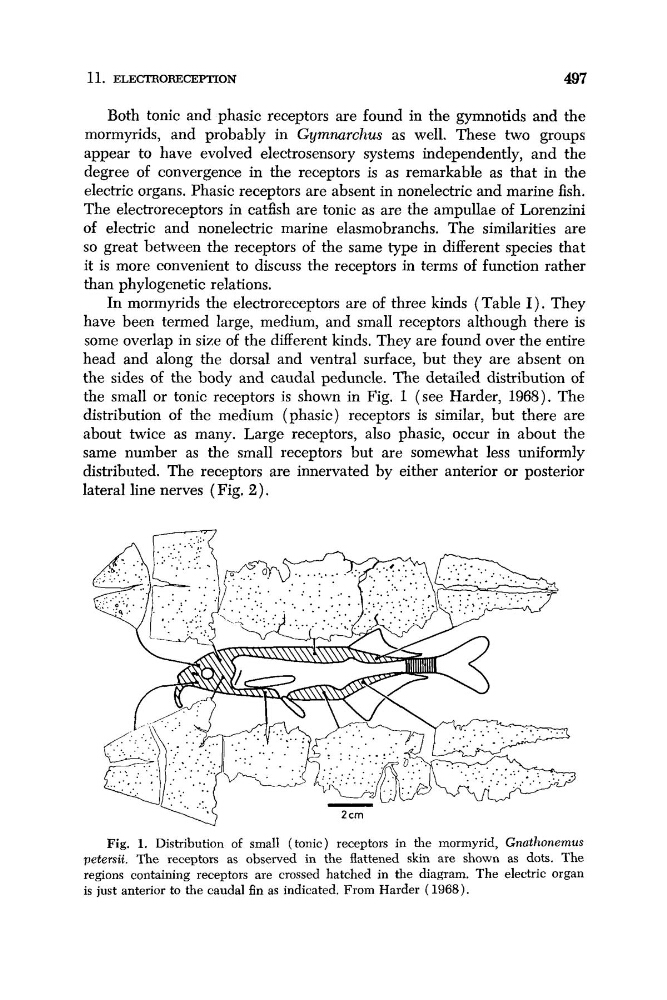
the small or tonic receptors is shown in Fig. 1 (see Harder, 1968). The
distribution of the medium (phasic) receptors is similar, but there are
about twice as many. Large receptors, also phasic, occur in about the
same number as the small receptors but are somewhat less uniformly
distributed. The receptors are innervated by either anterior or posterior
lateral line nerves ( Fig. 2 ) .
Fig. 1. Distribution of small (tonic) receptors in the mormyrid, Gnathonernus
petersii. The receptors as observed in the flattened skin are shown as dots. The
regions containing receptors are crossed hatched in the diagram. The electric organ
is just anterior to the caudal fin as indicated. From Harder ( 1968).
497
Both tonic and phasic receptors are found in the gymnotids and the
mormyrids, and probably in Gymnurchus as well. These two groups
appear to have evolved electrosensory systems independently, and the
degree of convergence in the receptors is as remarkable as that in the
electric organs. Phasic receptors are absent in nonelectric and marine fish.
The electroreceptors in catfish are tonic as are the ampullae of Lorenzini
of electric and nonelectric marine elasmobranchs. The similarities are
SO great between the receptors of the same type in different species that
it is more convenient to discuss the receptors in terms of function rather
than phylogenetic relations.
In mormyrids the electroreceptors are of three kinds (Table I ) . They
have been termed large, medium, and small receptors although there is
some overlap in size of the different kinds. They are found over the entire
head and along the dorsal and ventral surface, but they are absent on
the sides of the body and caudal peduncle. The detailed distribution of
the small or tonic receptors is shown in Fig. 1 (see Harder, 1968). The
distribution of the medium (phasic) receptors is similar, but there are
about twice as many. Large receptors, also phasic, occur in about the
same number as the small receptors but are somewhat less uniformly
distributed. The receptors are innervated by either anterior or posterior
lateral line nerves ( Fig. 2 ) .
Fig. 1. Distribution of small (tonic) receptors in the mormyrid, Gnathonernus
petersii. The receptors as observed in the flattened skin are shown as dots. The
regions containing receptors are crossed hatched in the diagram. The electric organ
is just anterior to the caudal fin as indicated. From Harder ( 1968).