

10. ELECTRIC ORGANS
477
firing of the accessory organs really represents delayed firing of the main
organ.
At chemically transmitting synapses such as those on electrocytes,
compensatory delays could in principle arise in “synaptic delay” [which
at the neuromuscular junction at least results from time required for
release of transmitter ( Katz and Miledi, 1965a,b) 1. Compensatory delays
may occur at a number of chemically transmitting synapses in electromotor systems. One instance is in the spinal electromotor nucleus of
the mormyrid Gnathonernus in which PSPs are synchronous at the two
ends of the nucleus, although the descending volley arrives at the
anterior end about 0.3 msec earlier than at the posterior end (M. V. L.
Bennett and E. Aljure, unpublished data).
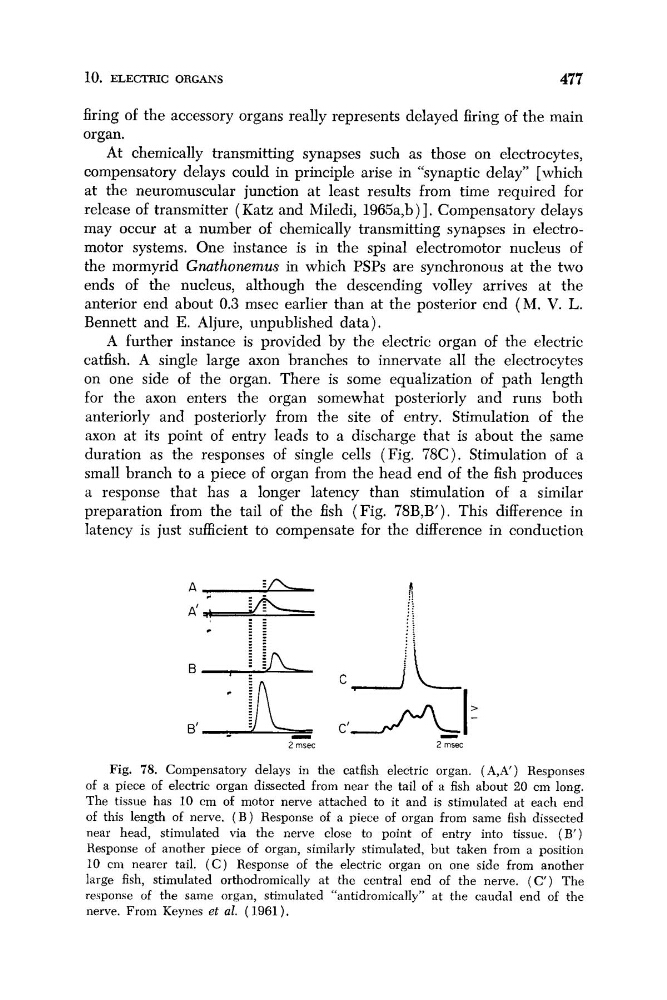
A further instance is provided by the electric organ of the electric
catfish. A single large axon branches to innervate all the electrocytes
on one side of the organ. There is some equalization of path length
for the axon enters the organ somewhat posteriorly and runs both
anteriorly and posteriorly from the site of entry. Stimulation of the
axon at its point of entry leads to a discharge that is about the same
duration as the responses of single cells (Fig. 78C). Stimulation of a
small branch to a piece of organ from the head end of the fish produces
a response that has a longer latency than stimulation of a similar
preparation from the tail of the fish (Fig. 78B,B’). This difference in
latency is just sufficient to compensate for the difference in conduction
2 msec
2 msec
Fig. 78. Compensatory delays in the catfish electric organ. (A,A’) Responses
of a piece of electric organ dissected from near the tail of a fish about 20 em long.
The tissue has 10 em of motor nerve attached to it and is stimulated at each end
of this length of nerve. ( B ) Response of a piece of organ from same fish dissected
near head, stimulated via the nerve close to point of entry into tissue. (B’)
Response of another piece of organ, similarly stimulated, but taken from a position
10 cni nearer tail. ( C ) Response of the electric organ on one side from another
large fish, stimulated orthodromically at the central end of the nerve. ( C ) The
response of the same organ, stimulated “antidroniically” at the caudal end of the
nerve. From Keynes et al. ( 1961).
477
firing of the accessory organs really represents delayed firing of the main
organ.
At chemically transmitting synapses such as those on electrocytes,
compensatory delays could in principle arise in “synaptic delay” [which
at the neuromuscular junction at least results from time required for
release of transmitter ( Katz and Miledi, 1965a,b) 1. Compensatory delays
may occur at a number of chemically transmitting synapses in electromotor systems. One instance is in the spinal electromotor nucleus of
the mormyrid Gnathonernus in which PSPs are synchronous at the two
ends of the nucleus, although the descending volley arrives at the
anterior end about 0.3 msec earlier than at the posterior end (M. V. L.
Bennett and E. Aljure, unpublished data).
A further instance is provided by the electric organ of the electric
catfish. A single large axon branches to innervate all the electrocytes
on one side of the organ. There is some equalization of path length
for the axon enters the organ somewhat posteriorly and runs both
anteriorly and posteriorly from the site of entry. Stimulation of the
axon at its point of entry leads to a discharge that is about the same
duration as the responses of single cells (Fig. 78C). Stimulation of a
small branch to a piece of organ from the head end of the fish produces
a response that has a longer latency than stimulation of a similar
preparation from the tail of the fish (Fig. 78B,B’). This difference in
latency is just sufficient to compensate for the difference in conduction
2 msec
2 msec
Fig. 78. Compensatory delays in the catfish electric organ. (A,A’) Responses
of a piece of electric organ dissected from near the tail of a fish about 20 em long.
The tissue has 10 em of motor nerve attached to it and is stimulated at each end
of this length of nerve. ( B ) Response of a piece of organ from same fish dissected
near head, stimulated via the nerve close to point of entry into tissue. (B’)
Response of another piece of organ, similarly stimulated, but taken from a position
10 cni nearer tail. ( C ) Response of the electric organ on one side from another
large fish, stimulated orthodromically at the central end of the nerve. ( C ) The
response of the same organ, stimulated “antidroniically” at the caudal end of the
nerve. From Keynes et al. ( 1961).