

470
M. V. L. BENNETT
2 ' U L
10 msec
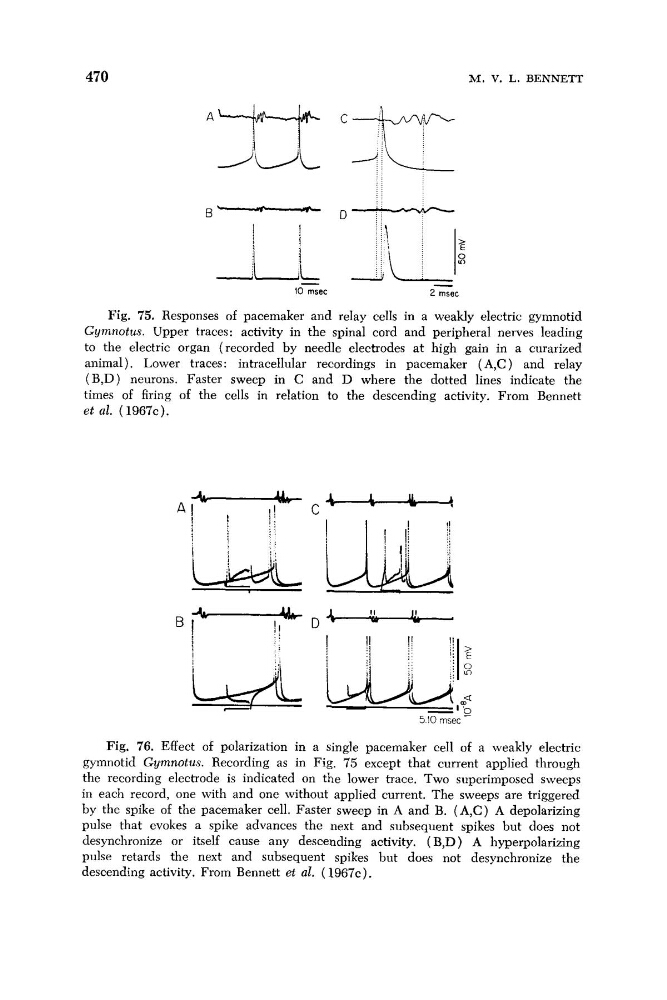
Fig. 75. Responses of pacemaker and
2 msec
relay cells in a weakly electric gymnotid
Gymnotus. Upper traces: activity in the spinal cord and peripheral nerves leading
to the electric organ (recorded by needle electrodes at high gain in a curarized
animal). Lower traces: intracellular recordings in pacemaker ( A,C) and relay
(B,D) neurons. Faster sweep in C and D where the dotted lines indicate the
times of firing of the cells in relation to the descending activity. From Bennett
et al. ( 1 9 6 7 ~ ) .
- c 4
L
4.
4
A l
1
- D 4
I 1
I!.
B l
I
Fig. 76. Effect of polarization in a single pacemaker cell of a weakly electric
gymnotid Gymnotus. Recording as in Fig. 75 except that current applied through
the recording electrode is indicated on the lower trace. Two superimposed sweeps
in each record, one with and one without applied current. The sweeps are triggered
by the spike of the pacemaker cell. Faster sweep in A and B. (A,C) A depolarizing
pulse that evokes a spike advances the next and subsequent spikes but does not
desynchronize or itself cause any descending activity. (B,D) A hyperpolarizing
pulse retards the next and subsequent spikes but does not desynchronize the
descending activity. From Bennett et al. ( 1 9 6 7 ~ ) .
M. V. L. BENNETT
2 ' U L
10 msec
Fig. 75. Responses of pacemaker and
2 msec
relay cells in a weakly electric gymnotid
Gymnotus. Upper traces: activity in the spinal cord and peripheral nerves leading
to the electric organ (recorded by needle electrodes at high gain in a curarized
animal). Lower traces: intracellular recordings in pacemaker ( A,C) and relay
(B,D) neurons. Faster sweep in C and D where the dotted lines indicate the
times of firing of the cells in relation to the descending activity. From Bennett
et al. ( 1 9 6 7 ~ ) .
- c 4
L
4.
4
A l
1
- D 4
I 1
I!.
B l
I
Fig. 76. Effect of polarization in a single pacemaker cell of a weakly electric
gymnotid Gymnotus. Recording as in Fig. 75 except that current applied through
the recording electrode is indicated on the lower trace. Two superimposed sweeps
in each record, one with and one without applied current. The sweeps are triggered
by the spike of the pacemaker cell. Faster sweep in A and B. (A,C) A depolarizing
pulse that evokes a spike advances the next and subsequent spikes but does not
desynchronize or itself cause any descending activity. (B,D) A hyperpolarizing
pulse retards the next and subsequent spikes but does not desynchronize the
descending activity. From Bennett et al. ( 1 9 6 7 ~ ) .