

468
M. V. L. BENNETT
Malaplerurus Gymnot ids Astroscopus
Midbrain
-
Medulla
-
Spinal cord
Periphery
-i
i -
Mormyrids
Pacemaker:
?@ % * -dominant---- - subor!=
-
-
Medullary
relay -
Spinal
relay
: l
&r o
p la q x
1
Organ ' 2 G e c
X Dendrodendritic
A~~~~~~~~~~ )eiectrical A Axosornatic- chemical
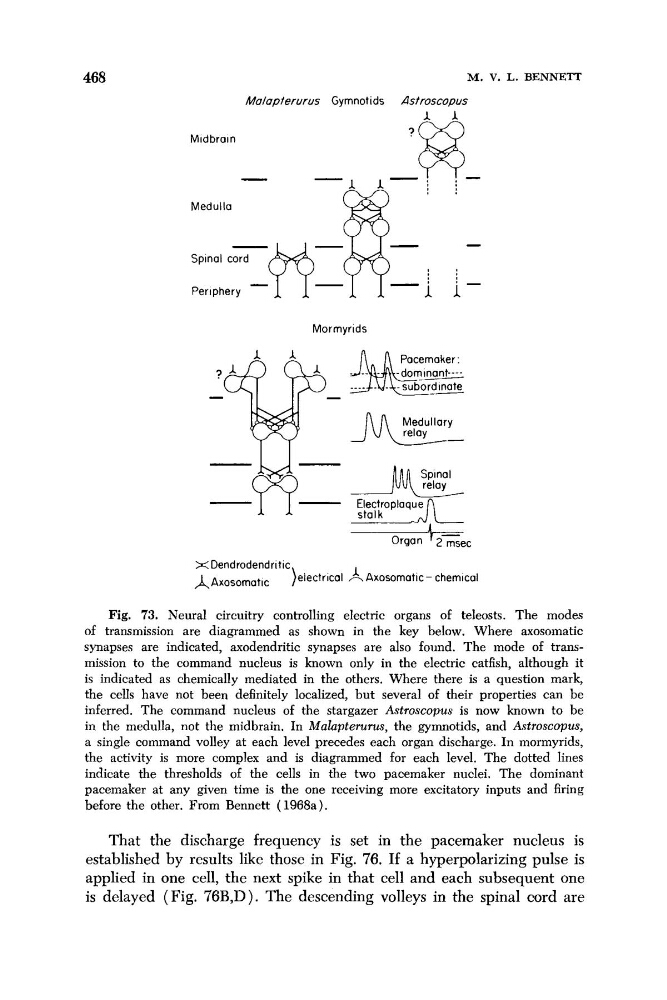
Fig. 73. Neural circuitry controlling electric organs of teleosts. The modes
of transmission are diagrammed as shown in the key below. Where axosomatic
synapses are indicated, axodendritic synapses are also found. The mode of transmission to the command nucleus is known only in the electric catfish, although it
is indicated as chemically mediated in the others. Where there is a question mark,
the cells have not been definitely localized, but several of their properties can be
inferred. The command nucleus of the stargazer Astroscopus is now known to be
in the medulla, not the midbrain. In Malapterurus, the gymnotids, and Astroscopus,
a single command volley at each level precedes each organ discharge. In mormyrids,
the activity is more complex and is diagrammed for each level. The dotted lines
indicate the thresholds of the cells in the two pacemaker nuclei. The dominant
pacemaker at any given time is the one receiving more excitatory inputs and firing
before the other. From Bennett (1968a).
That the discharge frequency is set in the pacemaker nucleus is
established by results like those in Fig. 76. If a hyperpolarizing pulse is
applied in one cell, the next spike in that cell and each subsequent one
is delayed (Fig. 76B,D). The descending volleys in the spinal cord are
M. V. L. BENNETT
Malaplerurus Gymnot ids Astroscopus
Midbrain
-
Medulla
-
Spinal cord
Periphery
-i
i -
Mormyrids
Pacemaker:
?@ % * -dominant---- - subor!=
-
-
Medullary
relay -
Spinal
relay
: l
&r o
p la q x
1
Organ ' 2 G e c
X Dendrodendritic
A~~~~~~~~~~ )eiectrical A Axosornatic- chemical
Fig. 73. Neural circuitry controlling electric organs of teleosts. The modes
of transmission are diagrammed as shown in the key below. Where axosomatic
synapses are indicated, axodendritic synapses are also found. The mode of transmission to the command nucleus is known only in the electric catfish, although it
is indicated as chemically mediated in the others. Where there is a question mark,
the cells have not been definitely localized, but several of their properties can be
inferred. The command nucleus of the stargazer Astroscopus is now known to be
in the medulla, not the midbrain. In Malapterurus, the gymnotids, and Astroscopus,
a single command volley at each level precedes each organ discharge. In mormyrids,
the activity is more complex and is diagrammed for each level. The dotted lines
indicate the thresholds of the cells in the two pacemaker nuclei. The dominant
pacemaker at any given time is the one receiving more excitatory inputs and firing
before the other. From Bennett (1968a).
That the discharge frequency is set in the pacemaker nucleus is
established by results like those in Fig. 76. If a hyperpolarizing pulse is
applied in one cell, the next spike in that cell and each subsequent one
is delayed (Fig. 76B,D). The descending volleys in the spinal cord are