

10. ELECTRIC ORGANS
435
Anterior
-3
4%
F"
Posterior
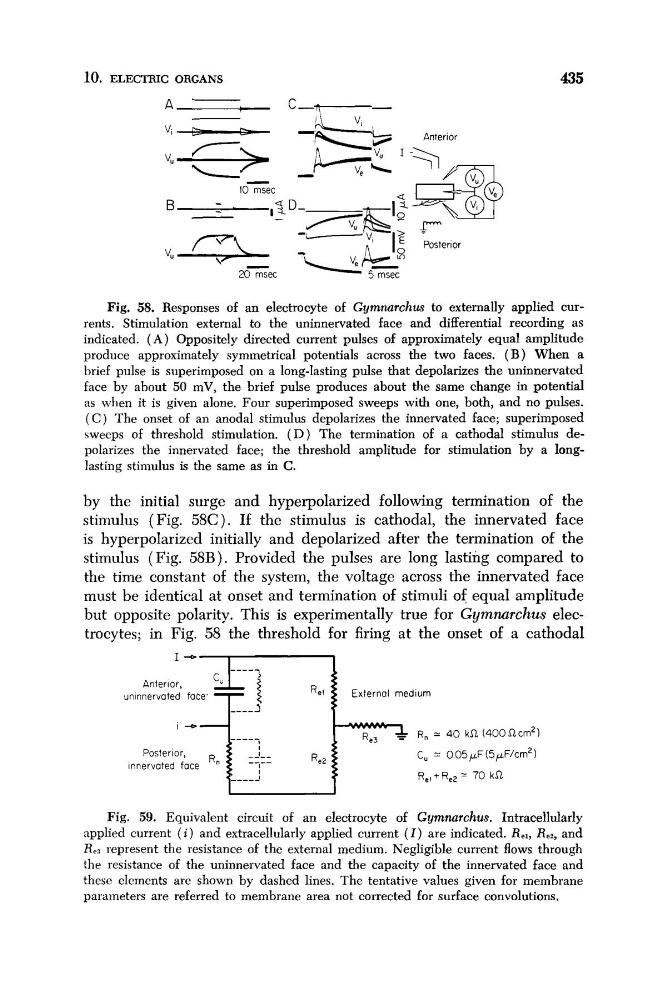
Fig. 58. Responses of an electrocyte of Gymnarchtm to externally applied currents. Stimulation external to the uninnervated face and differential recording as
indicated. ( A ) Oppositely directed current pulses of approximately equal amplitude
produce approximately symmetrical potentials across the two faces. ( B ) When a
brief pulse is superimposed on a long-lasting pulse that depolarizes the uninnervated
face by about 50 mV, the brief pulse produces about the same change in potential
as when it is given alone. Four superimposed sweeps with one, both, and no pulses.
( C ) The onset of an anodal stimulus depolarizes the innervated face; superimposed
sweeps of threshold stimulation. ( D ) The termination of a cathodal stimulus depolarizes the innervated face; the threshold amplitude for stimulation by a longlasting stimulus is the same as in C .
by the initial surge and hyperpolarized following termination of the
stimulus (Fig. 58C). If the stimulus is cathodal, the innervated face
is hyperpolarized initially and depolarized after the termination of the
stimulus (Fig. 58B). Provided the pulses are long lasting compared to
the time constant of the system, the voltage across the innervated face
must be identical at onset and termination of stimuli of equal amplitude
but opposite polarity. This is experimentally true for Gymna~chus electrocytes; in Fig. 58 the threshold for firing at the onset of a cathodal
1 - 9
Anterior,
uninnervoted face.
External medium
R, ,
= R, = 40 kR (400.Qcm2)
Re2
C, = 0 0 5 p F ( 5 p F / c m 2 1
Re, f Re, = 70 kR
Posterior,
Fig. 59. Equivalent circuit of an electrocyte of Gymnarchzls. Intracellularly
applied current ( i ) and extracellularly applied current ( I ) are indicated. Rel, Re?, and
R,, represent the resistance of the external medium. Negligible current flows through
the resistance of the uninnervated face and the capacity of the innervated face and
these elements are shown by dashed lines. The tentative values given for membrane
parameters are referred to membrane area not corrected for surface convolutions.
435
Anterior
-3
4%
F"
Posterior
Fig. 58. Responses of an electrocyte of Gymnarchtm to externally applied currents. Stimulation external to the uninnervated face and differential recording as
indicated. ( A ) Oppositely directed current pulses of approximately equal amplitude
produce approximately symmetrical potentials across the two faces. ( B ) When a
brief pulse is superimposed on a long-lasting pulse that depolarizes the uninnervated
face by about 50 mV, the brief pulse produces about the same change in potential
as when it is given alone. Four superimposed sweeps with one, both, and no pulses.
( C ) The onset of an anodal stimulus depolarizes the innervated face; superimposed
sweeps of threshold stimulation. ( D ) The termination of a cathodal stimulus depolarizes the innervated face; the threshold amplitude for stimulation by a longlasting stimulus is the same as in C .
by the initial surge and hyperpolarized following termination of the
stimulus (Fig. 58C). If the stimulus is cathodal, the innervated face
is hyperpolarized initially and depolarized after the termination of the
stimulus (Fig. 58B). Provided the pulses are long lasting compared to
the time constant of the system, the voltage across the innervated face
must be identical at onset and termination of stimuli of equal amplitude
but opposite polarity. This is experimentally true for Gymna~chus electrocytes; in Fig. 58 the threshold for firing at the onset of a cathodal
1 - 9
Anterior,
uninnervoted face.
External medium
R, ,
= R, = 40 kR (400.Qcm2)
Re2
C, = 0 0 5 p F ( 5 p F / c m 2 1
Re, f Re, = 70 kR
Posterior,
Fig. 59. Equivalent circuit of an electrocyte of Gymnarchzls. Intracellularly
applied current ( i ) and extracellularly applied current ( I ) are indicated. Rel, Re?, and
R,, represent the resistance of the external medium. Negligible current flows through
the resistance of the uninnervated face and the capacity of the innervated face and
these elements are shown by dashed lines. The tentative values given for membrane
parameters are referred to membrane area not corrected for surface convolutions.