

434
M. V. L. BENNETT
B-L2 ( ! !
r
L
i
Posterior
u8-67-- -r-Q
Anterior
J -
V" -
r
Poster lor
2 rnsec
4 rnsec
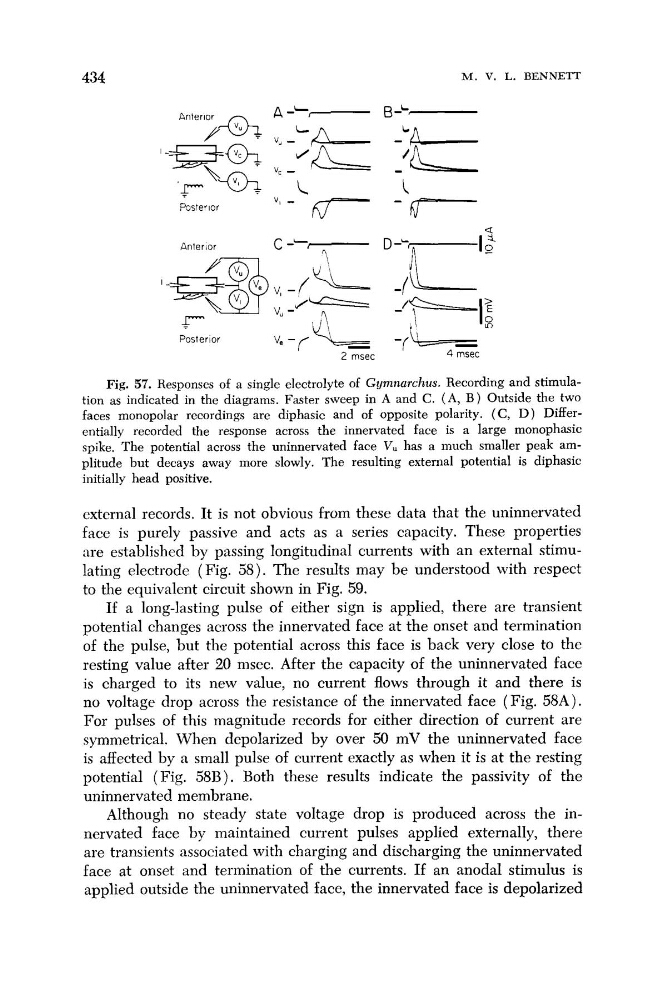
Fig. 57. Responses of a single electrolyte of Gymnarchus. Recording and stimulation as indicated in the diagrams. Faster sweep in A and C. (A, B ) Outside the two
faces monopolar recordings are diphasic and of opposite polarity. (C, D ) Differentially recorded the response across the innervated face is a large monophasic
spike. The potential across the uninnervated face V, has a much smaller peak amplitude but decays away more slowly. The resulting external potential is diphasic
initially head positive.
external records. It is not obvious from these data that the uninnervated
face is purely passive and acts as a series capacity. These properties
are established by passing longitudinal currents with an external stimulating electrode (Fig. 58). The results may be understood with respect
to the equivalent circuit shown in Fig. 59.
If a long-lasting pulse of either sign is applied, there are transient
potential changes across the innervated face at the onset and termination
of the pulse, but the potential across this face is back very close to the
resting value after 20 msec. After the capacity of the uninnervated face
is charged to its new value, no current flows through it and there is
no voltage drop across the resistance of the innervated face (Fig. 58A).
For pulses of this magnitude records for either direction of current are
symmetrical. When depolarized by over 50 mV the uninnervated face
is affected by a small pulse of current exactly as when it is at the resting
potential (Fig. 58B). Both these results indicate the passivity of the
uninnervated membrane.
Although no steady state voltage drop is produced across the innervated face by maintained current pulses applied externally, there
are transients associated with charging and discharging the uninnervated
face at onset and termination of the currents. If an anodal stimulus is
applied outside the uninnervated face, the innervated face is depolarized
M. V. L. BENNETT
B-L2 ( ! !
r
L
i
Posterior
u8-67-- -r-Q
Anterior
J -
V" -
r
Poster lor
2 rnsec
4 rnsec
Fig. 57. Responses of a single electrolyte of Gymnarchus. Recording and stimulation as indicated in the diagrams. Faster sweep in A and C. (A, B ) Outside the two
faces monopolar recordings are diphasic and of opposite polarity. (C, D ) Differentially recorded the response across the innervated face is a large monophasic
spike. The potential across the uninnervated face V, has a much smaller peak amplitude but decays away more slowly. The resulting external potential is diphasic
initially head positive.
external records. It is not obvious from these data that the uninnervated
face is purely passive and acts as a series capacity. These properties
are established by passing longitudinal currents with an external stimulating electrode (Fig. 58). The results may be understood with respect
to the equivalent circuit shown in Fig. 59.
If a long-lasting pulse of either sign is applied, there are transient
potential changes across the innervated face at the onset and termination
of the pulse, but the potential across this face is back very close to the
resting value after 20 msec. After the capacity of the uninnervated face
is charged to its new value, no current flows through it and there is
no voltage drop across the resistance of the innervated face (Fig. 58A).
For pulses of this magnitude records for either direction of current are
symmetrical. When depolarized by over 50 mV the uninnervated face
is affected by a small pulse of current exactly as when it is at the resting
potential (Fig. 58B). Both these results indicate the passivity of the
uninnervated membrane.
Although no steady state voltage drop is produced across the innervated face by maintained current pulses applied externally, there
are transients associated with charging and discharging the uninnervated
face at onset and termination of the currents. If an anodal stimulus is
applied outside the uninnervated face, the innervated face is depolarized