

432
M. V. L. BENNETT
appreciable fraction of the duration of the spike of the stalk face, the
activity of the stalk face is not synchronous in the different regions of
the cell. It thus fails to produce a distinct component in the overall
organ discharge which at any instant is an average of the contributions
of all regions of all the cells.
3. Gymnurchm
The monospecific genus Gymnarchus is found in tropical Africa. It
is closely related to the Mormyridae, but the mode of swimming is
remarkably similar to that of gymnotids. The animal moves with a
straight body by undulations of the dorsal fin. As far as locomotion is
concerned, it is like an upside-down gymnotid (Fig. 1). Movement
appears equally easy forward and backward, and often the animal
seems to investigate strange objects with the tip of its tail. The electric
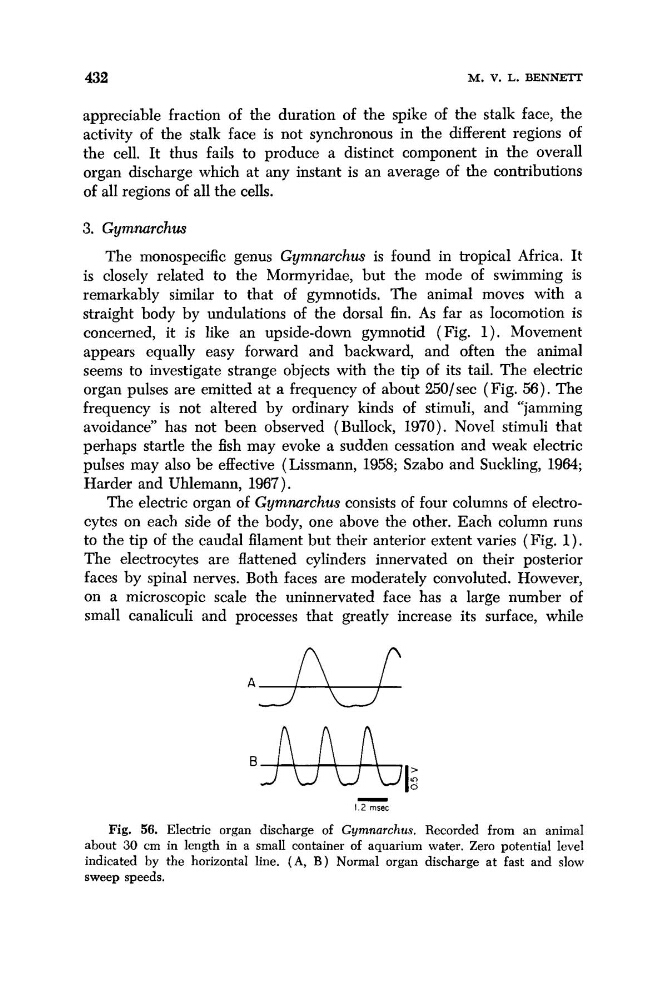
organ pulses are emitted at a frequency of about 25O/sec (Fig. 56). The
frequency is not altered by ordinary kinds of stimuli, and “jamming
avoidance” has not been observed ( Bullock, 1970). Novel stimuli that
perhaps startle the fish may evoke a sudden cessation and weak electric
pulses may also be effective (Lissmann, 1958; Szabo and Suckling, 1964;
Harder and Uhlemann, 1967).
The electric organ of Gymnurchus consists of four columns of electrocytes on each side of the body, one above the other. Each column runs
to the tip of the caudal filament but their anterior extent varies (Fig. 1).
The electrocytes are flattened cylinders innervated on their posterior
faces by spinal nerves. Both faces are moderately convoluted. However,
on a microscopic scale the uninnervated face has a large number of
small canaliculi and processes that greatly increase its surface, while
-
1.2 rnsec
Fig. 56. Electric organ discharge of Gymnarchus. Recorded from an animal
about 30 cm in length in a small container of aquarium water. Zero potential level
indicated by the horizontal line. (A, B ) Normal organ discharge at fast and slow
sweep speeds.
M. V. L. BENNETT
appreciable fraction of the duration of the spike of the stalk face, the
activity of the stalk face is not synchronous in the different regions of
the cell. It thus fails to produce a distinct component in the overall
organ discharge which at any instant is an average of the contributions
of all regions of all the cells.
3. Gymnurchm
The monospecific genus Gymnarchus is found in tropical Africa. It
is closely related to the Mormyridae, but the mode of swimming is
remarkably similar to that of gymnotids. The animal moves with a
straight body by undulations of the dorsal fin. As far as locomotion is
concerned, it is like an upside-down gymnotid (Fig. 1). Movement
appears equally easy forward and backward, and often the animal
seems to investigate strange objects with the tip of its tail. The electric
organ pulses are emitted at a frequency of about 25O/sec (Fig. 56). The
frequency is not altered by ordinary kinds of stimuli, and “jamming
avoidance” has not been observed ( Bullock, 1970). Novel stimuli that
perhaps startle the fish may evoke a sudden cessation and weak electric
pulses may also be effective (Lissmann, 1958; Szabo and Suckling, 1964;
Harder and Uhlemann, 1967).
The electric organ of Gymnurchus consists of four columns of electrocytes on each side of the body, one above the other. Each column runs
to the tip of the caudal filament but their anterior extent varies (Fig. 1).
The electrocytes are flattened cylinders innervated on their posterior
faces by spinal nerves. Both faces are moderately convoluted. However,
on a microscopic scale the uninnervated face has a large number of
small canaliculi and processes that greatly increase its surface, while
-
1.2 rnsec
Fig. 56. Electric organ discharge of Gymnarchus. Recorded from an animal
about 30 cm in length in a small container of aquarium water. Zero potential level
indicated by the horizontal line. (A, B ) Normal organ discharge at fast and slow
sweep speeds.