

10. ELECTRIC ORGANS
431
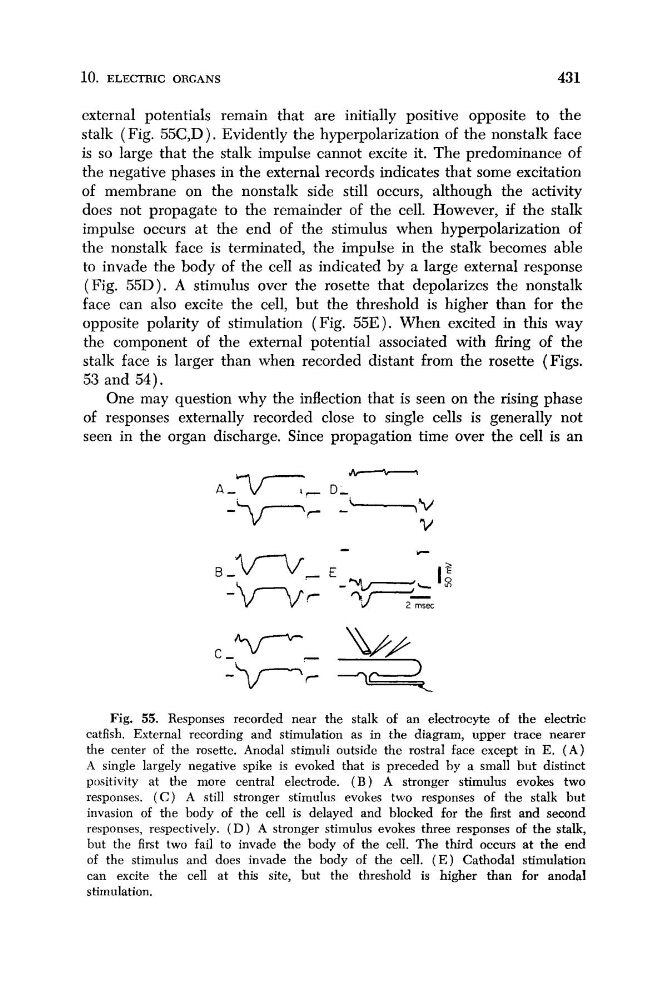
external potentials remain that are initially positive opposite to the
stalk (Fig. 55C,D). Evidently the hyperpolarization of the nonstalk face
is so large that the stalk impulse cannot excite it. The predominance of
the negative phases in the external records indicates that some excitation
of membrane on the nonstalk side still occurs, although the activity
does not propagate to the remainder of the cell. However, if the stalk
impulse occurs at the end of the stimulus when hyperpolarization of
the nonstalk face is terminated, the impulse in the stalk becomes able
to invade the body of the cell as indicated by a large external response
(Fig. 55D). A stimulus over the rosette that depolarizes the nonstalk
face can also excite the cell, but the threshold is higher than for the
opposite polarity of stimulation (Fig. 55E). When excited in this way
the component of the external potential associated with firing of the
stalk face is larger than when recorded distant from the rosette (Figs.
53 and 54).
One may question why the inflection that is seen on the rising phase
of responses externally recorded close to single cells is generally not
seen in the organ discharge. Since propagation time over the cell is an
Fig. 55. Responses recorded near the stalk of an electrocyte of the electric
catfish. External recording and stimulation as in the diagram, upper trace nearer
the center of the rosette. Anodal stimuli outside the rostra1 face except in E. ( A )
A single largely negative spike is evoked that is preceded by a small but distinct
positivity at the more central electrode. ( B ) A stronger stimulus evokes two
responses. ( C ) A still stronger stimulus evokes two responses of the stalk but
invasion of the body of the cell is delayed and blocked for the first and second
responses, respectively. ( D ) A stronger stimulus evokes three responses of the stalk,
but the first two fail to invade the body of the cell. The third occurs at the end
of the stimulus and does invade the body of the cell. ( E ) Cathodal stimulation
can excite the cell at this site, but the threshold is higher than for anodal
stimulation.
431
external potentials remain that are initially positive opposite to the
stalk (Fig. 55C,D). Evidently the hyperpolarization of the nonstalk face
is so large that the stalk impulse cannot excite it. The predominance of
the negative phases in the external records indicates that some excitation
of membrane on the nonstalk side still occurs, although the activity
does not propagate to the remainder of the cell. However, if the stalk
impulse occurs at the end of the stimulus when hyperpolarization of
the nonstalk face is terminated, the impulse in the stalk becomes able
to invade the body of the cell as indicated by a large external response
(Fig. 55D). A stimulus over the rosette that depolarizes the nonstalk
face can also excite the cell, but the threshold is higher than for the
opposite polarity of stimulation (Fig. 55E). When excited in this way
the component of the external potential associated with firing of the
stalk face is larger than when recorded distant from the rosette (Figs.
53 and 54).
One may question why the inflection that is seen on the rising phase
of responses externally recorded close to single cells is generally not
seen in the organ discharge. Since propagation time over the cell is an
Fig. 55. Responses recorded near the stalk of an electrocyte of the electric
catfish. External recording and stimulation as in the diagram, upper trace nearer
the center of the rosette. Anodal stimuli outside the rostra1 face except in E. ( A )
A single largely negative spike is evoked that is preceded by a small but distinct
positivity at the more central electrode. ( B ) A stronger stimulus evokes two
responses. ( C ) A still stronger stimulus evokes two responses of the stalk but
invasion of the body of the cell is delayed and blocked for the first and second
responses, respectively. ( D ) A stronger stimulus evokes three responses of the stalk,
but the first two fail to invade the body of the cell. The third occurs at the end
of the stimulus and does invade the body of the cell. ( E ) Cathodal stimulation
can excite the cell at this site, but the threshold is higher than for anodal
stimulation.