

10. ELECTRIC ORGANS
395
JL;
- + ;
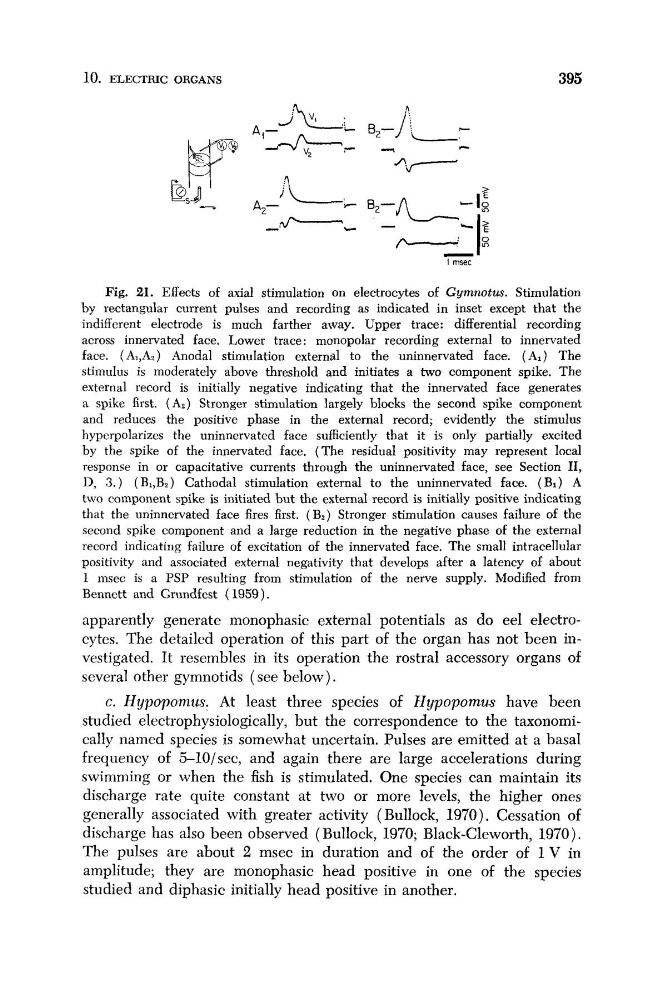
A,Fig. 21. Effects of axial stimulation on electrocytes of Gymnotus. Stimulation
by rectangular current pulses and recording as indicated in inset except that the
indifferent electrode is much farther away. Upper trace: differential recording
across innervated face. Lower trace : monopolar recording external to innervated
face. (A1,A2) Anodal stimulation external to the uninnervated face. (A1) The
stimulus is moderately above threshold and initiates a two component spike. The
external record is initially negative indicating that the innervated face generates
a spike first. ( A z ) Stronger stimulation largely blocks the second spike component
and reduces the positive phase in the external record; evidently the stimulus
hyperpolarizes the uninnervated face sufficiently that it is only partially excited
by the spike of the innervated face. (The residual positivity may represent local
response in or capacitative currents through the uninnervated face, see Section 11,
D, 3 . ) (B1,BZ) Cathodal stimulation external to the uninnervated face. (B,) A
two component spike is initiated but the external record is initially positive indicating
that the uninnervated face fires first. ( B z ) Stronger stimulation causes failure of the
second spike component and a large reduction in the negative phase of the external
record indicating failure of excitation of the innervated face. The small intracellular
positivity and aysociated external negativity that develops after a latency of about
1 msec ia a PSP resulting from stimulation of the nerve supply. Modified from
Bennett and Grundfest ( 1959).
apparently generate monophasic external potentials as do eel electrocytes. The detailed operation of this part of the organ has not been investigated. It resembles in its operation the rostra1 accessory organs of
several other gymnotids ( see below).
c. Hypopomus. At least three species of Hypopomus have been
studied electrophysiologically, but the correspondence to the taxonomically named species is somewhat uncertain. Pulses are emitted at a basal
frequency of 5-10/ sec, and again there are large accelerations during
swimming or when the fish is stimulated. One species can maintain its
discharge rate quite constant at two or more levels, the higher ones
generally associated with greater activity (Bullock, 1970). Cessation of
discharge has also been observed (Bullock, 1970; Black-Cleworth, 1970).
The pulses are about 2 msec in duration and of the order of 1 V in
amplitude; they are monophasic head positive in one of the species
studied and diphasic initially head positive in another.
395
JL;
- + ;
A,Fig. 21. Effects of axial stimulation on electrocytes of Gymnotus. Stimulation
by rectangular current pulses and recording as indicated in inset except that the
indifferent electrode is much farther away. Upper trace: differential recording
across innervated face. Lower trace : monopolar recording external to innervated
face. (A1,A2) Anodal stimulation external to the uninnervated face. (A1) The
stimulus is moderately above threshold and initiates a two component spike. The
external record is initially negative indicating that the innervated face generates
a spike first. ( A z ) Stronger stimulation largely blocks the second spike component
and reduces the positive phase in the external record; evidently the stimulus
hyperpolarizes the uninnervated face sufficiently that it is only partially excited
by the spike of the innervated face. (The residual positivity may represent local
response in or capacitative currents through the uninnervated face, see Section 11,
D, 3 . ) (B1,BZ) Cathodal stimulation external to the uninnervated face. (B,) A
two component spike is initiated but the external record is initially positive indicating
that the uninnervated face fires first. ( B z ) Stronger stimulation causes failure of the
second spike component and a large reduction in the negative phase of the external
record indicating failure of excitation of the innervated face. The small intracellular
positivity and aysociated external negativity that develops after a latency of about
1 msec ia a PSP resulting from stimulation of the nerve supply. Modified from
Bennett and Grundfest ( 1959).
apparently generate monophasic external potentials as do eel electrocytes. The detailed operation of this part of the organ has not been investigated. It resembles in its operation the rostra1 accessory organs of
several other gymnotids ( see below).
c. Hypopomus. At least three species of Hypopomus have been
studied electrophysiologically, but the correspondence to the taxonomically named species is somewhat uncertain. Pulses are emitted at a basal
frequency of 5-10/ sec, and again there are large accelerations during
swimming or when the fish is stimulated. One species can maintain its
discharge rate quite constant at two or more levels, the higher ones
generally associated with greater activity (Bullock, 1970). Cessation of
discharge has also been observed (Bullock, 1970; Black-Cleworth, 1970).
The pulses are about 2 msec in duration and of the order of 1 V in
amplitude; they are monophasic head positive in one of the species
studied and diphasic initially head positive in another.