

10. ELECTRIC ORGANS
365
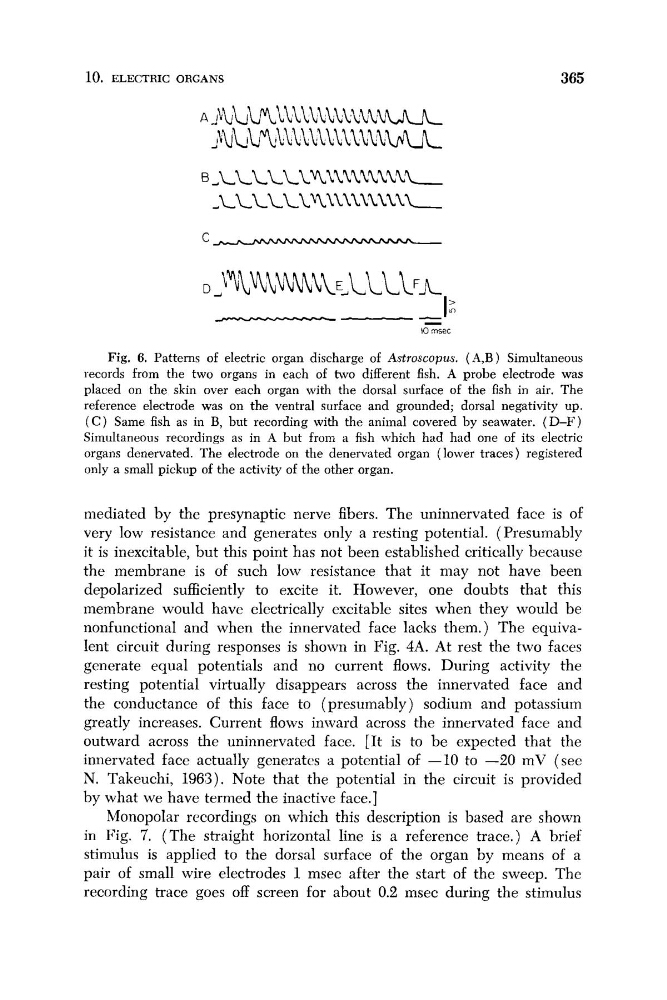
Fig. 6. Patterns of electric organ discharge of Astroscopus. ( A,B) Simultaneous
records from the two organs in each of two different fish. A probe electrode was
placed on the skin over each organ with the dorsal surface of the fish in air. The
reference electrode was on the ventral surface and grounded; dorsal negativity up.
( C ) Same fish as in B, but recording with the animal covered by seawater. (D-F)
Simultaneous recordings as in A but from a fish which had had one of its electric
organs denervated. The electrode on the denervated organ (lower traces) registered
only a small pickup of the activity of the other organ.
mediated by the presynaptic nerve fibers. The uninnervated face is of
very low resistance and generates only a resting potential. (Presumably
it is inexcitable, but this point has not been established critically because
the membrane is of such low resistance that it may not have been
depolarized sufficiently to excite it. However, one doubts that this
membrane would have electrically excitable sites when they would be
nonfunctional and when the innervated face lacks them.) The equivalent circuit during responses is shown in Fig. 4A. At rest the two faces
generate equal potentials and no current flows. During activity the
resting potential virtually disappears across the innervated face and
the conductance of this face to (presumably) sodium and potassium
greatly increases. Current flows inward across the innervated face and
outward across the uninnervated face. [It is to be expected that the
innervated face actually generates a potential of -10 to -20 mV (see
N. Takeuchi, 1963). Note that the potential in the circuit is provided
by what we have termed the inactive face.]
Monopolar recordings on which this description is based are shown
in Fig. 7. (The straight horizontal line is a reference trace.) A brief
stimulus is applied to the dorsal surface of the organ by means of a
pair of small wire electrodes 1 msec after the start of the sweep. The
recording trace goes off screen for about 0.2 msec during the stimulus
365
Fig. 6. Patterns of electric organ discharge of Astroscopus. ( A,B) Simultaneous
records from the two organs in each of two different fish. A probe electrode was
placed on the skin over each organ with the dorsal surface of the fish in air. The
reference electrode was on the ventral surface and grounded; dorsal negativity up.
( C ) Same fish as in B, but recording with the animal covered by seawater. (D-F)
Simultaneous recordings as in A but from a fish which had had one of its electric
organs denervated. The electrode on the denervated organ (lower traces) registered
only a small pickup of the activity of the other organ.
mediated by the presynaptic nerve fibers. The uninnervated face is of
very low resistance and generates only a resting potential. (Presumably
it is inexcitable, but this point has not been established critically because
the membrane is of such low resistance that it may not have been
depolarized sufficiently to excite it. However, one doubts that this
membrane would have electrically excitable sites when they would be
nonfunctional and when the innervated face lacks them.) The equivalent circuit during responses is shown in Fig. 4A. At rest the two faces
generate equal potentials and no current flows. During activity the
resting potential virtually disappears across the innervated face and
the conductance of this face to (presumably) sodium and potassium
greatly increases. Current flows inward across the innervated face and
outward across the uninnervated face. [It is to be expected that the
innervated face actually generates a potential of -10 to -20 mV (see
N. Takeuchi, 1963). Note that the potential in the circuit is provided
by what we have termed the inactive face.]
Monopolar recordings on which this description is based are shown
in Fig. 7. (The straight horizontal line is a reference trace.) A brief
stimulus is applied to the dorsal surface of the organ by means of a
pair of small wire electrodes 1 msec after the start of the sweep. The
recording trace goes off screen for about 0.2 msec during the stimulus