

354
M. V. L. BENNETT
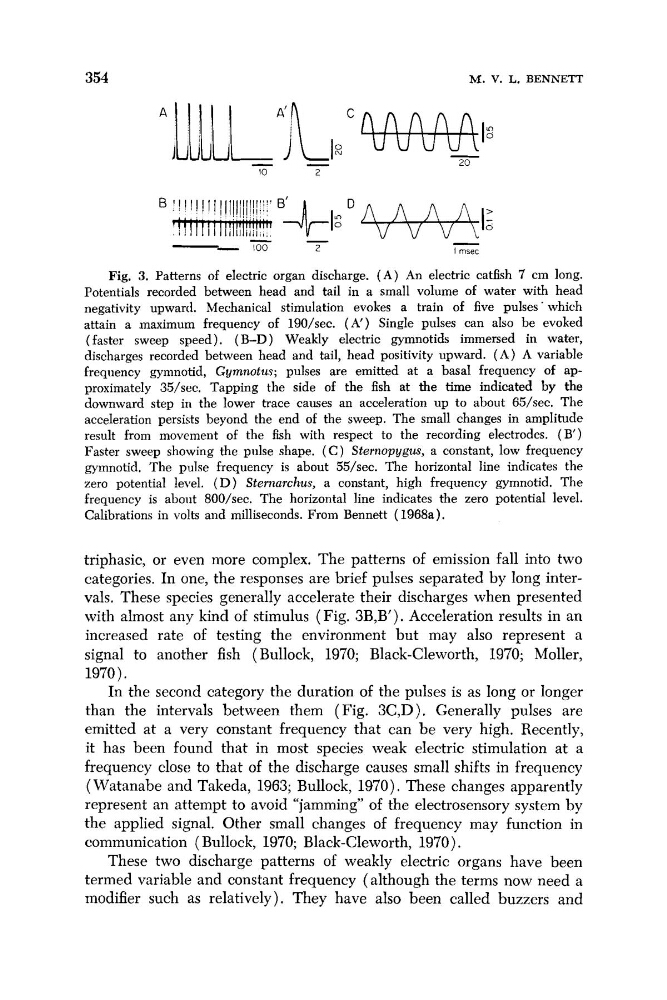
Fig. 3. Patterns of electric organ discharge. ( A ) An electric catfish 7 cm long.
Potentials recorded between head and tail in a small volume of water with head
negativity upward. Mechanical stimulation evokes a train of five pulses ‘ which
attain a maximum frequency of 190/sec. (A‘) Single pulses can also be evoked
(faster sweep speed). (B-D) Weakly electric gymnotids immersed in water,
discharges recorded between head and tail, head positivity upward. (A) A variable
frequency gymnotid, Gymnotus; pulses are emitted at a basal frequency of approximately 35/sec. Tapping the side of the fish at the time indicated by the
downward step in the lower trace causes an acceleration up to about 65/sec. The
acceleration persists beyond the end of the sweep. The small changes in amplitude
result from movement of the fish with respect to the recording electrodes. ( B )
Faster sweep showing the pulse shape. ( C ) Sternopygus, a constant, low frequency
gymnotid. The pulse frequency is about 55/sec. The horizontal line indicates the
zero potential level. ( D ) Sternarchus, a constant, high frequency gymnotid. The
frequency is about 800/sec. The horizontal line indicates the zero potential level.
Calibrations in volts and milliseconds. From Bennett ( 1968a).
triphasic, or even more complex. The patterns of emission fall into two
categories. In one, the responses are brief pulses separated by long intervals. These species generally accelerate their discharges when presented
with almost any kind of stimulus (Fig. 3B,B’). Acceleration results in an
increased rate of testing the environment but may also represent a
signal to another fish (Bullock, 1970; Black-Cleworth, 1970; Moller,
1970 ) .
In the second category the duration of the pulses is as long or longer
than the intervals between them (Fig. 3C,D). Generally pulses are
emitted at a very constant frequency that can be very high. Recently,
it has been found that in most species weak electric stimulation at a
frequency close to that of the discharge causes small shifts in frequency
( Watanabe and Takeda, 1963; Bullock, 1970). These changes apparently
represent an attempt to avoid “jamming” of the electrosensory system by
the applied signal. Other small changes of frequency may function in
communication ( Bullock, 1970; Black-Cleworth, 1970).
These two discharge patterns of weakly electric organs have been
termed variable and constant frequency (although the terms now need a
modifier such as relatively). They have also been called buzzers and
M. V. L. BENNETT
Fig. 3. Patterns of electric organ discharge. ( A ) An electric catfish 7 cm long.
Potentials recorded between head and tail in a small volume of water with head
negativity upward. Mechanical stimulation evokes a train of five pulses ‘ which
attain a maximum frequency of 190/sec. (A‘) Single pulses can also be evoked
(faster sweep speed). (B-D) Weakly electric gymnotids immersed in water,
discharges recorded between head and tail, head positivity upward. (A) A variable
frequency gymnotid, Gymnotus; pulses are emitted at a basal frequency of approximately 35/sec. Tapping the side of the fish at the time indicated by the
downward step in the lower trace causes an acceleration up to about 65/sec. The
acceleration persists beyond the end of the sweep. The small changes in amplitude
result from movement of the fish with respect to the recording electrodes. ( B )
Faster sweep showing the pulse shape. ( C ) Sternopygus, a constant, low frequency
gymnotid. The pulse frequency is about 55/sec. The horizontal line indicates the
zero potential level. ( D ) Sternarchus, a constant, high frequency gymnotid. The
frequency is about 800/sec. The horizontal line indicates the zero potential level.
Calibrations in volts and milliseconds. From Bennett ( 1968a).
triphasic, or even more complex. The patterns of emission fall into two
categories. In one, the responses are brief pulses separated by long intervals. These species generally accelerate their discharges when presented
with almost any kind of stimulus (Fig. 3B,B’). Acceleration results in an
increased rate of testing the environment but may also represent a
signal to another fish (Bullock, 1970; Black-Cleworth, 1970; Moller,
1970 ) .
In the second category the duration of the pulses is as long or longer
than the intervals between them (Fig. 3C,D). Generally pulses are
emitted at a very constant frequency that can be very high. Recently,
it has been found that in most species weak electric stimulation at a
frequency close to that of the discharge causes small shifts in frequency
( Watanabe and Takeda, 1963; Bullock, 1970). These changes apparently
represent an attempt to avoid “jamming” of the electrosensory system by
the applied signal. Other small changes of frequency may function in
communication ( Bullock, 1970; Black-Cleworth, 1970).
These two discharge patterns of weakly electric organs have been
termed variable and constant frequency (although the terms now need a
modifier such as relatively). They have also been called buzzers and