

328
J. DIAMOND
seen in Fig. 41 (the “late collateral inhibition” or LCI of Furukawa and
Furshpan) as a depolarization, which resulted from a leakage of chloride
ions into the cell from the recording microelectrode. Similar appearances
can be recorded during the VIIIth nerve inhibition (Fig. 36a).
The electrical inhibition is obviously able to be effective during the
period of synaptic delay required by the conventional “chemical” inhibition. We can suppose therefore that in the context of our discussion the
electrical inhibition must be considered as possibly very important indeed, at least as a means of increasing the time taken by the “electrical”
e.p.s.p. to reach threshold (even though the electrical inhibition might
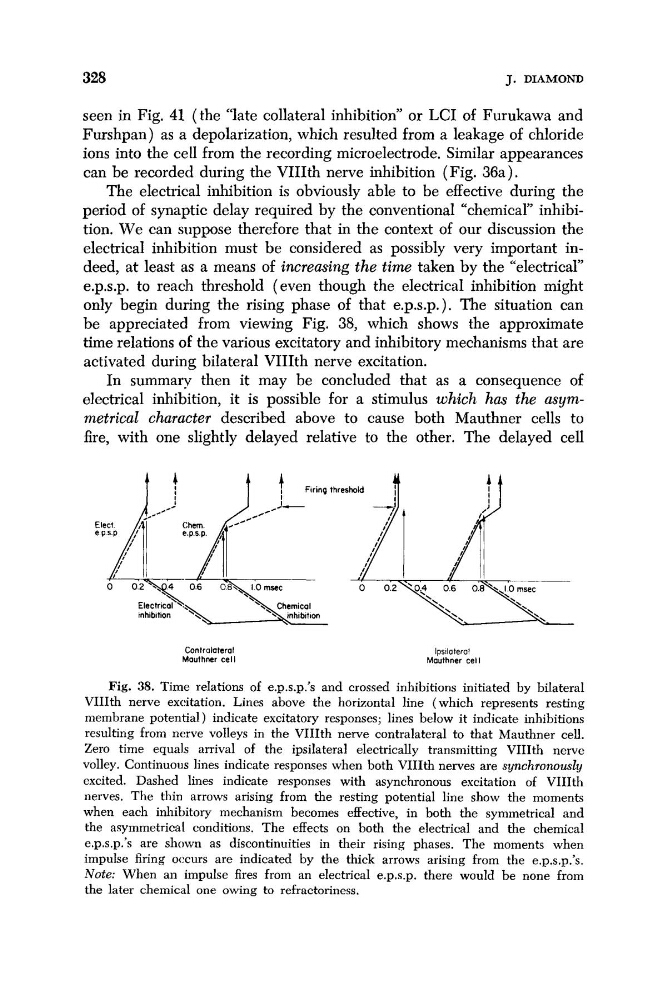
only begin during the rising phase of that e.p.s.p.). The situation can
be appreciated from viewing Fig. 38, which shows the approximate
time relations of the various excitatory and inhibitory mechanisms that are
activated during bilateral VIIIth nerve excitation.
In summary then it may be concluded that as a consequence of
electrical inhibition, it is possible for a stimulus which h a the asymmetrical character described above to cause both Mauthner cells to
fire, with one slightly delayed relative to the other. The delayed cell
1 Firing
Elect e P S.P Arinhibition
Contralatcrol
Mouthmr cel I
lpsilaterol
Mauthner cell
Fig. 38. Time relations of e.p.s.p.’s and crossed inhibitions initiated by bilateral
VIIIth nerve excitation. Lines above the horizontal line (which represents resting
membrane potential ) indicate excitatory responses; lines below it indicate inhibitions
resulting from nerve volleys in the VIIIth nerve contralateral to that Mauthner cell.
Zero time equals arrival of the ipsilateral electrically transmitting VIIIth nerve
volley. Continuous lines indicate responses when both VIIIth nerves are synchronously
excited. Dashed lines indicate responses with asynchronous excitation of VIIIth
nerves. The thin arrows arising from the resting potential line show the moments
when each inhibitory mechanism becomes effective, in both the symmetrical and
the asymmetrical conditions. The effects on both the electrical and the chemical
e.p.s.p.’s are shown as discontinuities in their rising phases. The moments when
impulse firing o(:curs are indicated by the thick arrows arising from the e.p.s.p.’s.
Note: When an impulse fires from an electrical e.p.s.p. there would be none from
the later chemical one owing to refractoriness.
J. DIAMOND
seen in Fig. 41 (the “late collateral inhibition” or LCI of Furukawa and
Furshpan) as a depolarization, which resulted from a leakage of chloride
ions into the cell from the recording microelectrode. Similar appearances
can be recorded during the VIIIth nerve inhibition (Fig. 36a).
The electrical inhibition is obviously able to be effective during the
period of synaptic delay required by the conventional “chemical” inhibition. We can suppose therefore that in the context of our discussion the
electrical inhibition must be considered as possibly very important indeed, at least as a means of increasing the time taken by the “electrical”
e.p.s.p. to reach threshold (even though the electrical inhibition might
only begin during the rising phase of that e.p.s.p.). The situation can
be appreciated from viewing Fig. 38, which shows the approximate
time relations of the various excitatory and inhibitory mechanisms that are
activated during bilateral VIIIth nerve excitation.
In summary then it may be concluded that as a consequence of
electrical inhibition, it is possible for a stimulus which h a the asymmetrical character described above to cause both Mauthner cells to
fire, with one slightly delayed relative to the other. The delayed cell
1 Firing
Elect e P S.P Arinhibition
Contralatcrol
Mouthmr cel I
lpsilaterol
Mauthner cell
Fig. 38. Time relations of e.p.s.p.’s and crossed inhibitions initiated by bilateral
VIIIth nerve excitation. Lines above the horizontal line (which represents resting
membrane potential ) indicate excitatory responses; lines below it indicate inhibitions
resulting from nerve volleys in the VIIIth nerve contralateral to that Mauthner cell.
Zero time equals arrival of the ipsilateral electrically transmitting VIIIth nerve
volley. Continuous lines indicate responses when both VIIIth nerves are synchronously
excited. Dashed lines indicate responses with asynchronous excitation of VIIIth
nerves. The thin arrows arising from the resting potential line show the moments
when each inhibitory mechanism becomes effective, in both the symmetrical and
the asymmetrical conditions. The effects on both the electrical and the chemical
e.p.s.p.’s are shown as discontinuities in their rising phases. The moments when
impulse firing o(:curs are indicated by the thick arrows arising from the e.p.s.p.’s.
Note: When an impulse fires from an electrical e.p.s.p. there would be none from
the later chemical one owing to refractoriness.