

326
J. DIAMOND
the positivity was markedly reduced although still detectable. The true
trans-membrane potential is obtained by algebraically subtracting the
extracellular from the intracellular potential (Fig. 37B); the result shows
conclusively that during the period of external positivity the membrane
was genuinely hyperpolarized. These results also indicate that the
source of such a potential (the “battery”) is not in the Mauthner cell
membrane but in some other structure outside it. It seems likely that
the arriving impulses in the inhibitory fibers die out toward the outer
limit of the axon cap, and the fiber terminals within the cap act as a
passive source of external current, thus creating the positive field. Whatever the exact mechanism involved, the system does not require a synaptic delay in the conventional sense to cause an efective inhibition of the
axon hillock region of the Mauthner cell. Interestingly, both the VIIIth
nerve inhibition and the collateral inhibition have two components. The
first is the early transient electrical one just described (the EHP), which
is almost immediately followed by a conventional chemically transmitted post-synaptic inhibition. The second component can clearly be
( A )
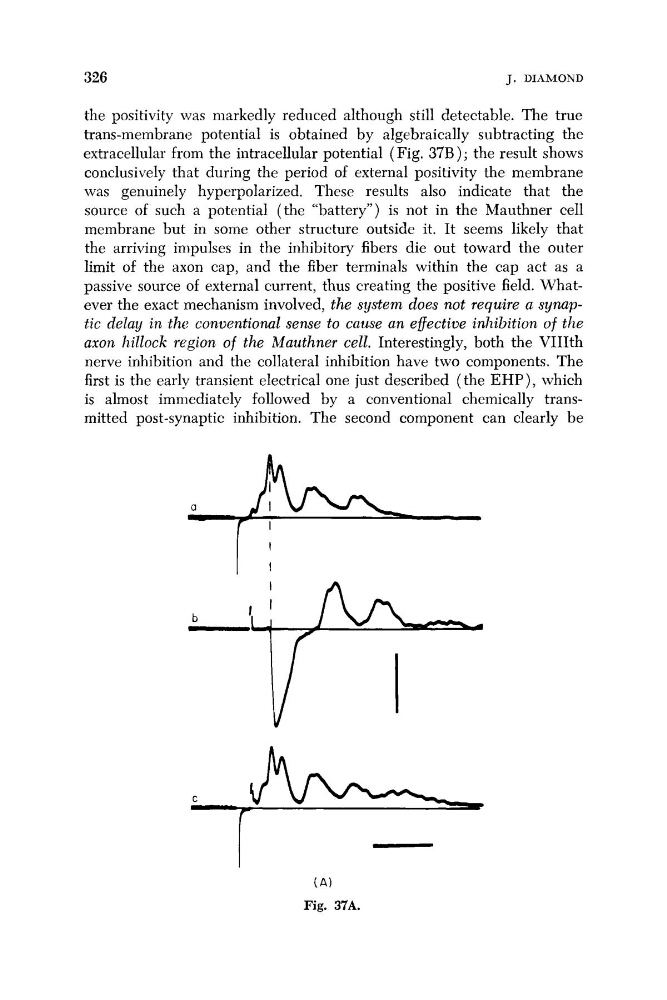
Fig. 37A.
J. DIAMOND
the positivity was markedly reduced although still detectable. The true
trans-membrane potential is obtained by algebraically subtracting the
extracellular from the intracellular potential (Fig. 37B); the result shows
conclusively that during the period of external positivity the membrane
was genuinely hyperpolarized. These results also indicate that the
source of such a potential (the “battery”) is not in the Mauthner cell
membrane but in some other structure outside it. It seems likely that
the arriving impulses in the inhibitory fibers die out toward the outer
limit of the axon cap, and the fiber terminals within the cap act as a
passive source of external current, thus creating the positive field. Whatever the exact mechanism involved, the system does not require a synaptic delay in the conventional sense to cause an efective inhibition of the
axon hillock region of the Mauthner cell. Interestingly, both the VIIIth
nerve inhibition and the collateral inhibition have two components. The
first is the early transient electrical one just described (the EHP), which
is almost immediately followed by a conventional chemically transmitted post-synaptic inhibition. The second component can clearly be
( A )
Fig. 37A.