

278
J. DIAMOND
IV. THE “MAUTHNER REFLEX”
A. The Response
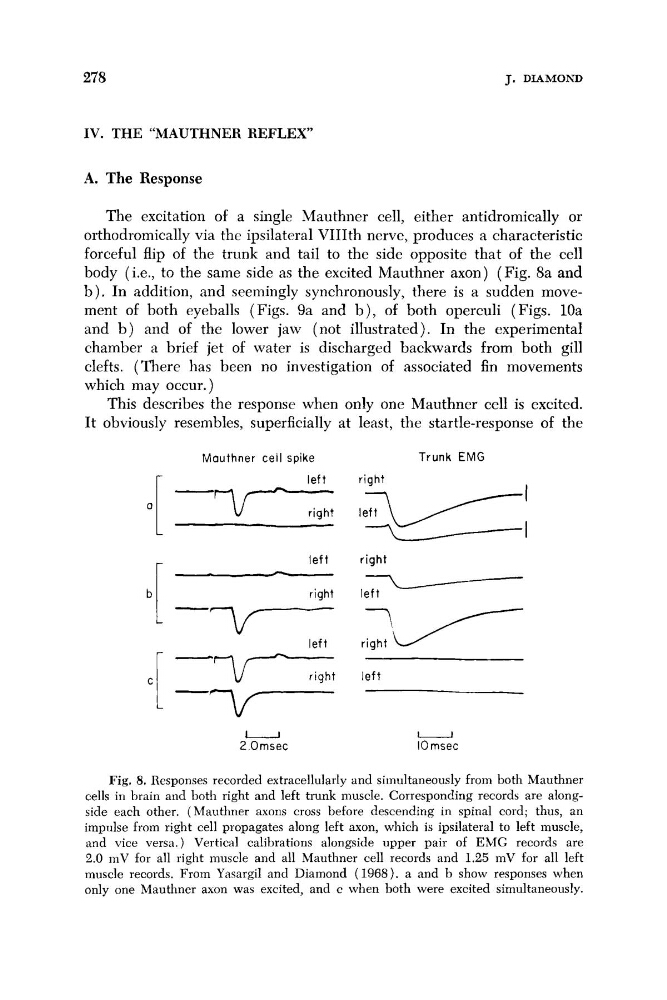
The excitation of a single Mauthner cell, either antidromically or
orthodromically via the ipsilateral VIIIth nerve, produces a characteristic
forceful flip of the trunk and tail to the side opposite that of the cell
body (i.e., to the same side as the excited Mauthner axon) (Fig. 8a and
b ) . In addition, and seemingly synchronously, there is a sudden movement of both eyeballs (Figs. 9a and b ) , of both operculi (Figs. 10a
and b ) and of the lower jaw (not illustrated). In the experimental
chamber a brief jet of water is discharged backwards from both gill
clefts. (There has been no investigation of associated fin movements
which may occur.)
This describes the response when only one Mauthner cell is excited.
It obviously resembles, superficially at least, the startle-response of the
Mauthner cell spike
a [ -+ right
r
left
I
h
b l
right
C r -7r-t
1 - 7 r -
u
2.0rnsec
Trunk EMG
right
right
right 7 /
left
U
1 0 msec
Fig, 8. Responses recorded extracellularly and simultaneously from both Mauthner
cells in brain and both right and left trunk muscle. Corresponding records are alongside each other. (Mauthner axons cross before descending in spinal cord; thus, an
impulse from right cell propagates along left axon, which is ipsilateral to left muscle,
and vice versa.) Vertical calibrations alongside upper pair of EMG records are
2.0 mV for all right muscle and all Mauthner cell records and 1.25 mV for all left
muscle records. From Yasargil and Diamond ( 1968). a and b show responses when
only one Mauthner axon was excited, and c when both were excited simultaneously.
J. DIAMOND
IV. THE “MAUTHNER REFLEX”
A. The Response
The excitation of a single Mauthner cell, either antidromically or
orthodromically via the ipsilateral VIIIth nerve, produces a characteristic
forceful flip of the trunk and tail to the side opposite that of the cell
body (i.e., to the same side as the excited Mauthner axon) (Fig. 8a and
b ) . In addition, and seemingly synchronously, there is a sudden movement of both eyeballs (Figs. 9a and b ) , of both operculi (Figs. 10a
and b ) and of the lower jaw (not illustrated). In the experimental
chamber a brief jet of water is discharged backwards from both gill
clefts. (There has been no investigation of associated fin movements
which may occur.)
This describes the response when only one Mauthner cell is excited.
It obviously resembles, superficially at least, the startle-response of the
Mauthner cell spike
a [ -+ right
r
left
I
h
b l
right
C r -7r-t
1 - 7 r -
u
2.0rnsec
Trunk EMG
right
right
right 7 /
left
U
1 0 msec
Fig, 8. Responses recorded extracellularly and simultaneously from both Mauthner
cells in brain and both right and left trunk muscle. Corresponding records are alongside each other. (Mauthner axons cross before descending in spinal cord; thus, an
impulse from right cell propagates along left axon, which is ipsilateral to left muscle,
and vice versa.) Vertical calibrations alongside upper pair of EMG records are
2.0 mV for all right muscle and all Mauthner cell records and 1.25 mV for all left
muscle records. From Yasargil and Diamond ( 1968). a and b show responses when
only one Mauthner axon was excited, and c when both were excited simultaneously.