

7 . THE LABYRINTH
233
and 40 dB above 1 pbar according to frequency and method of transduction. The responses observed in these experiments were jaw movements
and brief cessation of respiration either unconditioned or negatively
reinforced by electric shocks.
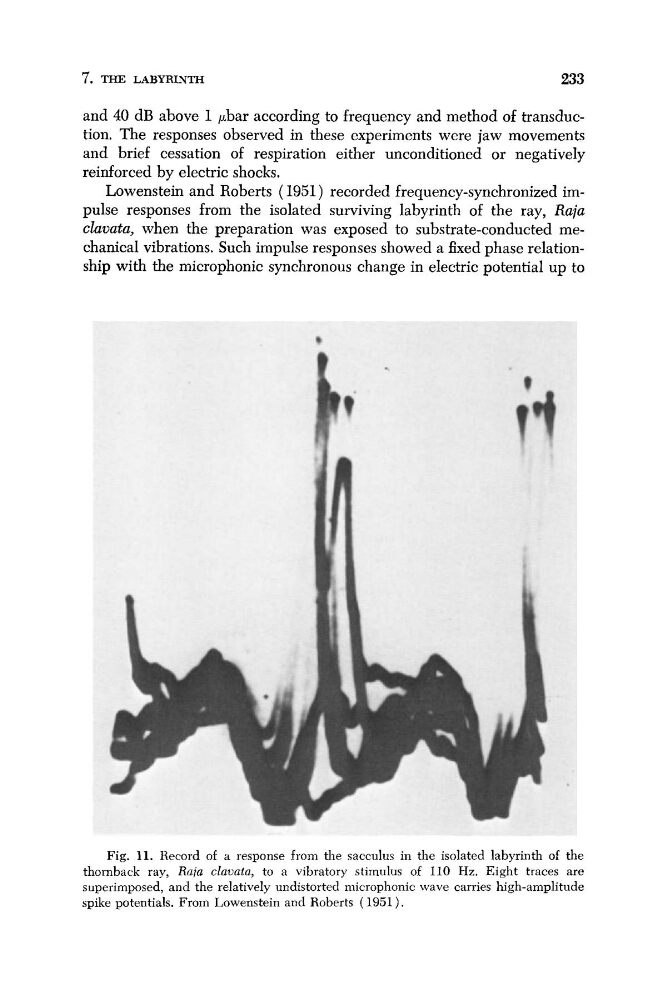
Lowenstein and Roberts ( 1951 ) recorded frequency-synchronized impulse responses from the isolated surviving labyrinth of the ray, Raja
clavata, when the preparation was exposed to substrate-conducted mechanical vibrations. Such impulse responses showed a fixed phase relationship with the microphonic synchronous change in electric potential up to
Fig. 11. Record of a response from the sacculus in the isolated labyrinth of the
thornback ray, Raia clavata, to a vibratory stimulus of 110 Hz. Eight traces are
superimposed, and the relatively undistorted microphonic wave carries high-amplitude
spike potentials. From Lowenstein and Roberts ( 1951).
233
and 40 dB above 1 pbar according to frequency and method of transduction. The responses observed in these experiments were jaw movements
and brief cessation of respiration either unconditioned or negatively
reinforced by electric shocks.
Lowenstein and Roberts ( 1951 ) recorded frequency-synchronized impulse responses from the isolated surviving labyrinth of the ray, Raja
clavata, when the preparation was exposed to substrate-conducted mechanical vibrations. Such impulse responses showed a fixed phase relationship with the microphonic synchronous change in electric potential up to
Fig. 11. Record of a response from the sacculus in the isolated labyrinth of the
thornback ray, Raia clavata, to a vibratory stimulus of 110 Hz. Eight traces are
superimposed, and the relatively undistorted microphonic wave carries high-amplitude
spike potentials. From Lowenstein and Roberts ( 1951).