

232
0. LOWENSTEIN
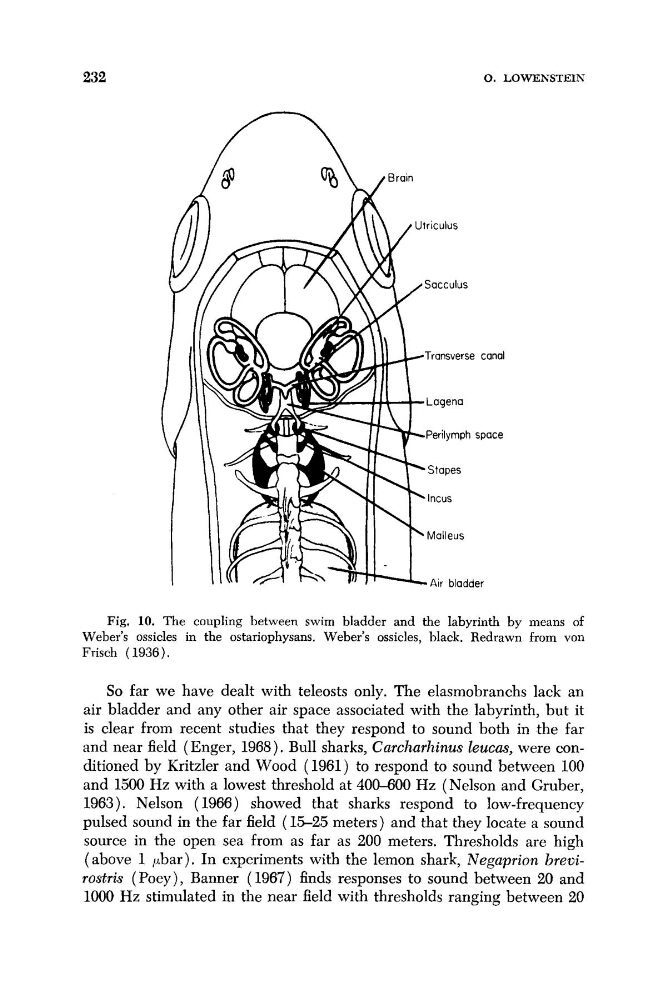
Transverse canal
Stapes
Incus
Malleus
Air bladder
Fig. 10. The coupling between swim bladder and the labyrinth by means of
Weber’s ossicles in the ostariophysans. Weber’s ossicles, black. Redrawn from von
Frisch ( 1936).
So far we have dealt with teleosts only. The elasmobranchs lack an
air bladder and any other air space associated with the labyrinth, but it
is clear from recent studies that they respond to sound both in the far
and near field (Enger, 1968). Bull sharks, Curcharhinus leucas, were conditioned by Kritzler and Wood (1961) to respond to sound between 100
and 1500 Hz with a lowest threshold at 400-600 Hz (Nelson and Gruber,
1963). Nelson ( 1966) showed that sharks respond to low-frequency
pulsed sound in the far field (15-25 meters) and that they locate a sound
source in the open sea from as far as 200 meters. Thresholds are high
(above 1 pbar). In experiments with the lemon shark, Neguprion breuirostris (Poey), Banner ( 1967) finds responses to sound between 20 and
1000 Hz stimulated in the near field with thresholds ranging between 20
0. LOWENSTEIN
Transverse canal
Stapes
Incus
Malleus
Air bladder
Fig. 10. The coupling between swim bladder and the labyrinth by means of
Weber’s ossicles in the ostariophysans. Weber’s ossicles, black. Redrawn from von
Frisch ( 1936).
So far we have dealt with teleosts only. The elasmobranchs lack an
air bladder and any other air space associated with the labyrinth, but it
is clear from recent studies that they respond to sound both in the far
and near field (Enger, 1968). Bull sharks, Curcharhinus leucas, were conditioned by Kritzler and Wood (1961) to respond to sound between 100
and 1500 Hz with a lowest threshold at 400-600 Hz (Nelson and Gruber,
1963). Nelson ( 1966) showed that sharks respond to low-frequency
pulsed sound in the far field (15-25 meters) and that they locate a sound
source in the open sea from as far as 200 meters. Thresholds are high
(above 1 pbar). In experiments with the lemon shark, Neguprion breuirostris (Poey), Banner ( 1967) finds responses to sound between 20 and
1000 Hz stimulated in the near field with thresholds ranging between 20