

7. THE LABYRINTH
221
receptor” used for the lagena by MacNaughton and McNally (1916)
appears thus to be very appropriate.
Thus it appears that in the elasmobranch labyrinth sensitivity to gravitational stimuli is found in all three otolith organs. How far this is utilized
in the elicitation of equilibrium responses is another question which cannot be decided by electrophysiological experiments. We shall return to the
discussion of this question when dealing with the auditory function of
the fish labyrinth.
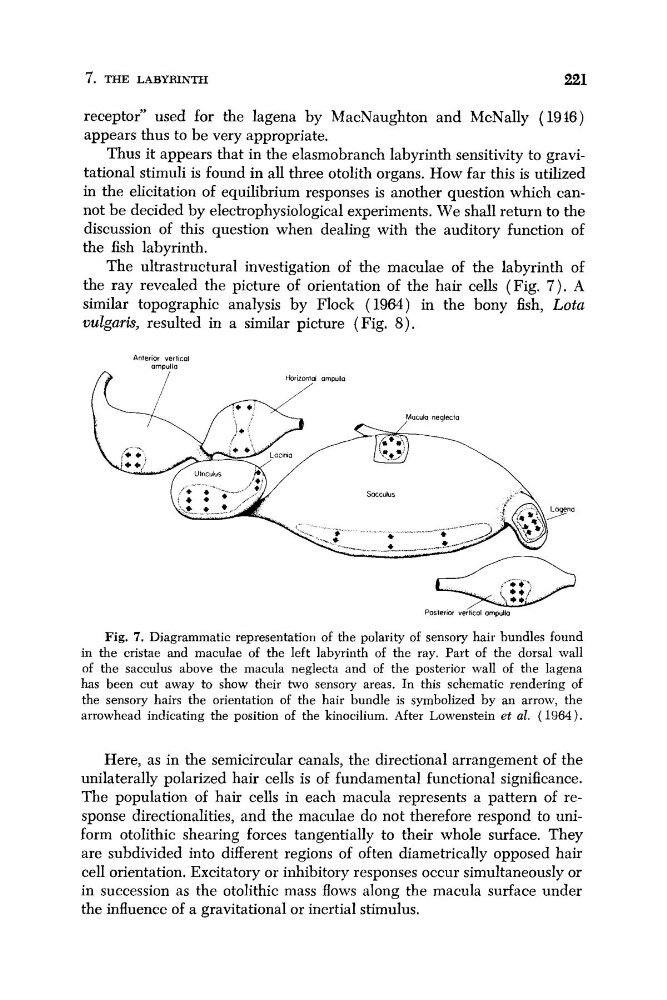
The ultrastructural investigation of the maculae of the labyrinth of
the ray revealed the picture of orientation of the hair cells (Fig. 7). A
similar topographic analysis by Flock (1964) in the bony fish, Lota
vulgaris, resulted in a similar picture (Fig. 8 ) .
* x
Moculo neglecta
Fig. 7. Diagrammatic representation of the polarity of sensory hair bundles found
in the cristae and maculae of the left labyrinth of the ray. Part of the dorsal wall
of the sacculus above the macula neglecta and of the posterior wall of the lagena
has been cut away to show their two sensory areas. In this schematic rendering of
the sensory hairs the orientation of the hair bundle is symbolized by an arrow, the
arrowhead indicating the position of the kinocilium. After Lowenstein et al. (1964).
Here, as in the semicircular canals, the directional arrangement of the
unilaterally polarized hair cells is of fundamental functional significance.
The population of hair cells in each macula represents a pattern of response directionalities, and the maculae do not therefore respond to uniform otolithic shearing forces tangentially to their whole surface. They
are subdivided into different regions of often diametrically opposed hair
cell orientation. Excitatory or inhibitory responses occur simultaneously or
in succession as the otolithic mass flows along the macula surface under
the influence of a gravitational or inertial stimulus.
221
receptor” used for the lagena by MacNaughton and McNally (1916)
appears thus to be very appropriate.
Thus it appears that in the elasmobranch labyrinth sensitivity to gravitational stimuli is found in all three otolith organs. How far this is utilized
in the elicitation of equilibrium responses is another question which cannot be decided by electrophysiological experiments. We shall return to the
discussion of this question when dealing with the auditory function of
the fish labyrinth.
The ultrastructural investigation of the maculae of the labyrinth of
the ray revealed the picture of orientation of the hair cells (Fig. 7). A
similar topographic analysis by Flock (1964) in the bony fish, Lota
vulgaris, resulted in a similar picture (Fig. 8 ) .
* x
Moculo neglecta
Fig. 7. Diagrammatic representation of the polarity of sensory hair bundles found
in the cristae and maculae of the left labyrinth of the ray. Part of the dorsal wall
of the sacculus above the macula neglecta and of the posterior wall of the lagena
has been cut away to show their two sensory areas. In this schematic rendering of
the sensory hairs the orientation of the hair bundle is symbolized by an arrow, the
arrowhead indicating the position of the kinocilium. After Lowenstein et al. (1964).
Here, as in the semicircular canals, the directional arrangement of the
unilaterally polarized hair cells is of fundamental functional significance.
The population of hair cells in each macula represents a pattern of response directionalities, and the maculae do not therefore respond to uniform otolithic shearing forces tangentially to their whole surface. They
are subdivided into different regions of often diametrically opposed hair
cell orientation. Excitatory or inhibitory responses occur simultaneously or
in succession as the otolithic mass flows along the macula surface under
the influence of a gravitational or inertial stimulus.