

0. LOWENSTEIN
216
1936) and the ray, Raja clavata (Lowenstein and Sand, 1940a,b; Groen
et al., 1952; Lowenstein, 1954). It was found that there is a spontaneous
discharge of sensory impulses from a considerable proportion of the sense
endings from each ampulla when the labyrinth is at rest (resting discharge). During angular displacement in the appropriate direction the
discharge frequency of impulses is increased or inhibited as the case may
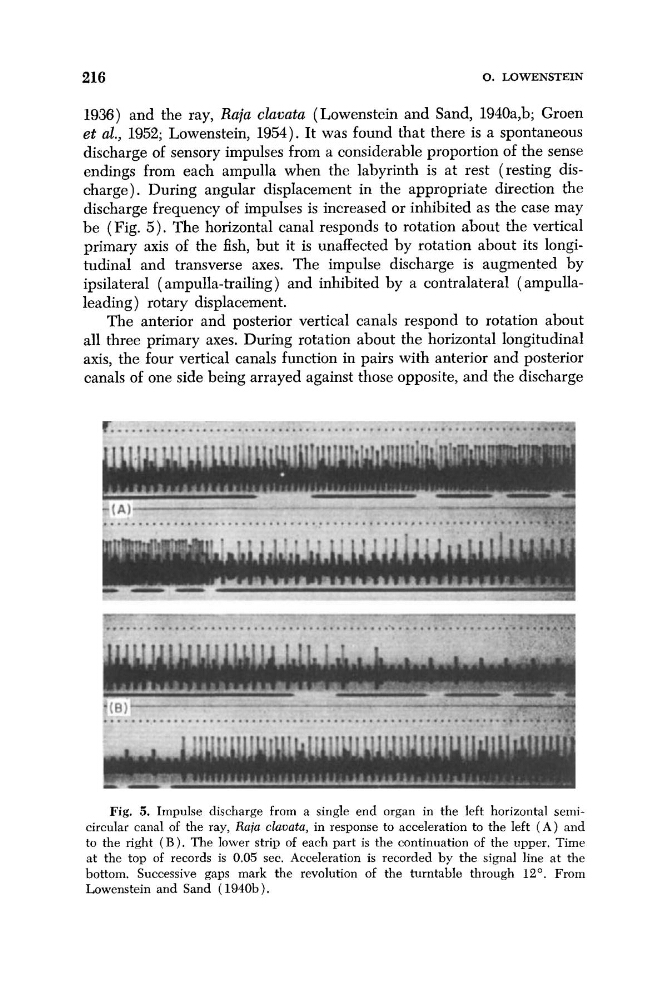
be (Fig. 5 ) . The horizontal canal responds to rotation about the vertical
primary axis of the fish, but it is unaffected by rotation about its longitudinal and transverse axes. The impulse discharge is augmented by
ipsilateral ( ampulla-trailing ) and inhibited by a contralateral ( ampullaleading) rotary displacement.
The anterior and posterior vertical canals respond to rotation about
all three primary axes. During rotation about the horizontal longitudinal
axis, the four vertical canals function in pairs with anterior and posterior
canals of one side being arrayed against those opposite, and the discharge
Fig. 5. Impulse discharge from a single end organ in the left horizontal semicircular canal of the ray, Raja clauatu, in response to acceleration to the left ( A ) and
to the right ( B ) . The lower strip of each part is the continuation of the upper. Time
at the top of records is 0.05 sec. Acceleration is recorded by the signal line at the
bottom. Successive gaps mark the revolution of the turntable through 12'. From
Lowenstein and Sand (1940b).
216
1936) and the ray, Raja clavata (Lowenstein and Sand, 1940a,b; Groen
et al., 1952; Lowenstein, 1954). It was found that there is a spontaneous
discharge of sensory impulses from a considerable proportion of the sense
endings from each ampulla when the labyrinth is at rest (resting discharge). During angular displacement in the appropriate direction the
discharge frequency of impulses is increased or inhibited as the case may
be (Fig. 5 ) . The horizontal canal responds to rotation about the vertical
primary axis of the fish, but it is unaffected by rotation about its longitudinal and transverse axes. The impulse discharge is augmented by
ipsilateral ( ampulla-trailing ) and inhibited by a contralateral ( ampullaleading) rotary displacement.
The anterior and posterior vertical canals respond to rotation about
all three primary axes. During rotation about the horizontal longitudinal
axis, the four vertical canals function in pairs with anterior and posterior
canals of one side being arrayed against those opposite, and the discharge
Fig. 5. Impulse discharge from a single end organ in the left horizontal semicircular canal of the ray, Raja clauatu, in response to acceleration to the left ( A ) and
to the right ( B ) . The lower strip of each part is the continuation of the upper. Time
at the top of records is 0.05 sec. Acceleration is recorded by the signal line at the
bottom. Successive gaps mark the revolution of the turntable through 12'. From
Lowenstein and Sand (1940b).