

7. THE LABYRINTH
215
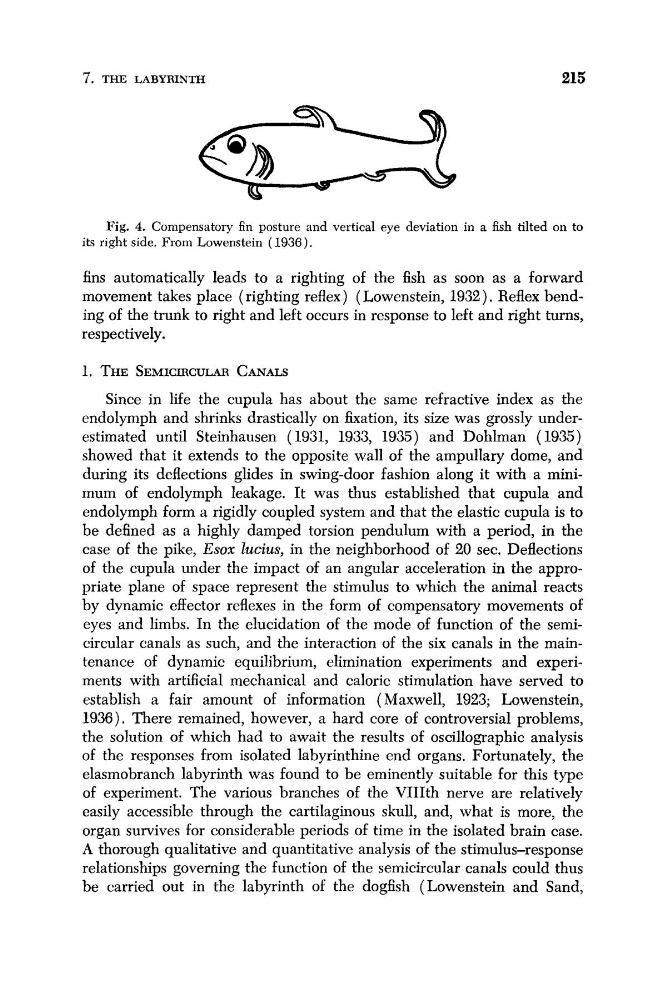
Fig. 4. Compensatory fin posture and vertical eye deviation in a fish tilted on to
its right side. From Lowenstein ( 1936).
fins automatically leads to a righting of the fish as soon as a forward
movement takes place (righting reflex) ( Lowenstein, 1932). Reflex bending of the trunk to right and left occurs in response to left and right turns,
respectively.
1. THE SEMICIRCULAR CANALS
Since in life the cupula has about the same refractive index as the
endolymph and shrinks drastically on fixation, its size was grossly underestimated until Steinhausen (1931, 1933, 1935) and Dohlman (1935)
showed that it extends to the opposite wall of the ampullary dome, and
during its deflections glides in swing-door fashion along it with a minimum of endolymph leakage. It was thus established that cupula and
endolymph form a rigidly coupled system and that the elastic cupula is to
be defined as a highly damped torsion pendulum with a period, in the
case of the pike, Esox lucius, in the neighborhood of 20 sec. Deflections
of the cupula under the impact of an angular acceleration in the appropriate plane of space represent the stimulus to which the animal reacts
by dynamic effector reflexes in the form of compensatory movements of
eyes and limbs. In the elucidation of the mode of function of the semicircular canals as such, and the interaction of the six canals in the maintenance of dynamic equilibrium, elimination experiments and experiments with artificial mechanical and caloric stimulation have served to
establish a fair amount of information (Maxwell, 1923; Lowenstein,
1936). There remained, however, a hard core of controversial problems,
the solution of which had to await the results of oscillographic analysis
of the responses from isolated labyrinthine end organs. Fortunately, the
elasmobranch labyrinth was found to be eminently suitable for this type
of experiment. The various branches of the VIIIth nerve are relatively
easily accessible through the cartilaginous skull, and, what is more, the
organ survives for considerable periods of time in the isolated brain case.
A thorough qualitative and quantitative analysis of the stimulus-response
relationships governing the function of the semicircular canals could thus
be carried out in the labyrinth of the dogfish (Lowenstein and Sand,
215
Fig. 4. Compensatory fin posture and vertical eye deviation in a fish tilted on to
its right side. From Lowenstein ( 1936).
fins automatically leads to a righting of the fish as soon as a forward
movement takes place (righting reflex) ( Lowenstein, 1932). Reflex bending of the trunk to right and left occurs in response to left and right turns,
respectively.
1. THE SEMICIRCULAR CANALS
Since in life the cupula has about the same refractive index as the
endolymph and shrinks drastically on fixation, its size was grossly underestimated until Steinhausen (1931, 1933, 1935) and Dohlman (1935)
showed that it extends to the opposite wall of the ampullary dome, and
during its deflections glides in swing-door fashion along it with a minimum of endolymph leakage. It was thus established that cupula and
endolymph form a rigidly coupled system and that the elastic cupula is to
be defined as a highly damped torsion pendulum with a period, in the
case of the pike, Esox lucius, in the neighborhood of 20 sec. Deflections
of the cupula under the impact of an angular acceleration in the appropriate plane of space represent the stimulus to which the animal reacts
by dynamic effector reflexes in the form of compensatory movements of
eyes and limbs. In the elucidation of the mode of function of the semicircular canals as such, and the interaction of the six canals in the maintenance of dynamic equilibrium, elimination experiments and experiments with artificial mechanical and caloric stimulation have served to
establish a fair amount of information (Maxwell, 1923; Lowenstein,
1936). There remained, however, a hard core of controversial problems,
the solution of which had to await the results of oscillographic analysis
of the responses from isolated labyrinthine end organs. Fortunately, the
elasmobranch labyrinth was found to be eminently suitable for this type
of experiment. The various branches of the VIIIth nerve are relatively
easily accessible through the cartilaginous skull, and, what is more, the
organ survives for considerable periods of time in the isolated brain case.
A thorough qualitative and quantitative analysis of the stimulus-response
relationships governing the function of the semicircular canals could thus
be carried out in the labyrinth of the dogfish (Lowenstein and Sand,