

212
0. LOWENSTEIN
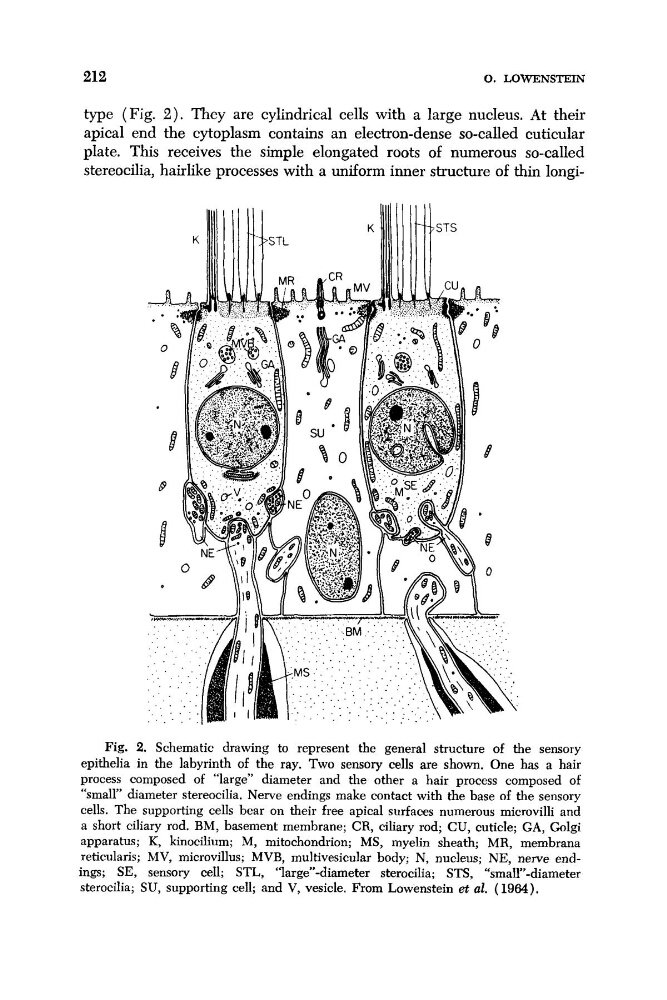
type (Fig. 2 ) . They are cylindrical cells with a large nucleus. At their
apical end the cytoplasm contains an electron-dense so-called cuticular
plate. This receives the simple elongated roots of numerous so-called
stereocilia, hairlike processes with a uniform inner structure of thin longiFig. 2. Schematic drawing to represent the general structure of the sensory
epithelia in the labyrinth of the ray. Two sensory cells are shown. One has a hair
process composed of “large” diameter and the other a hair process composed of
“small” diameter stereocilia. Nerve endings make contact with the base of the sensory
cells. The supporting cells bear on their free apical surfaces numerous microvilli and
a short ciliary rod. BM, basement membrane; CR, ciliary rod; CU, cuticle; GA, Golgi
apparatus; K, kinocilium; M, mitochondrion; MS, myelin sheath; MR, membrana
reticularis; MV, microvillus; MVB, multivesicular body; N, nucleus; NE, nerve endings; SE, sensory cell; STL, ‘large’’-diameter sterocilia; STS, ‘‘small’’-diameter
sterocilia; SU, supporting cell; and V, vesicle. From Lowenstein et al. (1964).
0. LOWENSTEIN
type (Fig. 2 ) . They are cylindrical cells with a large nucleus. At their
apical end the cytoplasm contains an electron-dense so-called cuticular
plate. This receives the simple elongated roots of numerous so-called
stereocilia, hairlike processes with a uniform inner structure of thin longiFig. 2. Schematic drawing to represent the general structure of the sensory
epithelia in the labyrinth of the ray. Two sensory cells are shown. One has a hair
process composed of “large” diameter and the other a hair process composed of
“small” diameter stereocilia. Nerve endings make contact with the base of the sensory
cells. The supporting cells bear on their free apical surfaces numerous microvilli and
a short ciliary rod. BM, basement membrane; CR, ciliary rod; CU, cuticle; GA, Golgi
apparatus; K, kinocilium; M, mitochondrion; MS, myelin sheath; MR, membrana
reticularis; MV, microvillus; MVB, multivesicular body; N, nucleus; NE, nerve endings; SE, sensory cell; STL, ‘large’’-diameter sterocilia; STS, ‘‘small’’-diameter
sterocilia; SU, supporting cell; and V, vesicle. From Lowenstein et al. (1964).