

174
WILLIAM N. TAVOLGA
resulted from the omission of shock during the testing trials, and extinction of the response took place. It is possible, therefore, that Weiss’s data
do not represent auditory thresholds at all. Such differences in technique
may also explain why thresholds obtained by Weiss et al. (1969) on
Ictalurus nebubsus were 10-20 dB higher than those reported earlier
by Poggendorf ( 1952).
Fishes without a Weberian apparatus have not been tested as extensively as the ostariophysines. However, the mormyrids and labyrinthine
fishes possess air chambers directly coupled to the perilymphatic fluid
and inner ear. The studies of Diesselhorst (1938), StipetiL (1939), and
Schneider (1941) showed upper frequency limits of over 3000 Hz for
mormyrids, with a threshold of -50 to -40 dB pb at 258 Hz (Diesselhorst, 1938). Schneider ( 1941) reported upper frequency limits of 4500
Hz for certain labyrinthines.
Upper frequency limits in most other nonostariophysine species are
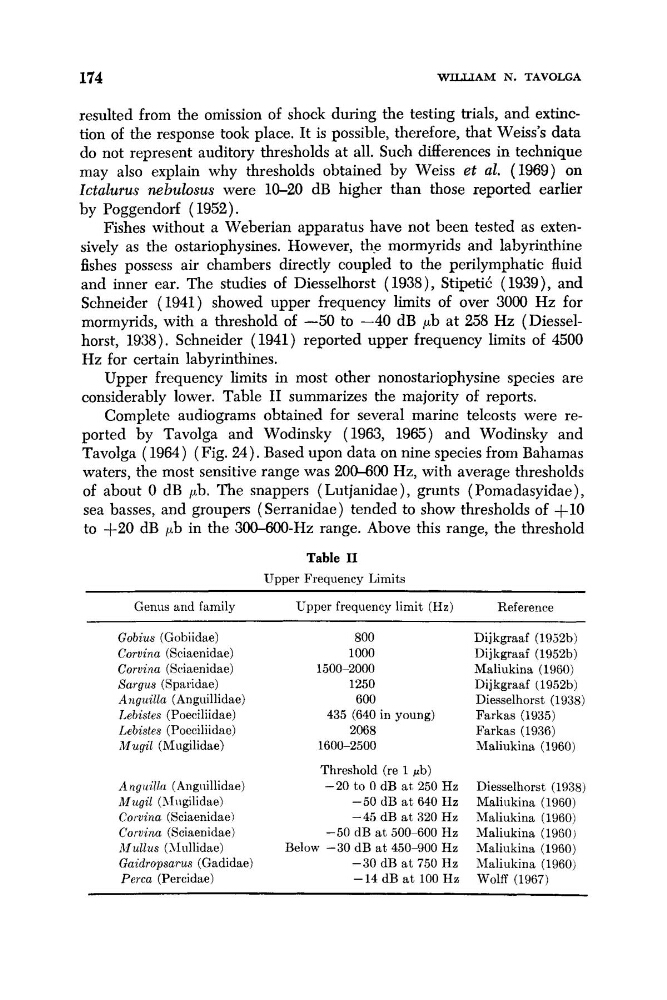
considerably lower. Table I1 summarizes the majority of reports.
Complete audiograms obtained for several marine teleosts were reported by Tavolga and Wodinsky (1963, 1965) and Wodinsky and
Tavolga ( 1964) (Fig. 24). Based upon data on nine species from Bahamas
waters, the most sensitive range was 200-600 Hz, with average thresholds
of about 0 dB pb. The snappers (Lutjanidae), grunts (Pomadasyidae),
sea basses, and groupers (Serranidae) tended to show thresholds of +lo
to +20 dB pb in the 300-600-Hz range. Above this range, the threshold
Table I1
Upper Frequency Limits
Genus and family
Upper frequency limit (Hz)
Reference
Gobius (Gobiidae)
Corvina (Sciaenidae)
Corvina (Sciaenidae)
Sargus (Sparidae)
Anguilla (Anguillidae)
Lebistes (Poeciliidae)
Lebistes (Poeciliidae)
Mugil (Mugilidae)
A nguilla (Angaillidae)
Mugil (Mngilidae)
Corvina (Sciaenidae)
Corvina (Sciaenidae)
Mullus (Ilullidae)
Gaidropsarus (Gadidae)
Perm (Percidae)
800
1000
1500-2000
1250
600
2068
435 (640 in young)
1600-2500
Threshold (re 1 pb)
-20 to 0 dB a t 250 HZ
-50 dB a t 640 Hz
-45 dB a t 320 Hz
-50 dB a t 500-600 Hz
Below -30 dB at 450-900 Hz
-30 dB a t 750 Hz
-14 dB at 100 Hz
Dijkgraaf (1952b)
Dijkgraaf (195213)
Maliukina (1960)
Dijkgraaf (1952b)
Diesselhorst (1938)
Farkas (1935)
Farkas (1936)
Maliukina (1960)
Diesselhorst (1938)
Maliitkina (1960)
Maliukina (1960)
Maliukina (1960)
Maliukina (1960)
Maliukina (1960)
Wolff (1967)
WILLIAM N. TAVOLGA
resulted from the omission of shock during the testing trials, and extinction of the response took place. It is possible, therefore, that Weiss’s data
do not represent auditory thresholds at all. Such differences in technique
may also explain why thresholds obtained by Weiss et al. (1969) on
Ictalurus nebubsus were 10-20 dB higher than those reported earlier
by Poggendorf ( 1952).
Fishes without a Weberian apparatus have not been tested as extensively as the ostariophysines. However, the mormyrids and labyrinthine
fishes possess air chambers directly coupled to the perilymphatic fluid
and inner ear. The studies of Diesselhorst (1938), StipetiL (1939), and
Schneider (1941) showed upper frequency limits of over 3000 Hz for
mormyrids, with a threshold of -50 to -40 dB pb at 258 Hz (Diesselhorst, 1938). Schneider ( 1941) reported upper frequency limits of 4500
Hz for certain labyrinthines.
Upper frequency limits in most other nonostariophysine species are
considerably lower. Table I1 summarizes the majority of reports.
Complete audiograms obtained for several marine teleosts were reported by Tavolga and Wodinsky (1963, 1965) and Wodinsky and
Tavolga ( 1964) (Fig. 24). Based upon data on nine species from Bahamas
waters, the most sensitive range was 200-600 Hz, with average thresholds
of about 0 dB pb. The snappers (Lutjanidae), grunts (Pomadasyidae),
sea basses, and groupers (Serranidae) tended to show thresholds of +lo
to +20 dB pb in the 300-600-Hz range. Above this range, the threshold
Table I1
Upper Frequency Limits
Genus and family
Upper frequency limit (Hz)
Reference
Gobius (Gobiidae)
Corvina (Sciaenidae)
Corvina (Sciaenidae)
Sargus (Sparidae)
Anguilla (Anguillidae)
Lebistes (Poeciliidae)
Lebistes (Poeciliidae)
Mugil (Mugilidae)
A nguilla (Angaillidae)
Mugil (Mngilidae)
Corvina (Sciaenidae)
Corvina (Sciaenidae)
Mullus (Ilullidae)
Gaidropsarus (Gadidae)
Perm (Percidae)
800
1000
1500-2000
1250
600
2068
435 (640 in young)
1600-2500
Threshold (re 1 pb)
-20 to 0 dB a t 250 HZ
-50 dB a t 640 Hz
-45 dB a t 320 Hz
-50 dB a t 500-600 Hz
Below -30 dB at 450-900 Hz
-30 dB a t 750 Hz
-14 dB at 100 Hz
Dijkgraaf (1952b)
Dijkgraaf (195213)
Maliukina (1960)
Dijkgraaf (1952b)
Diesselhorst (1938)
Farkas (1935)
Farkas (1936)
Maliukina (1960)
Diesselhorst (1938)
Maliitkina (1960)
Maliukina (1960)
Maliukina (1960)
Maliukina (1960)
Maliukina (1960)
Wolff (1967)