

164
WILLIAM N. TAVOLGA
the ear, i.e., in some form of vibration detection. Pearson (1936) traced
out the course of the VIIIth nerve and showed that the peripheral sensory
supply to the lateral line system was derived from the acoustic nerve
VIII. In spite of this report, and the earlier descriptions of Herrick
( 1898), some recent textbooks and manuals of comparative anatomy still
give the innervation of the lateral line and head canals as the facial (VII) ,
glossopharyngeal ( IX), and vagus (X) nerves, based upon gross anatomical observations. This error has been pointed out most recently by van
Bergeijk ( 1967a).
B. Mechanisms of Sound Detection
1. INNER EAR
The morphological aspects of sound detection in fishes will be treated
briefly here. The structure of the labyrinth, including the inner ear, has
been reviewed in some detail by Grass6 (1958) and Moulton (1963), and
will be covered by Lowenstein in another chapter in this volume. The
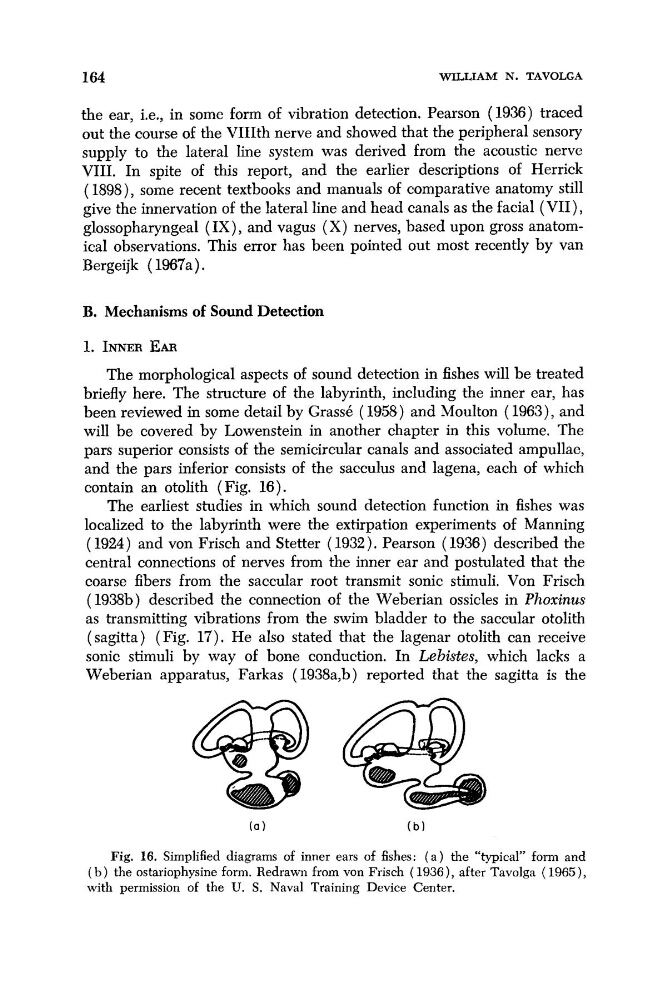
pars superior consists of the semicircular canals and associated ampullae,
and the pars inferior consists of the sacculus and lagena, each of which
contain an otolith (Fig. 16).
The earliest studies in which sound detection function in fishes was
localized to the labyrinth were the extirpation experiments of Manning
( 1924) and von Frisch and Stetter (1932). Pearson (1936) described the
central connections of nerves from the inner ear and postulated that the
coarse fibers from the saccular root transmit sonic stimuli. Von Frisch
( 1938b) described the connection of the Weberian ossicles in Phorinus
as transmitting vibrations from the swim bladder to the saccular otolith
(sagitta) (Fig. 17). He also stated that the lagenar otolith can receive
sonic stimuli by way of bone conduction. In Lebistes, which lacks a
Weberian apparatus, Farkas (1938a,b) reported that the sagitta is the
Fig. 16. Simplified diagrams of inner ears of fishes: ( a ) the “typical” form and
( b ) the ostariophysine form. Redrawn from von Frisch (1936), after Tavolga (1965),
with permission of the U. S. Naval Training Device Center.
WILLIAM N. TAVOLGA
the ear, i.e., in some form of vibration detection. Pearson (1936) traced
out the course of the VIIIth nerve and showed that the peripheral sensory
supply to the lateral line system was derived from the acoustic nerve
VIII. In spite of this report, and the earlier descriptions of Herrick
( 1898), some recent textbooks and manuals of comparative anatomy still
give the innervation of the lateral line and head canals as the facial (VII) ,
glossopharyngeal ( IX), and vagus (X) nerves, based upon gross anatomical observations. This error has been pointed out most recently by van
Bergeijk ( 1967a).
B. Mechanisms of Sound Detection
1. INNER EAR
The morphological aspects of sound detection in fishes will be treated
briefly here. The structure of the labyrinth, including the inner ear, has
been reviewed in some detail by Grass6 (1958) and Moulton (1963), and
will be covered by Lowenstein in another chapter in this volume. The
pars superior consists of the semicircular canals and associated ampullae,
and the pars inferior consists of the sacculus and lagena, each of which
contain an otolith (Fig. 16).
The earliest studies in which sound detection function in fishes was
localized to the labyrinth were the extirpation experiments of Manning
( 1924) and von Frisch and Stetter (1932). Pearson (1936) described the
central connections of nerves from the inner ear and postulated that the
coarse fibers from the saccular root transmit sonic stimuli. Von Frisch
( 1938b) described the connection of the Weberian ossicles in Phorinus
as transmitting vibrations from the swim bladder to the saccular otolith
(sagitta) (Fig. 17). He also stated that the lagenar otolith can receive
sonic stimuli by way of bone conduction. In Lebistes, which lacks a
Weberian apparatus, Farkas (1938a,b) reported that the sagitta is the
Fig. 16. Simplified diagrams of inner ears of fishes: ( a ) the “typical” form and
( b ) the ostariophysine form. Redrawn from von Frisch (1936), after Tavolga (1965),
with permission of the U. S. Naval Training Device Center.