

5. THE ENDOCRINE PANCREAS
281
!=D
I
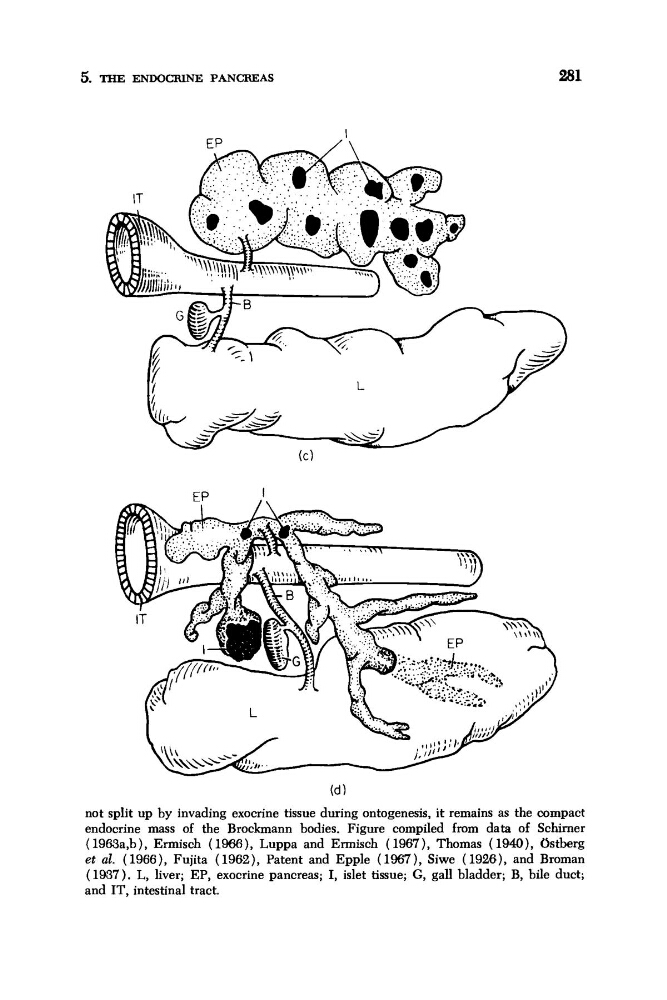
not split up by invading exocrine tissue during ontogenesis, it remains as the compact
endocrine mass of the Brockmann bodies. Figure compiled from data of Schirner
(1963a,b), Ermisch (1966), Luppa and Ermisch (1967), Thomas (1940), Ostberg
et al. (1966), Fujita (1962), Patent and Epple (1967), Siwe (1926), and Broman
(1937). L, liver; EP, exocrine pancreas; I, islet tissue; G, gall bladder; B, bile duct;
and IT, intestinal tract.
281
!=D
I
not split up by invading exocrine tissue during ontogenesis, it remains as the compact
endocrine mass of the Brockmann bodies. Figure compiled from data of Schirner
(1963a,b), Ermisch (1966), Luppa and Ermisch (1967), Thomas (1940), Ostberg
et al. (1966), Fujita (1962), Patent and Epple (1967), Siwe (1926), and Broman
(1937). L, liver; EP, exocrine pancreas; I, islet tissue; G, gall bladder; B, bile duct;
and IT, intestinal tract.