

14
J. N. BALL AND BRIDGET I. BAKER
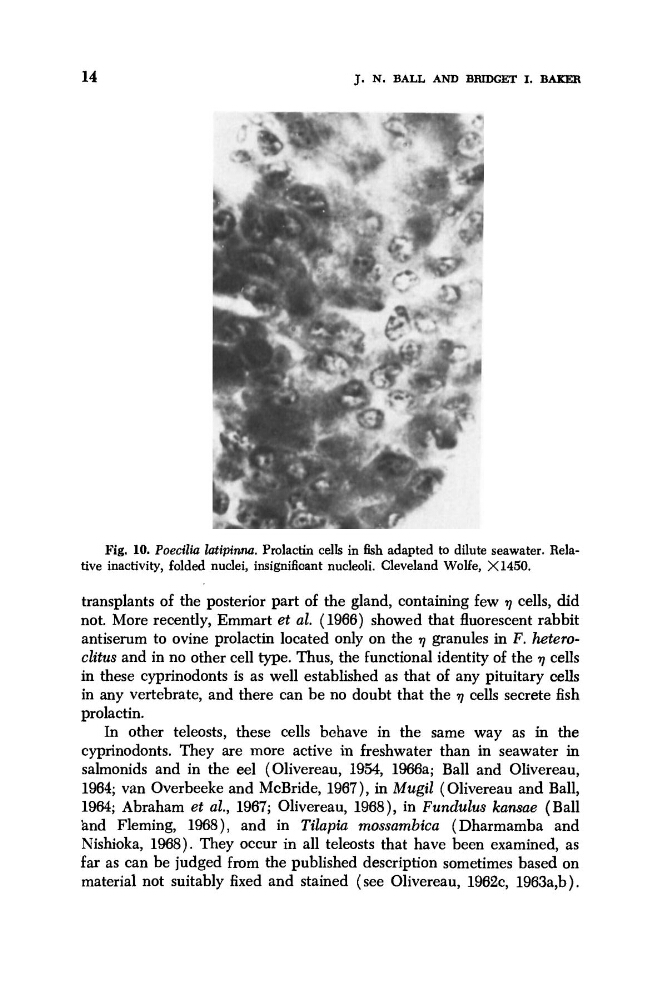
Fig. 10. Poecilia latipinna. Prolactin cells in fish adapted to dilute seawater. Relative inactivity, folded nuclei, insignificant nucleoli. Cleveland Wolfe, X 1450.
transplants of the posterior part of the gland, containing few 71 cells, did
not. More recently, Emmart et al. (1966) showed that fluorescent rabbit
antiserum to ovine prolactin located only on the 71 granules in F. heteroclitus and in no other cell type. Thus, the functional identity of the 7 cells
in these cyprinodonts is as well established as that of any pituitary cells
in any vertebrate, and there can be no doubt that the r] cells secrete fish
prolactin.
In other teleosts, these cells behave in the same way as in the
cyprinodonts. They are more active in freshwater than in seawater in
salmonids and in the eel (Olivereau, 1954, 1966a; Ball and Olivereau,
1964; van Overbeeke and McBride, 1967), in Mugil (Olivereau and Ball,
1964; Abraham et al., 1967; Olivereau, 1968), in Fundulus kansue (Ball
and Fleming, 1968), and in Tilapia mossambica (Dharmamba and
Nishioka, 1968). They occur in all teleosts that have been examined, as
far as can be judged from the published description sometimes based on
material not suitably fixed and stained (see Olivereau, 1962c, 1963a,b).
J. N. BALL AND BRIDGET I. BAKER
Fig. 10. Poecilia latipinna. Prolactin cells in fish adapted to dilute seawater. Relative inactivity, folded nuclei, insignificant nucleoli. Cleveland Wolfe, X 1450.
transplants of the posterior part of the gland, containing few 71 cells, did
not. More recently, Emmart et al. (1966) showed that fluorescent rabbit
antiserum to ovine prolactin located only on the 71 granules in F. heteroclitus and in no other cell type. Thus, the functional identity of the 7 cells
in these cyprinodonts is as well established as that of any pituitary cells
in any vertebrate, and there can be no doubt that the r] cells secrete fish
prolactin.
In other teleosts, these cells behave in the same way as in the
cyprinodonts. They are more active in freshwater than in seawater in
salmonids and in the eel (Olivereau, 1954, 1966a; Ball and Olivereau,
1964; van Overbeeke and McBride, 1967), in Mugil (Olivereau and Ball,
1964; Abraham et al., 1967; Olivereau, 1968), in Fundulus kansue (Ball
and Fleming, 1968), and in Tilapia mossambica (Dharmamba and
Nishioka, 1968). They occur in all teleosts that have been examined, as
far as can be judged from the published description sometimes based on
material not suitably fixed and stained (see Olivereau, 1962c, 1963a,b).