

10. THE SWIM BLADDER AS A HYDROSTATIC ORGAN
431
arterial blood. This will cause diffusion of 0, from venous to arterial
blood of the rete and consequently an increased Po, in the arterial blood
entering the bladder. When this blood in turn experiences a reduced
solubility, the Po, will increase further and still more 0, will enter the
bladder. Thus the small increase in Po, caused by reduced solubility,
the primary effect, will be accumulated by circulation through the rete.
The process is cumulative and is termed “hairpin countercurrent multiplication” ( ccm ) .
Haldane (1922) and, in particular, Koch (1934) were the first to
suggest how the rete might function to concentrate 0, and inert gases
subsequent to release from the blood. The potential properties of such
a system were, however, first clearly realized by Kuhn and Riiffel (1942),
who introduced to biology the concept of countercurrent multiplication.
Hargitay and Kuhn (1951) developed an extensive model of such a
mechanism in the case of urine concentration in the loop of Henle.
Kuhn and Kuhn (1961) expounded the ccm of gases in the rete
mathematically. [Helpful reviews are given by Kuhn et al. (1963),
Alexander (1966), and Enns et al. ( 1967).] They assumed the rete
tissue to be impermeable to salts and acids and treated separately the
importance of a salting out effect, the Bohr effect, and the Root effect
on the concentrating ability. (The Bohr effect denotes the pH sensitive
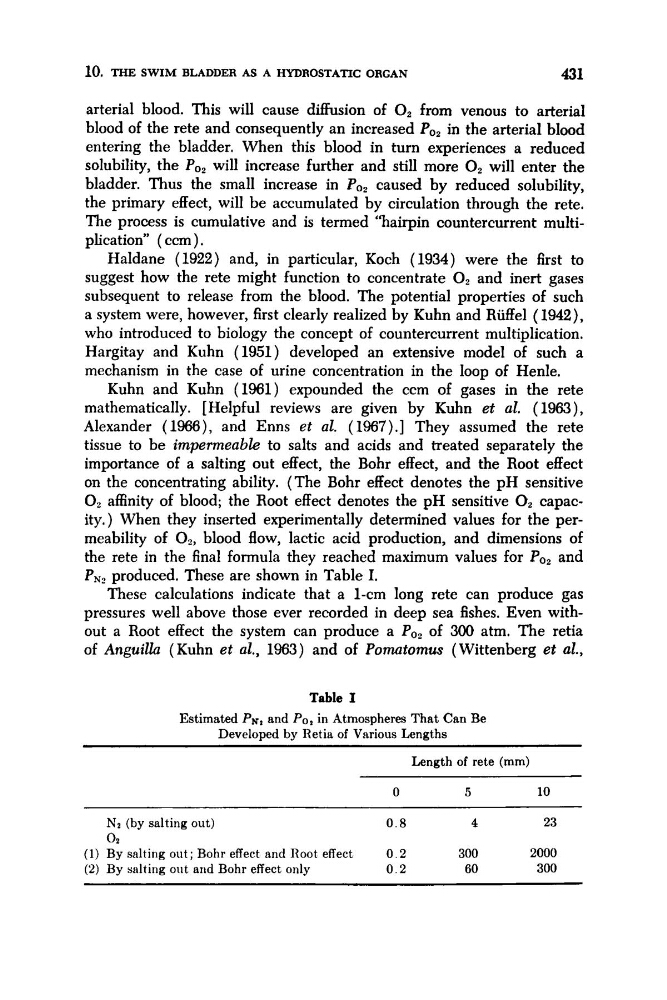
0, affinity of blood; the Root effect denotes the pH sensitive 0, capacity, ) When they inserted experimentally determined values for the permeability of 02, blood flow, lactic acid production, and dimensions of
the rete in the final formula they reached maximum values for Po, and
P,? produced, These are shown in Table I.
These calculations indicate that a 1-cm long rete can produce gas
pressures well above those ever recorded in deep sea fishes. Even without a Root effect the system can produce a Po, of 300 atm. The retia
of Anguilla (Kuhn et al., 1963) and of Pomutomus (Wittenberg et al.,
Table I
Estimated PN, and PO* in Atmospheres That Can Be
Developed by Retia of Various Lengths
Length of rete (mm)
0
5
10
Ns (by salting out)
0 . 8
4
23
0 2
(1) By salting out; Bohr effect and Root effect
0 . 2
300
2000
(2) By salting out and Bohr effect only
0 . 2
60
300
431
arterial blood. This will cause diffusion of 0, from venous to arterial
blood of the rete and consequently an increased Po, in the arterial blood
entering the bladder. When this blood in turn experiences a reduced
solubility, the Po, will increase further and still more 0, will enter the
bladder. Thus the small increase in Po, caused by reduced solubility,
the primary effect, will be accumulated by circulation through the rete.
The process is cumulative and is termed “hairpin countercurrent multiplication” ( ccm ) .
Haldane (1922) and, in particular, Koch (1934) were the first to
suggest how the rete might function to concentrate 0, and inert gases
subsequent to release from the blood. The potential properties of such
a system were, however, first clearly realized by Kuhn and Riiffel (1942),
who introduced to biology the concept of countercurrent multiplication.
Hargitay and Kuhn (1951) developed an extensive model of such a
mechanism in the case of urine concentration in the loop of Henle.
Kuhn and Kuhn (1961) expounded the ccm of gases in the rete
mathematically. [Helpful reviews are given by Kuhn et al. (1963),
Alexander (1966), and Enns et al. ( 1967).] They assumed the rete
tissue to be impermeable to salts and acids and treated separately the
importance of a salting out effect, the Bohr effect, and the Root effect
on the concentrating ability. (The Bohr effect denotes the pH sensitive
0, affinity of blood; the Root effect denotes the pH sensitive 0, capacity, ) When they inserted experimentally determined values for the permeability of 02, blood flow, lactic acid production, and dimensions of
the rete in the final formula they reached maximum values for Po, and
P,? produced, These are shown in Table I.
These calculations indicate that a 1-cm long rete can produce gas
pressures well above those ever recorded in deep sea fishes. Even without a Root effect the system can produce a Po, of 300 atm. The retia
of Anguilla (Kuhn et al., 1963) and of Pomutomus (Wittenberg et al.,
Table I
Estimated PN, and PO* in Atmospheres That Can Be
Developed by Retia of Various Lengths
Length of rete (mm)
0
5
10
Ns (by salting out)
0 . 8
4
23
0 2
(1) By salting out; Bohr effect and Root effect
0 . 2
300
2000
(2) By salting out and Bohr effect only
0 . 2
60
300