

9. AIR BREATHING IN FISHES
401
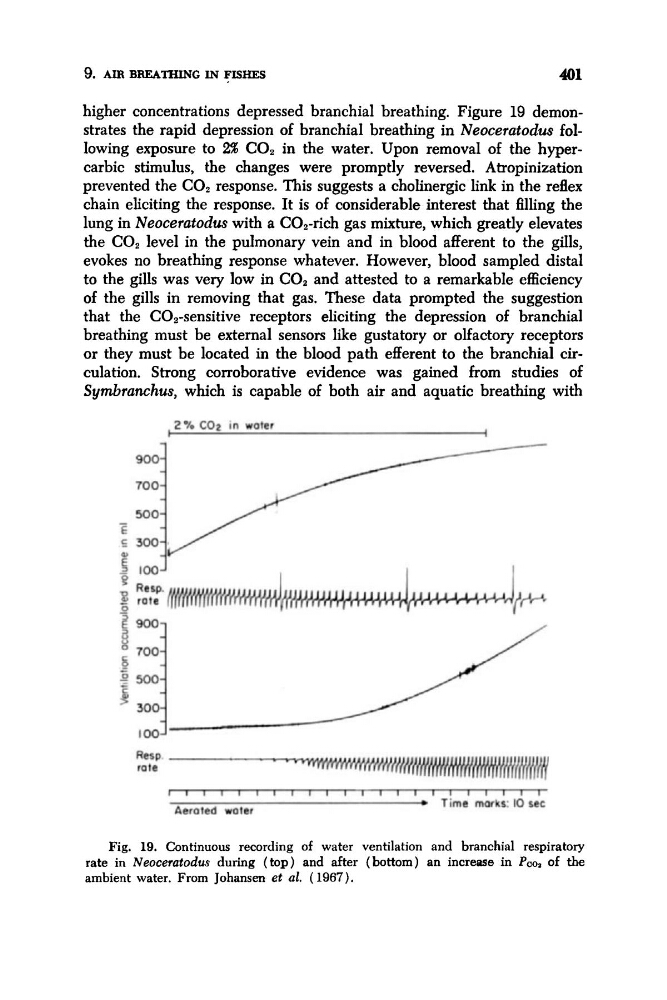
higher concentrations depressed branchial breathing. Figure 19 demonstrates the rapid depression of branchial breathing in Neocerutodus following exposure to 2% CO, in the water. Upon removal of the hypercarbic stimulus, the changes were promptly reversed. Atropinization
prevented the CO, response. This suggests a cholinergic link in the reflex
chain eliciting the response. It is of considerable interest that filling the
lung in Neocerutodus with a CO,-rich gas mixture, which greatly elevates
the CO, level in the pulmonary vein and in blood afferent to the gills,
evokes no breathing response whatever. However, blood sampled distal
to the gills was very low in CO, and attested to a remarkable efficiency
of the gills in removing that gas. These data prompted the suggestion
that the C0,-sensitive receptors eliciting the depression of branchial
breathing must be external sensors like gustatory or olfactory receptors
or they must be located in the blood path efferent to the branchial circulation. Strong corroborative evidence was gained from studies of
Symbrunchus, which is capable of both air and aquatic breathing with
Fig. 19. Continuous recording of water ventilation and branchial respiratory
rate in Neoceratodus during (top) and after (bottom) an increase in Paot of the
ambient water. From Johansen et al. (1967).
401
higher concentrations depressed branchial breathing. Figure 19 demonstrates the rapid depression of branchial breathing in Neocerutodus following exposure to 2% CO, in the water. Upon removal of the hypercarbic stimulus, the changes were promptly reversed. Atropinization
prevented the CO, response. This suggests a cholinergic link in the reflex
chain eliciting the response. It is of considerable interest that filling the
lung in Neocerutodus with a CO,-rich gas mixture, which greatly elevates
the CO, level in the pulmonary vein and in blood afferent to the gills,
evokes no breathing response whatever. However, blood sampled distal
to the gills was very low in CO, and attested to a remarkable efficiency
of the gills in removing that gas. These data prompted the suggestion
that the C0,-sensitive receptors eliciting the depression of branchial
breathing must be external sensors like gustatory or olfactory receptors
or they must be located in the blood path efferent to the branchial circulation. Strong corroborative evidence was gained from studies of
Symbrunchus, which is capable of both air and aquatic breathing with
Fig. 19. Continuous recording of water ventilation and branchial respiratory
rate in Neoceratodus during (top) and after (bottom) an increase in Paot of the
ambient water. From Johansen et al. (1967).