

396
K JELL JOHANSEN
100-N 80.10
-
0
-
0
c
c
c 60o\ "
&
0
- -
t
0 400 I 20
40
60
80
100
120
140
(A)
Po2 in water (mm Hg)
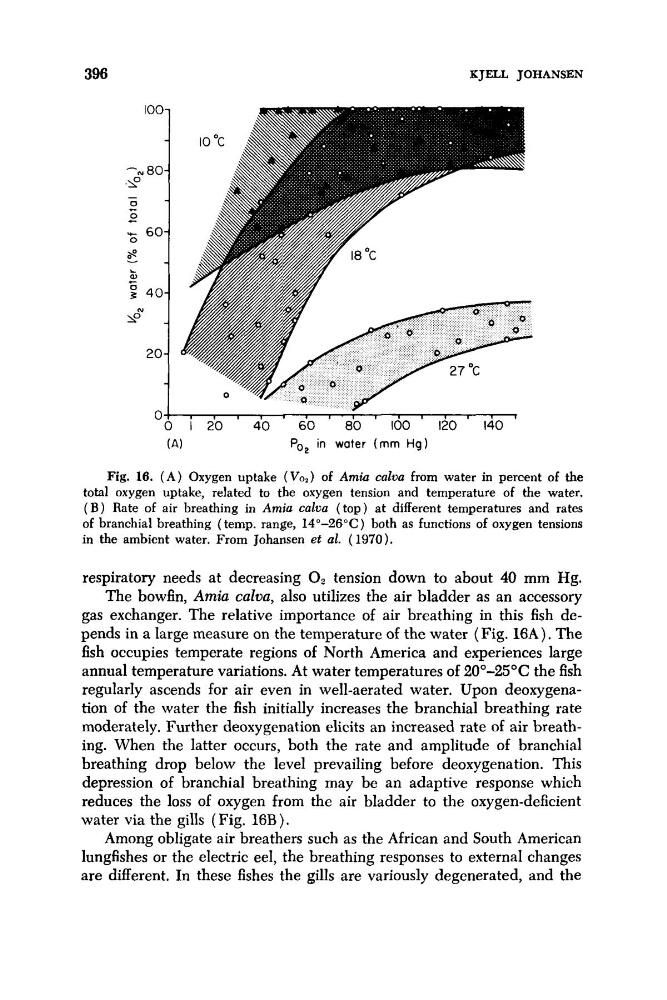
Fig. 16. ( A ) Oxygen uptake ( V O ~ )
of Amiu caZua from water in percent of the
total oxygen uptake, related to the oxygen tension and temperature of the water.
( B ) Rate of air breathing in Amia calm (top) at different temperatures and rates
of branchial breathing (temp. range, 14"-26"C) both as functions of oxygen tensions
in the ambient water. From Johansen et aZ. (1970).
respiratory needs at decreasing 0, tension down to about 40 mm Hg.
The bowfin, Amia calva, also utilizes the air bladder as an accessory
gas exchanger. The relative importance of air breathing in this fish depends in a large measure on the temperature of the water (Fig. 16A). The
fish occupies temperate regions of North America and experiences large
annual temperature variations. At water temperatures of 2Oo-25"C the fish
regularly ascends for air even in well-aerated water. Upon deoxygenation of the water the fish initially increases the branchial breathing rate
moderately. Further deoxygenation elicits an increased rate of air breathing. When the latter occurs, both the rate and amplitude of branchial
breathing drop below the level prevailing before deoxygenation. This
depression of branchial breathing may be an adaptive response which
reduces the loss of oxygen from the air bladder to the oxygen-deficient
water via the gills (Fig. 16B).
Among obligate air breathers such as the African and South American
lungfishes or the electric eel, the breathing responses to external changes
are different, In these fishes the gills are variously degenerated, and the
K JELL JOHANSEN
100-N 80.10
-
0
-
0
c
c
c 60o\ "
&
0
- -
t
0 400 I 20
40
60
80
100
120
140
(A)
Po2 in water (mm Hg)
Fig. 16. ( A ) Oxygen uptake ( V O ~ )
of Amiu caZua from water in percent of the
total oxygen uptake, related to the oxygen tension and temperature of the water.
( B ) Rate of air breathing in Amia calm (top) at different temperatures and rates
of branchial breathing (temp. range, 14"-26"C) both as functions of oxygen tensions
in the ambient water. From Johansen et aZ. (1970).
respiratory needs at decreasing 0, tension down to about 40 mm Hg.
The bowfin, Amia calva, also utilizes the air bladder as an accessory
gas exchanger. The relative importance of air breathing in this fish depends in a large measure on the temperature of the water (Fig. 16A). The
fish occupies temperate regions of North America and experiences large
annual temperature variations. At water temperatures of 2Oo-25"C the fish
regularly ascends for air even in well-aerated water. Upon deoxygenation of the water the fish initially increases the branchial breathing rate
moderately. Further deoxygenation elicits an increased rate of air breathing. When the latter occurs, both the rate and amplitude of branchial
breathing drop below the level prevailing before deoxygenation. This
depression of branchial breathing may be an adaptive response which
reduces the loss of oxygen from the air bladder to the oxygen-deficient
water via the gills (Fig. 16B).
Among obligate air breathers such as the African and South American
lungfishes or the electric eel, the breathing responses to external changes
are different, In these fishes the gills are variously degenerated, and the