

9. AIR BREATHING IN FISHES
389
oxygenation in both the pulmonary vein and in systemic arteries. The
concurrent increase in CO, tension is related to a loss of the important
escape route via gills and skin and the inevitable retention of CO, resulting from the anatomical dead space of the bidirectional airway. The CO,
retention is minimized by the high tidal volumes relative to total lung
volume. The time course of the blood gas changes during air exposure
of the two lungfishes (Fig. 11) also shows the inadequacy of the
Neoceratodus lung to cope with both O? absorption and C 0 2 elimination,
while the Protopterus lung can handle both tasks even though the internal CO, levels stabilize at a much higher level in air than in water
(Lenfant and Johansen, 1968).
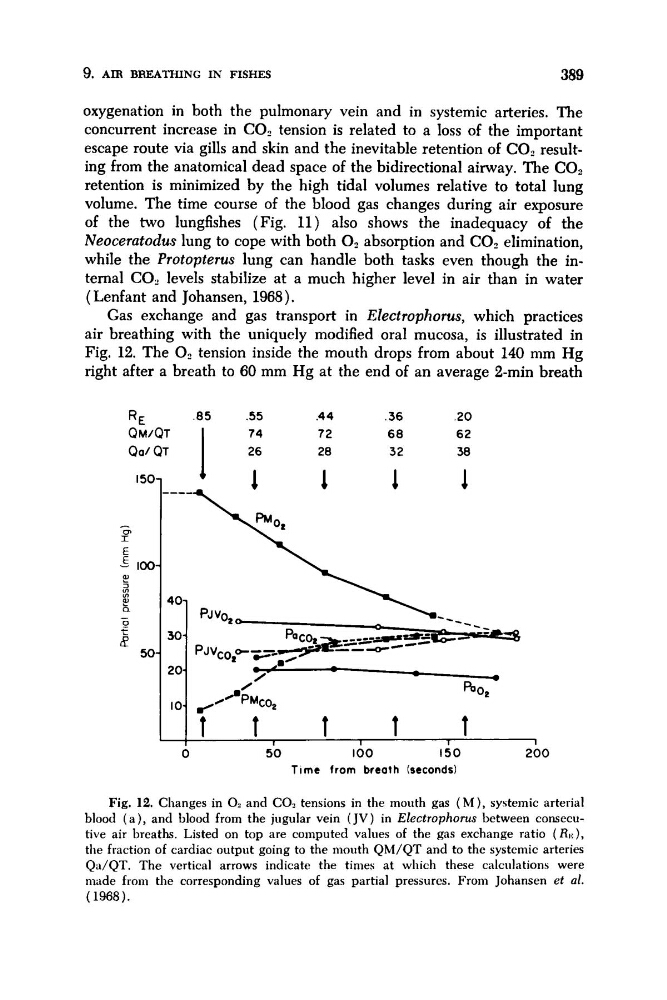
Gas exchange and gas transport in Electropkorus, which practices
air breathing with the uniquely modified oral mucosa, is illustrated in
Fig. 12. The 0, tension inside the mouth drops from about 140 mm Hg
right after a breath to 60 mm Hg at the end of an average 2-min breath
RE
.85
5 5
.4 4
.36
.20
QMIQT
74
72
6 8
62
Qa/QT
1 26 28 32 38
0
50
I00
150
200
Time from breath (seconds)
Fig. 12. Changes in 0: and CO, tensions in the mouth gas ( M ) , systemic arterial
blood ( a ) , and blood from the jugular vein ( J V ) in Ebctrophorus between consecutive air breaths. Listed on top are computed values of the gas exchange ratio (ZL),
the fraction of cardiac output going to the mouth QM/QT and to the systemic arteries
Qa/QT. The vertical arrows indicate the times a t which these calculations were
n u d e from the corresponding values of gas partial pressures. From Johansen et ul.
(1968).
389
oxygenation in both the pulmonary vein and in systemic arteries. The
concurrent increase in CO, tension is related to a loss of the important
escape route via gills and skin and the inevitable retention of CO, resulting from the anatomical dead space of the bidirectional airway. The CO,
retention is minimized by the high tidal volumes relative to total lung
volume. The time course of the blood gas changes during air exposure
of the two lungfishes (Fig. 11) also shows the inadequacy of the
Neoceratodus lung to cope with both O? absorption and C 0 2 elimination,
while the Protopterus lung can handle both tasks even though the internal CO, levels stabilize at a much higher level in air than in water
(Lenfant and Johansen, 1968).
Gas exchange and gas transport in Electropkorus, which practices
air breathing with the uniquely modified oral mucosa, is illustrated in
Fig. 12. The 0, tension inside the mouth drops from about 140 mm Hg
right after a breath to 60 mm Hg at the end of an average 2-min breath
RE
.85
5 5
.4 4
.36
.20
QMIQT
74
72
6 8
62
Qa/QT
1 26 28 32 38
0
50
I00
150
200
Time from breath (seconds)
Fig. 12. Changes in 0: and CO, tensions in the mouth gas ( M ) , systemic arterial
blood ( a ) , and blood from the jugular vein ( J V ) in Ebctrophorus between consecutive air breaths. Listed on top are computed values of the gas exchange ratio (ZL),
the fraction of cardiac output going to the mouth QM/QT and to the systemic arteries
Qa/QT. The vertical arrows indicate the times a t which these calculations were
n u d e from the corresponding values of gas partial pressures. From Johansen et ul.
(1968).