

388
K JELL JOHANSEN
There is a concurrent drop in CO, tensions but aquatic respiration still
dominates the elimination of C02 (Table IV).
The marked differences in the importance and efficiency of air breathing in Neoceratodus and Protopterus can best be discussed when the
blood gas data are described in a nomogram (Fig. 10). While resting
in aerated water, Neoceratodus practices water breathing only, whereas
Protopterus practices frequent air breathing which results in a sizable
gain in 0, saturation of blood passing the lungs. A significant drop in
blood CO, tension also accompanies perfusion of the lungs. The much
higher CO, tensions in Protopterus than in Neoceratodus is a correlate
of the increased importance of air breathing. The behavioral response to
air exposure of these two lungfishes differs markedly. While both intensify their air breathing by increased frequency and depth, Neoceratodus becomes restless and splashes about in frantic efforts to get back
into water. Protopterus, on the other hand, normally takes to air exposure
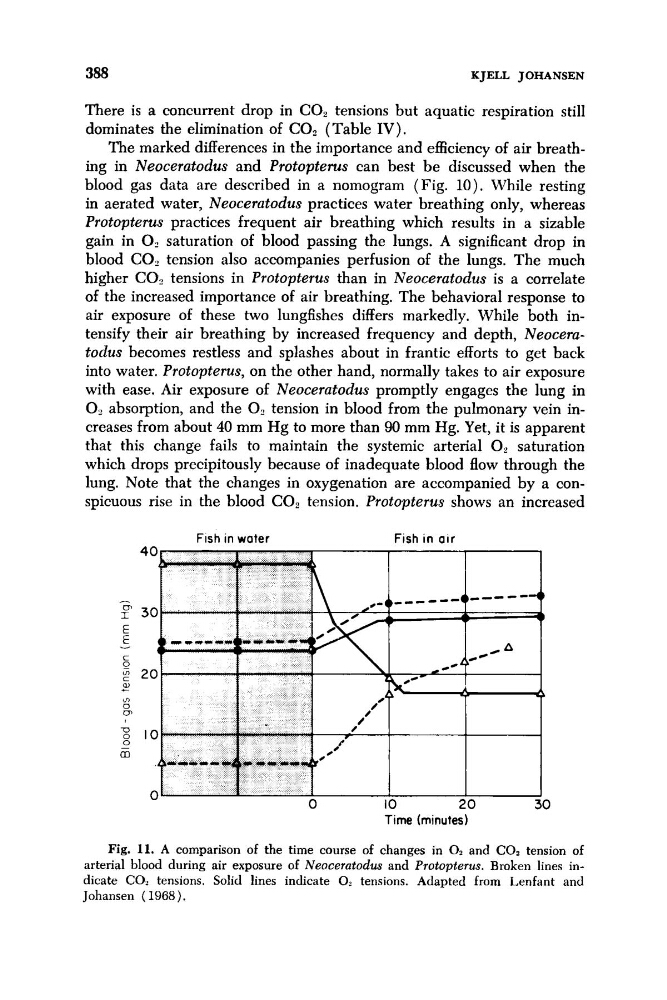
with ease. Air exposure of Neoceratodus promptly engages the lung in
O2 absorption, and the 0, tension in blood from the pulmonary vein increases from about 40 mm Hg to more than 90 mm Hg. Yet, it is apparent
that this change fails to maintain the systemic arterial 0, saturation
which drops precipitously because of inadequate blood 00w through the
lung. Note that the changes in oxygenation are accompanied by a conspicuous rise in the blood CO, tension. Protopterus shows an increased
Fish in water
Fish in air
Time (minutes)
Fig. 11. A comparison of the time course of changes in 0 2 and C 0 2 tension of
arterial blood during air exposure of Neoceratodus and Protopterus. Broken lines indicate COX tensions. Solid lines indicate 0, tensions. Adapted from Lenfant and
Johansen ( 1968).
K JELL JOHANSEN
There is a concurrent drop in CO, tensions but aquatic respiration still
dominates the elimination of C02 (Table IV).
The marked differences in the importance and efficiency of air breathing in Neoceratodus and Protopterus can best be discussed when the
blood gas data are described in a nomogram (Fig. 10). While resting
in aerated water, Neoceratodus practices water breathing only, whereas
Protopterus practices frequent air breathing which results in a sizable
gain in 0, saturation of blood passing the lungs. A significant drop in
blood CO, tension also accompanies perfusion of the lungs. The much
higher CO, tensions in Protopterus than in Neoceratodus is a correlate
of the increased importance of air breathing. The behavioral response to
air exposure of these two lungfishes differs markedly. While both intensify their air breathing by increased frequency and depth, Neoceratodus becomes restless and splashes about in frantic efforts to get back
into water. Protopterus, on the other hand, normally takes to air exposure
with ease. Air exposure of Neoceratodus promptly engages the lung in
O2 absorption, and the 0, tension in blood from the pulmonary vein increases from about 40 mm Hg to more than 90 mm Hg. Yet, it is apparent
that this change fails to maintain the systemic arterial 0, saturation
which drops precipitously because of inadequate blood 00w through the
lung. Note that the changes in oxygenation are accompanied by a conspicuous rise in the blood CO, tension. Protopterus shows an increased
Fish in water
Fish in air
Time (minutes)
Fig. 11. A comparison of the time course of changes in 0 2 and C 0 2 tension of
arterial blood during air exposure of Neoceratodus and Protopterus. Broken lines indicate COX tensions. Solid lines indicate 0, tensions. Adapted from Lenfant and
Johansen ( 1968).