

8. THE REGULATION OF BREATHING
349
being connected to inhibitory fibers running in the cardiac branch of the
vagus. The reason for such a precise relationship, as opposed to a more
general one between bulk flows as outlined above, was thought to be one
of providing synchronization of high flow rates in the two pulsatile systems. The outcome would be a moment-to-moment balance of ventilation
and perfusion and an increase in efficiency of gas exchange. This proposal
was reexamined by Hughes and Shelton (1962) who combined Hughes'
results (196Oa) on ventilation in ScyZiorlzinus with those of Satchell
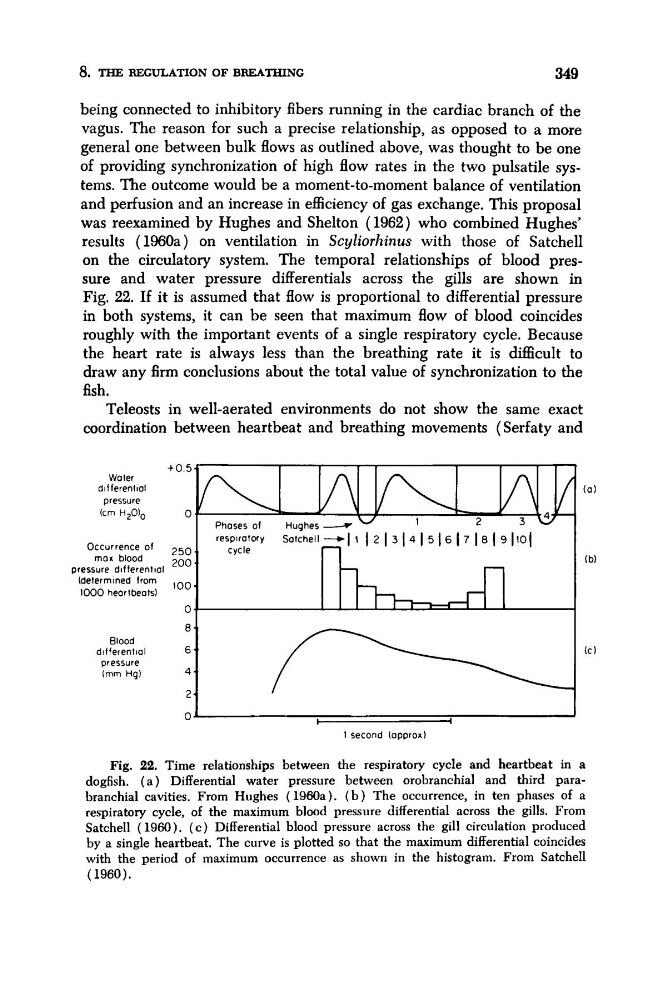
on the circulatory system. The temporal relationships of blood pressure and water pressure differentials across the gills are shown in
Fig. 22. If it is assumed that flow is proportional to differential pressure
in both systems, it can be seen that maximum flow of blood coincides
roughly with the important events of a single respiratory cycle. Because
the heart rate is always less than the breathing rate it is difficult to
draw any firm conclusions about the total value of synchronization to the
fish.
Teleosts in well-aerated environments do not show the same exact
coordination between heartbeat and breathing movements ( Serfaty and
Woler
dif ferenliol
pressure
(cm H,Ol o
Occurrence of
mar blood
pressure differential
(determined from
1000 heorlbeolsl
pressure
/
(mm Hg)
Y
t
I
I second (opprox)
Fig. 22. Time relationships between the respiratory cycle and heartbeat in a
dogfish. ( a ) Differential water pressure between orobranchial and third parabranchial cavities. From Hughes ( 1960a). ( b ) The occurrence, in ten phases of a
respiratory cycle, of the maximum blood pressure differential across the gills. From
Satchell (1960). ( c ) Differential blood pressure across the gill circulation produced
by a single heartbeat, The curve is plotted so that the maximum differential coincides
with the period of maximum occurrence as shown in the histogram. From Satchell
( 1960).
349
being connected to inhibitory fibers running in the cardiac branch of the
vagus. The reason for such a precise relationship, as opposed to a more
general one between bulk flows as outlined above, was thought to be one
of providing synchronization of high flow rates in the two pulsatile systems. The outcome would be a moment-to-moment balance of ventilation
and perfusion and an increase in efficiency of gas exchange. This proposal
was reexamined by Hughes and Shelton (1962) who combined Hughes'
results (196Oa) on ventilation in ScyZiorlzinus with those of Satchell
on the circulatory system. The temporal relationships of blood pressure and water pressure differentials across the gills are shown in
Fig. 22. If it is assumed that flow is proportional to differential pressure
in both systems, it can be seen that maximum flow of blood coincides
roughly with the important events of a single respiratory cycle. Because
the heart rate is always less than the breathing rate it is difficult to
draw any firm conclusions about the total value of synchronization to the
fish.
Teleosts in well-aerated environments do not show the same exact
coordination between heartbeat and breathing movements ( Serfaty and
Woler
dif ferenliol
pressure
(cm H,Ol o
Occurrence of
mar blood
pressure differential
(determined from
1000 heorlbeolsl
pressure
/
(mm Hg)
Y
t
I
I second (opprox)
Fig. 22. Time relationships between the respiratory cycle and heartbeat in a
dogfish. ( a ) Differential water pressure between orobranchial and third parabranchial cavities. From Hughes ( 1960a). ( b ) The occurrence, in ten phases of a
respiratory cycle, of the maximum blood pressure differential across the gills. From
Satchell (1960). ( c ) Differential blood pressure across the gill circulation produced
by a single heartbeat, The curve is plotted so that the maximum differential coincides
with the period of maximum occurrence as shown in the histogram. From Satchell
( 1960).