

348
G. SHELTON
(1964), Rahn (1966), Randall et al. (1967), and Piiper and BaumgartenSchumann (1968a,b). Hughes and Shelton (1962) introduced the concept of capacity-rate ratio in an attempt to quantify some aspects of
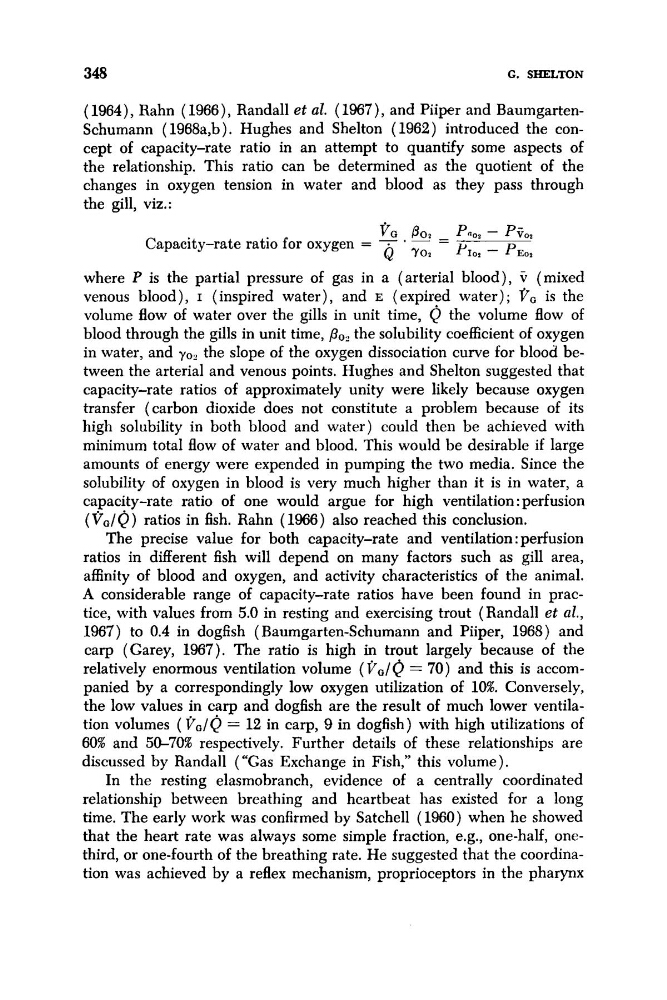
the relationship. This ratio can be determined as the quotient of the
changes in oxygen tension in water and blood as they pass through
the gill, viz.:
where P is the partial pressure of gas in a (arterial blood), V (mixed
venous blood), I (inspired water), and E (expired water); Po is the
volume flow of water over the gills in unit time, Q the volume flow of
blood through the gills in unit time, Po2 the solubility coefficient of oxygen
in water, and yo? the slope of the oxygen dissociation curve for blood between the arterial and venous points. Hughes and Shelton suggested that
capacity-rate ratios of approximately unity were likely because oxygen
transfer (carbon dioxide does not constitute a problem because of its
high solubility in both blood and water) could then be achieved with
minimum total flow of water and blood. This would be desirable if large
amounts of energy were expended in pumping the two media. Since the
solubility of oxygen in blood is very much higher than it is in water, a
capacity-rate ratio of one would argue for high ventilation : perfusion
(vG/Q) ratios in fish. Rahn (1966) also reached this conclusion.
The precise value for both capacity-rate and ventilation : perfusion
ratios in different fish will depend on many factors such as gill area,
affinity of blood and oxygen, and activity characteristics of the animal.
A considerable range of capacity-rate ratios have been found in practice, with values from 5.0 in resting and exercising trout (Randall et al.,
1967) to 0.4 in dogfish ( Baumgarten-Schumann and Piiper, 1968) and
carp (Garey, 1967). The ratio is high in trout largely because of the
relatively enormous ventilation volume ( V G / Q = 70) and this is accompanied by a correspondingly low oxygen utilization of 10%. Conversely,
the low values in carp and dogfish are the result of much lower ventilation volumes ( V G / Q = 12 in carp, 9 in dogfish) with high utilizations of
60% and 50-70% respectively. Further details of these relationships are
discussed by Randall (“Gas Exchange in Fish,” this volume).
In the resting elasmobranch, evidence of a centrally coordinated
relationship between breathing and heartbeat has existed for a long
time. The early work was confirmed by Satchel1 (1960) when he showed
that the heart rate was always some simple fraction, e.g., one-half, onethird, or one-fourth of the breathing rate. He suggested that the coordination was achieved by a reflex mechanism, proprioceptors in the pharynx
G. SHELTON
(1964), Rahn (1966), Randall et al. (1967), and Piiper and BaumgartenSchumann (1968a,b). Hughes and Shelton (1962) introduced the concept of capacity-rate ratio in an attempt to quantify some aspects of
the relationship. This ratio can be determined as the quotient of the
changes in oxygen tension in water and blood as they pass through
the gill, viz.:
where P is the partial pressure of gas in a (arterial blood), V (mixed
venous blood), I (inspired water), and E (expired water); Po is the
volume flow of water over the gills in unit time, Q the volume flow of
blood through the gills in unit time, Po2 the solubility coefficient of oxygen
in water, and yo? the slope of the oxygen dissociation curve for blood between the arterial and venous points. Hughes and Shelton suggested that
capacity-rate ratios of approximately unity were likely because oxygen
transfer (carbon dioxide does not constitute a problem because of its
high solubility in both blood and water) could then be achieved with
minimum total flow of water and blood. This would be desirable if large
amounts of energy were expended in pumping the two media. Since the
solubility of oxygen in blood is very much higher than it is in water, a
capacity-rate ratio of one would argue for high ventilation : perfusion
(vG/Q) ratios in fish. Rahn (1966) also reached this conclusion.
The precise value for both capacity-rate and ventilation : perfusion
ratios in different fish will depend on many factors such as gill area,
affinity of blood and oxygen, and activity characteristics of the animal.
A considerable range of capacity-rate ratios have been found in practice, with values from 5.0 in resting and exercising trout (Randall et al.,
1967) to 0.4 in dogfish ( Baumgarten-Schumann and Piiper, 1968) and
carp (Garey, 1967). The ratio is high in trout largely because of the
relatively enormous ventilation volume ( V G / Q = 70) and this is accompanied by a correspondingly low oxygen utilization of 10%. Conversely,
the low values in carp and dogfish are the result of much lower ventilation volumes ( V G / Q = 12 in carp, 9 in dogfish) with high utilizations of
60% and 50-70% respectively. Further details of these relationships are
discussed by Randall (“Gas Exchange in Fish,” this volume).
In the resting elasmobranch, evidence of a centrally coordinated
relationship between breathing and heartbeat has existed for a long
time. The early work was confirmed by Satchel1 (1960) when he showed
that the heart rate was always some simple fraction, e.g., one-half, onethird, or one-fourth of the breathing rate. He suggested that the coordination was achieved by a reflex mechanism, proprioceptors in the pharynx