

8. THE REGULATION OF BREATHING
335
ventilation and utilization even more complicated. A measure of the
gas exchange capacity of the respiratory surface is given by the transfer
factor which is the constant of proportionality relating total gas exchange and the mean partial pressure gradient between water and
blood. Randall et al. (1967) have shown that the transfer factor in trout
increases gradually during hypoxia, and to a lesser extent during exercise,
so that the gas exchange capacity of the gills must also be increased.
Although utilization is determined by a combination of ventilation
volume and the gas exchange properties of the gills (see chapter by
Randall, “Gas Exchange in Fish,” this volume, for a detailed discussion),
it is so all-embracing as to say little about the details of the exchange.
For example, it takes no account of the role of the bloodstream in gas
exchange. In this respect effectiveness ( E ) , which is the ratio between
actual and maximum possible gas transfer in a countercurrent exchange
system (Hughes and Shelton, 1962), can give a more useful measure.
Effectiveness can be calculated for oxygen with reference to the transfer
either from water or into blood, and similar figures can be obtained for
carbon dioxide moving in the opposite direction (Randall et al., 1967;
Piiper and Baumgarten-Schumann, 1968b ) . The relationship between
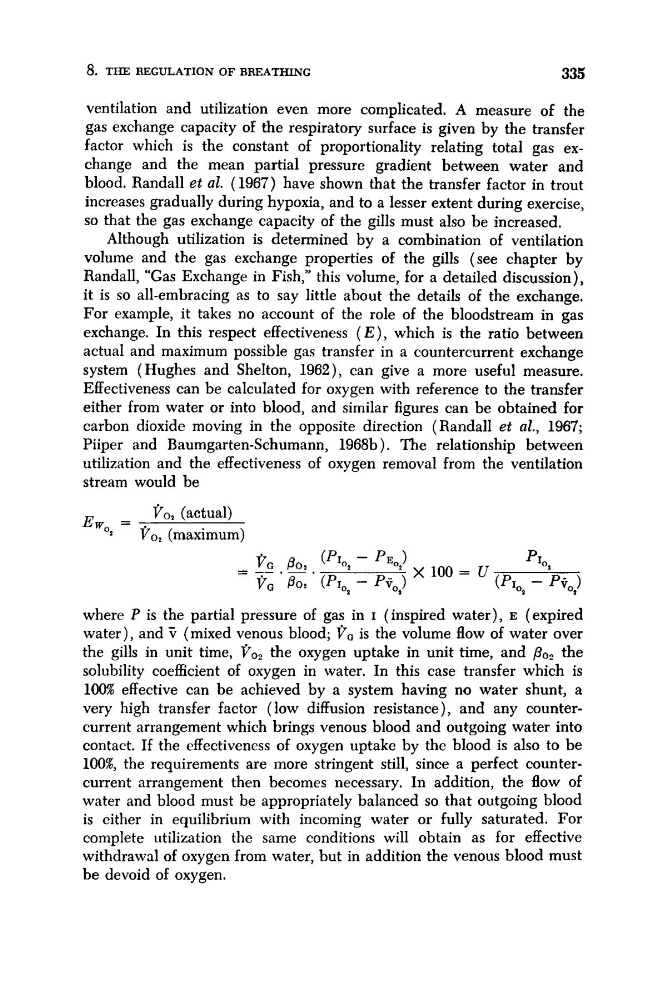
utilization and the effectiveness of oxygen removal from the ventilation
stream would be
Pol (actual)
- -
E w ~ 2
po2 (maximum)
where P is the partial pressure of gas in I (inspired water), E (expired
water), and 7 (mixed venous blood; P, is the volume flow of water over
the gills in unit time, Po2 the oxygen uptake in unit time, and Po2 the
solubility coefficient of oxygen in water. In this case transfer which is
100% effective can be achieved by a system having no water shunt, a
very high transfer factor (low diffusion resistance), and any countercurrent arrangement which brings venous blood and outgoing water into
contact. If the effectiveness of oxygen uptake by the blood is also to be
loo%, the requirements are more stringent still, since a perfect countercurrent arrangement then becomes necessary. In addition, the flow of
water and blood must be appropriately balanced so that outgoing blood
is either in equilibrium with incoming water or fully saturated. For
complete utilization the same conditions will obtain as for effective
withdrawal of oxygen from water, but in addition the venous blood must
be devoid of oxygen.
335
ventilation and utilization even more complicated. A measure of the
gas exchange capacity of the respiratory surface is given by the transfer
factor which is the constant of proportionality relating total gas exchange and the mean partial pressure gradient between water and
blood. Randall et al. (1967) have shown that the transfer factor in trout
increases gradually during hypoxia, and to a lesser extent during exercise,
so that the gas exchange capacity of the gills must also be increased.
Although utilization is determined by a combination of ventilation
volume and the gas exchange properties of the gills (see chapter by
Randall, “Gas Exchange in Fish,” this volume, for a detailed discussion),
it is so all-embracing as to say little about the details of the exchange.
For example, it takes no account of the role of the bloodstream in gas
exchange. In this respect effectiveness ( E ) , which is the ratio between
actual and maximum possible gas transfer in a countercurrent exchange
system (Hughes and Shelton, 1962), can give a more useful measure.
Effectiveness can be calculated for oxygen with reference to the transfer
either from water or into blood, and similar figures can be obtained for
carbon dioxide moving in the opposite direction (Randall et al., 1967;
Piiper and Baumgarten-Schumann, 1968b ) . The relationship between
utilization and the effectiveness of oxygen removal from the ventilation
stream would be
Pol (actual)
- -
E w ~ 2
po2 (maximum)
where P is the partial pressure of gas in I (inspired water), E (expired
water), and 7 (mixed venous blood; P, is the volume flow of water over
the gills in unit time, Po2 the oxygen uptake in unit time, and Po2 the
solubility coefficient of oxygen in water. In this case transfer which is
100% effective can be achieved by a system having no water shunt, a
very high transfer factor (low diffusion resistance), and any countercurrent arrangement which brings venous blood and outgoing water into
contact. If the effectiveness of oxygen uptake by the blood is also to be
loo%, the requirements are more stringent still, since a perfect countercurrent arrangement then becomes necessary. In addition, the flow of
water and blood must be appropriately balanced so that outgoing blood
is either in equilibrium with incoming water or fully saturated. For
complete utilization the same conditions will obtain as for effective
withdrawal of oxygen from water, but in addition the venous blood must
be devoid of oxygen.