

334
G. SHELTON
l00r
I
1000
2000
3000
4000
5000
6000
7000
0'
Ventilotion volume (ml/min/kg)
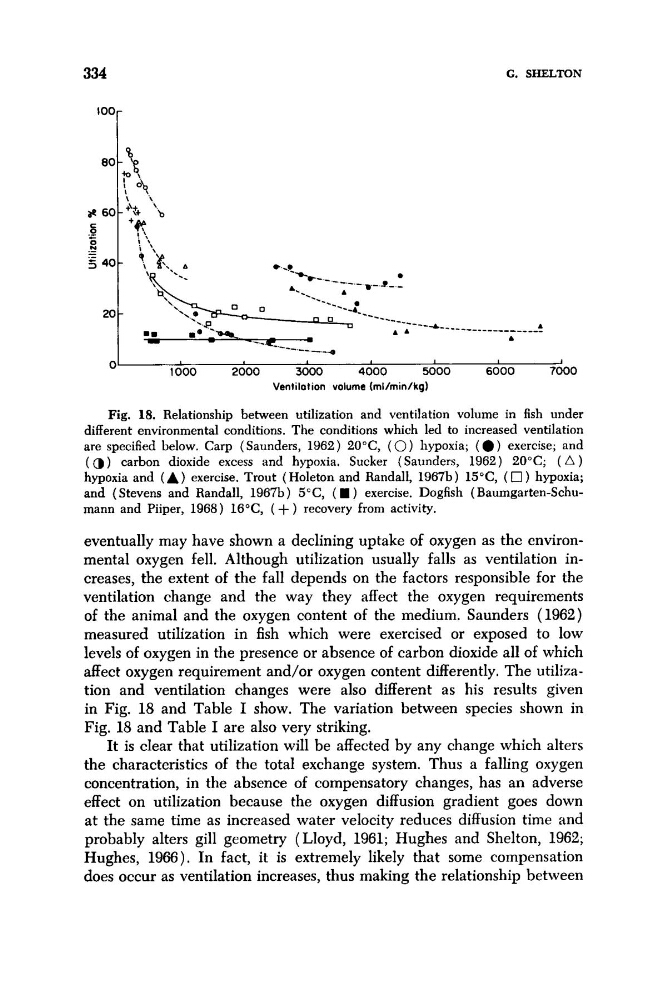
Fig. 18. Relationship between utilization and ventilation volume in fish under
different environmental conditions. The conditions which led to increased ventilation
are specified below. Carp (Saunders, 1962) 20°C, (0) hypoxia; ( 0 ) exercise; and
( a) carbon dioxide excess and hypoxia. Sucker (Saunders, 1962) 20°C; ( A )
hypoxia and (A) exercise. Trout ( Holeton and Randall, 1967b) 15"C, ( 0 ) hypoxia;
and (Stevens and Randall, 1967b) 5"C, ( ) exercise. Dogfish (Baumgarten-Schumann and Piiper, 1968) 16"C, ( + ) recovery from activity.
eventually may have shown a declining uptake of oxygen as the environmental oxygen fell. Although utilization usually falls as ventilation increases, the extent of the fall depends on the factors responsible for the
ventilation change and the way they affect the oxygen requirements
of the animal and the oxygen content of the medium. Saunders (1962)
measured utilization in fish which were exercised or exposed to low
levels of oxygen in the presence or absence of carbon dioxide all of which
affect oxygen requirement and/or oxygen content differently. The utilization and ventilation changes were also different as his results given
in Fig. 18 and Table I show. The variation between species shown in
Fig. 18 and Table I are also very striking.
It is clear that utilization will be affected by any change which alters
the characteristics of the total exchange system. Thus a falling oxygen
concentration, in the absence of compensatory changes, has an adverse
effect on utilization because the oxygen diffusion gradient goes down
at the same time as increased water velocity reduces diffusion time and
probably alters gill geometry (Lloyd, 1961; Hughes and Shelton, 1962;
Hughes, 1966). In fact, it is extremely likely that some compensation
does occur as ventilation increases, thus making the relationship between
G. SHELTON
l00r
I
1000
2000
3000
4000
5000
6000
7000
0'
Ventilotion volume (ml/min/kg)
Fig. 18. Relationship between utilization and ventilation volume in fish under
different environmental conditions. The conditions which led to increased ventilation
are specified below. Carp (Saunders, 1962) 20°C, (0) hypoxia; ( 0 ) exercise; and
( a) carbon dioxide excess and hypoxia. Sucker (Saunders, 1962) 20°C; ( A )
hypoxia and (A) exercise. Trout ( Holeton and Randall, 1967b) 15"C, ( 0 ) hypoxia;
and (Stevens and Randall, 1967b) 5"C, ( ) exercise. Dogfish (Baumgarten-Schumann and Piiper, 1968) 16"C, ( + ) recovery from activity.
eventually may have shown a declining uptake of oxygen as the environmental oxygen fell. Although utilization usually falls as ventilation increases, the extent of the fall depends on the factors responsible for the
ventilation change and the way they affect the oxygen requirements
of the animal and the oxygen content of the medium. Saunders (1962)
measured utilization in fish which were exercised or exposed to low
levels of oxygen in the presence or absence of carbon dioxide all of which
affect oxygen requirement and/or oxygen content differently. The utilization and ventilation changes were also different as his results given
in Fig. 18 and Table I show. The variation between species shown in
Fig. 18 and Table I are also very striking.
It is clear that utilization will be affected by any change which alters
the characteristics of the total exchange system. Thus a falling oxygen
concentration, in the absence of compensatory changes, has an adverse
effect on utilization because the oxygen diffusion gradient goes down
at the same time as increased water velocity reduces diffusion time and
probably alters gill geometry (Lloyd, 1961; Hughes and Shelton, 1962;
Hughes, 1966). In fact, it is extremely likely that some compensation
does occur as ventilation increases, thus making the relationship between