

320
C. SHELTON
suggested that the more caudal regions of the central nervous system
were inessential. The fish center thus appears to extend over a wide
area of the medulla below the cerebellum and facial lobes (Fig. 13).
No recognizable subunits, either anatomical or functional, were located
in the area.
These general conclusions are supported by a number of different investigations in which electrical activity was recorded in the brain of
teleosts (von Baumgarten and Salmoiraghi, 1962; Hukuhara and Okada,
1956; Shelton, 1961; Woldring and Dirken, 1951). All the activity was
recorded from the area outlined above, although the search was often
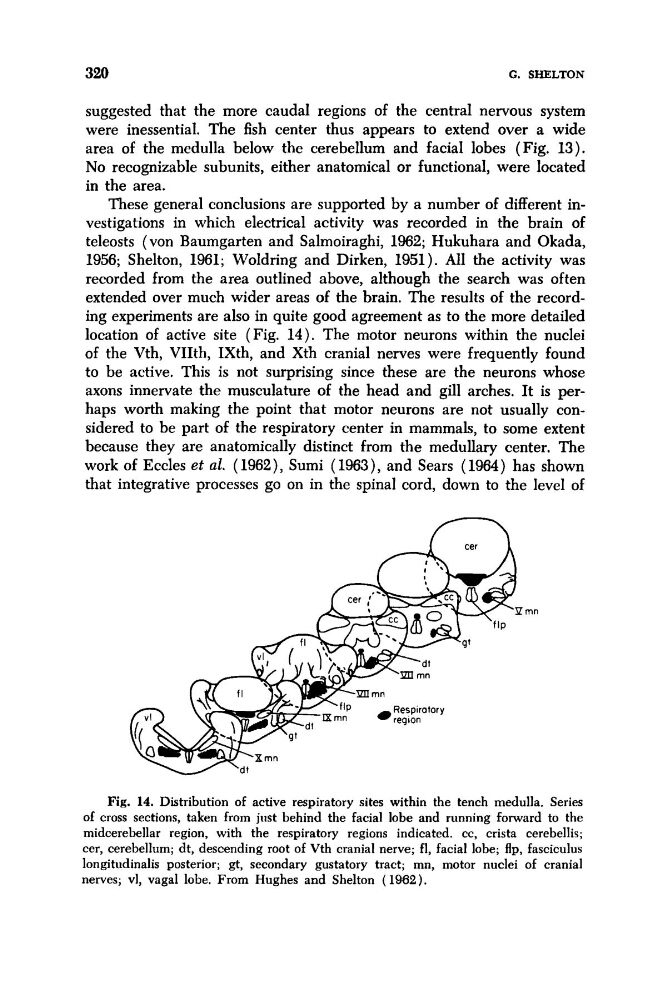
extended over much wider areas of the brain. The results of the recording experiments are also in quite good agreement as to the more detailed
location of active site (Fig. 14). The motor neurons within the nuclei
of the Vth, VIIth, IXth, and Xth cranial nerves were frequently found
to be active. This is not surprising since these are the neurons whose
axons innervate the musculature of the head and gill arches. It is perhaps worth making the point that motor neurons are not usually considered to be part of the respiratory center in mammals, to some extent
because they are anatomically distinct from the medullary center. The
work of Eccles et al. (1962), Sumi (1963), and Sears (1964) has shown
that integrative processes go on in the spinal cord, down to the level of
n
Fig. 14. Distribution of active respiratory sites within the tench medulla. Series
of cross sections, taken from just behind the facial lobe and running forward to the
midcerebellar region, with the respiratory regions indicated. cc, crista cerebellis;
cer, cerebellum; dt, descending root of Vth cranial nerve; fl, facial lobe; flp, fasciculus
longitudinalis posterior; gt, secondary gustatory tract; mn, motor nuclei of cranial
nerves; vl, vagal lobe. From Hughes and Shelton (1962).
C. SHELTON
suggested that the more caudal regions of the central nervous system
were inessential. The fish center thus appears to extend over a wide
area of the medulla below the cerebellum and facial lobes (Fig. 13).
No recognizable subunits, either anatomical or functional, were located
in the area.
These general conclusions are supported by a number of different investigations in which electrical activity was recorded in the brain of
teleosts (von Baumgarten and Salmoiraghi, 1962; Hukuhara and Okada,
1956; Shelton, 1961; Woldring and Dirken, 1951). All the activity was
recorded from the area outlined above, although the search was often
extended over much wider areas of the brain. The results of the recording experiments are also in quite good agreement as to the more detailed
location of active site (Fig. 14). The motor neurons within the nuclei
of the Vth, VIIth, IXth, and Xth cranial nerves were frequently found
to be active. This is not surprising since these are the neurons whose
axons innervate the musculature of the head and gill arches. It is perhaps worth making the point that motor neurons are not usually considered to be part of the respiratory center in mammals, to some extent
because they are anatomically distinct from the medullary center. The
work of Eccles et al. (1962), Sumi (1963), and Sears (1964) has shown
that integrative processes go on in the spinal cord, down to the level of
n
Fig. 14. Distribution of active respiratory sites within the tench medulla. Series
of cross sections, taken from just behind the facial lobe and running forward to the
midcerebellar region, with the respiratory regions indicated. cc, crista cerebellis;
cer, cerebellum; dt, descending root of Vth cranial nerve; fl, facial lobe; flp, fasciculus
longitudinalis posterior; gt, secondary gustatory tract; mn, motor nuclei of cranial
nerves; vl, vagal lobe. From Hughes and Shelton (1962).