

8. THE REGULATION OF BREATHING
319
some and recording from others, should provide more information on
neuron interaction. The practical difficulties are obviously considerable
and interpretation is not easy as studies on the integrative properties of
decapod heart ganglia have shown. Even though the anatomy and physiology of the interconnections in this potentially simple, nine-neuron
group are well established (Hartline, 1967), a complete analysis of the
ganglion's rhythmic activity is not yet possible.
B. The Site and Extension of the Respiratory Center
The teleost medulla is capable of coordinating rhythmic breathing
movements independently of the rest of the brain and spinal cord. In
this respect the respiratory centers of fish and mammals are similar,
since it is usually agreed that in the latter basic control of respiratory
rhythmicity is a property of the medulla. (Wang and Ngai, 1964; Salmoiraghi, 1963). However, in fish, no extramedullary centers have been
identified, although there is, of course, no differentiated pontine region.
Transections immediately in front of the motor nuclei of the Vth and
VIIth cranial nerves did not substantially change the breathing movements of tench ( Shelton, 1959). Similarly, transections through the
posterior parts of the Xth motor nucleus, just behind the facial lobe,
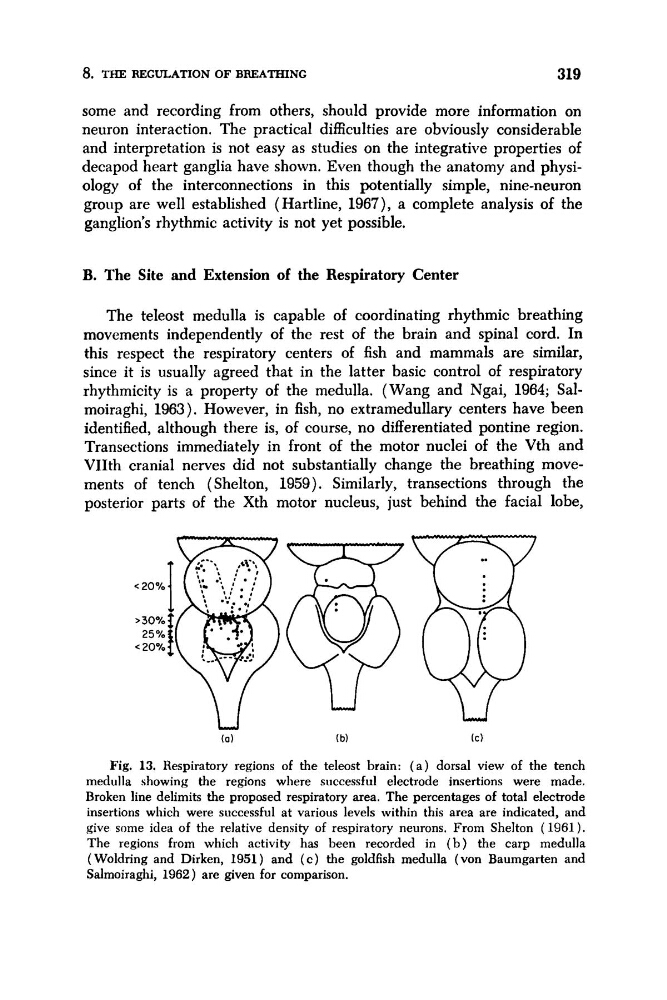
Fig. 13. Respiratory regions of the teleost brain: ( a ) dorsal view of the tench
medulla showing the regions where successful electrode insertions were made.
Broken line delimits the proposed respiratory area. The percentages of total electrode
insertions which were successful at various levels within this area are indicated, and
give some idea of the relative density of respiratory neurons. From Shelton ( 1961 ).
The regions from which activity has been recorded in ( b ) the carp medulla
(Woldring and Dirken, 1951) and ( c ) the goldfish medulla (von Baumgarten and
Salmoiraghi, 1962) are given for comparison.
319
some and recording from others, should provide more information on
neuron interaction. The practical difficulties are obviously considerable
and interpretation is not easy as studies on the integrative properties of
decapod heart ganglia have shown. Even though the anatomy and physiology of the interconnections in this potentially simple, nine-neuron
group are well established (Hartline, 1967), a complete analysis of the
ganglion's rhythmic activity is not yet possible.
B. The Site and Extension of the Respiratory Center
The teleost medulla is capable of coordinating rhythmic breathing
movements independently of the rest of the brain and spinal cord. In
this respect the respiratory centers of fish and mammals are similar,
since it is usually agreed that in the latter basic control of respiratory
rhythmicity is a property of the medulla. (Wang and Ngai, 1964; Salmoiraghi, 1963). However, in fish, no extramedullary centers have been
identified, although there is, of course, no differentiated pontine region.
Transections immediately in front of the motor nuclei of the Vth and
VIIth cranial nerves did not substantially change the breathing movements of tench ( Shelton, 1959). Similarly, transections through the
posterior parts of the Xth motor nucleus, just behind the facial lobe,
Fig. 13. Respiratory regions of the teleost brain: ( a ) dorsal view of the tench
medulla showing the regions where successful electrode insertions were made.
Broken line delimits the proposed respiratory area. The percentages of total electrode
insertions which were successful at various levels within this area are indicated, and
give some idea of the relative density of respiratory neurons. From Shelton ( 1961 ).
The regions from which activity has been recorded in ( b ) the carp medulla
(Woldring and Dirken, 1951) and ( c ) the goldfish medulla (von Baumgarten and
Salmoiraghi, 1962) are given for comparison.