

7. GAS EXCHANGE IN FISH
285
- - Expired w t e r
- -
-
a
-
-
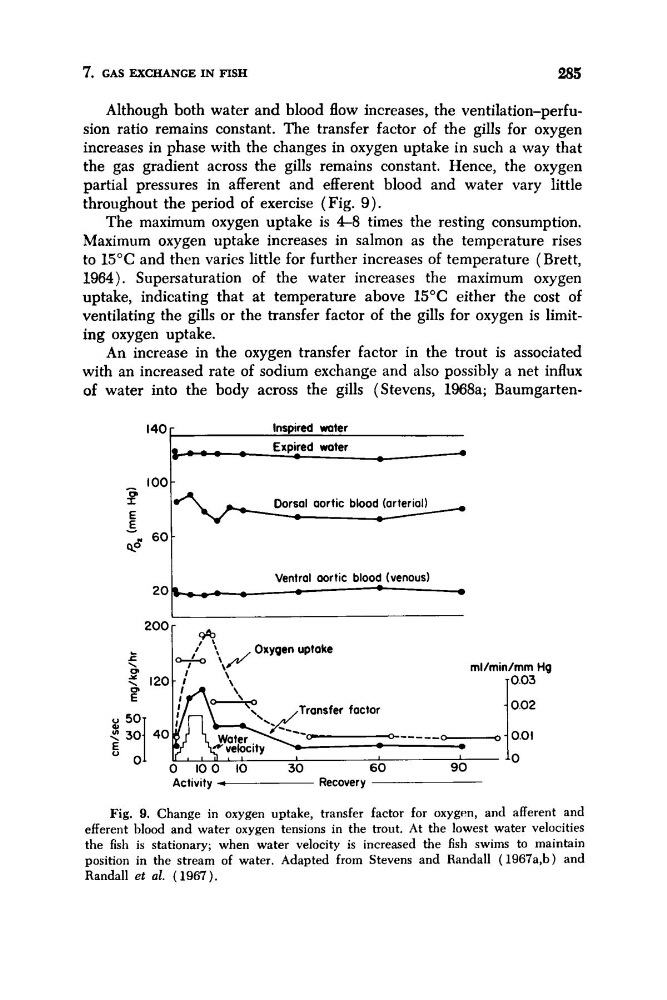
Although both water and blood flow increases, the ventilation-perfusion ratio remains constant. The transfer factor of the gills for oxygen
increases in phase with the changes in oxygen uptake in such a way that
the gas gradient across the gills remains constant. Hence, the oxygen
partial pressures in afferent and efferent blood and water vary little
throughout the period of exercise (Fig. 9).
The maximum oxygen uptake is 4-8 times the resting consumption.
Maximum oxygen uptake increases in salmon as the temperature rises
to 15°C and then varies little for further increases of temperature (Brett,
1964). Supersaturation of the water increases the maximum oxygen
uptake, indicating that at temperature above 15°C either the cost of
ventilating the gills or the transfer factor of the gills for oxygen is limiting oxygen uptake.
An increase in the oxygen transfer factor in the trout is associated
with an increased rate of sodium exchange and also possibly a net influx
of water into the body across the gills (Stevens, 1968a; Baumgarten200
Ventral aortic blood - (venous)
2 0 -
=
-
-
285
- - Expired w t e r
- -
-
a
-
-
Although both water and blood flow increases, the ventilation-perfusion ratio remains constant. The transfer factor of the gills for oxygen
increases in phase with the changes in oxygen uptake in such a way that
the gas gradient across the gills remains constant. Hence, the oxygen
partial pressures in afferent and efferent blood and water vary little
throughout the period of exercise (Fig. 9).
The maximum oxygen uptake is 4-8 times the resting consumption.
Maximum oxygen uptake increases in salmon as the temperature rises
to 15°C and then varies little for further increases of temperature (Brett,
1964). Supersaturation of the water increases the maximum oxygen
uptake, indicating that at temperature above 15°C either the cost of
ventilating the gills or the transfer factor of the gills for oxygen is limiting oxygen uptake.
An increase in the oxygen transfer factor in the trout is associated
with an increased rate of sodium exchange and also possibly a net influx
of water into the body across the gills (Stevens, 1968a; Baumgarten200
Ventral aortic blood - (venous)
2 0 -
=
-
-