

272
I00 -
80 -
-
8 6 0 -
P
.- 8
e
af
-
-
c
c
4020 -
D. J. RAh'DALL
Root effect
Pco, 7-10 mm Hg
I50
0
0
50
I00
F& (mm Hg)
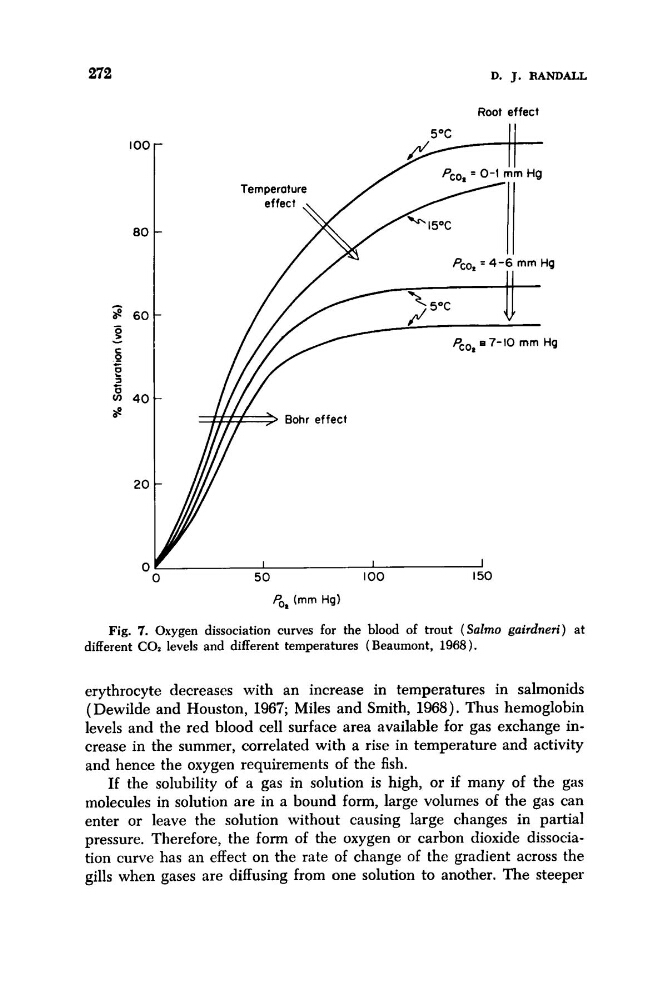
Fig. 7. Oxygen dissociation curves for the blood of trout (Salmo gairdneri) at
different COz levels and different temperatures (Beaumont, 1968).
erythrocyte decreases with an increase in temperatures in salmonids
(Dewilde and Houston, 1967; Miles and Smith, 1968). Thus hemoglobin
levels and the red blood cell surface area available for gas exchange increase in the summer, correlated with a rise in temperature and activity
and hence the oxygen requirements of the fish.
If the solubility of a gas in solution is high, or if many of the gas
molecules in solution are in a bound form, large volumes of the gas can
enter or leave the solution without causing large changes in partial
pressure. Therefore, the form of the oxygen or carbon dioxide dissociation curve has an effect on the rate of change of the gradient across the
gills when gases are diffusing from one solution to another. The steeper
I00 -
80 -
-
8 6 0 -
P
.- 8
e
af
-
-
c
c
4020 -
D. J. RAh'DALL
Root effect
Pco, 7-10 mm Hg
I50
0
0
50
I00
F& (mm Hg)
Fig. 7. Oxygen dissociation curves for the blood of trout (Salmo gairdneri) at
different COz levels and different temperatures (Beaumont, 1968).
erythrocyte decreases with an increase in temperatures in salmonids
(Dewilde and Houston, 1967; Miles and Smith, 1968). Thus hemoglobin
levels and the red blood cell surface area available for gas exchange increase in the summer, correlated with a rise in temperature and activity
and hence the oxygen requirements of the fish.
If the solubility of a gas in solution is high, or if many of the gas
molecules in solution are in a bound form, large volumes of the gas can
enter or leave the solution without causing large changes in partial
pressure. Therefore, the form of the oxygen or carbon dioxide dissociation curve has an effect on the rate of change of the gradient across the
gills when gases are diffusing from one solution to another. The steeper