

234
AUSTEN RIGGS
I .5
I .a
t
05
I> 1
'
: -
m
3 0
I
- 0.5
- I .o
7 pH=8.72
t
0
0.5
1. 0
1.5
Log P
-
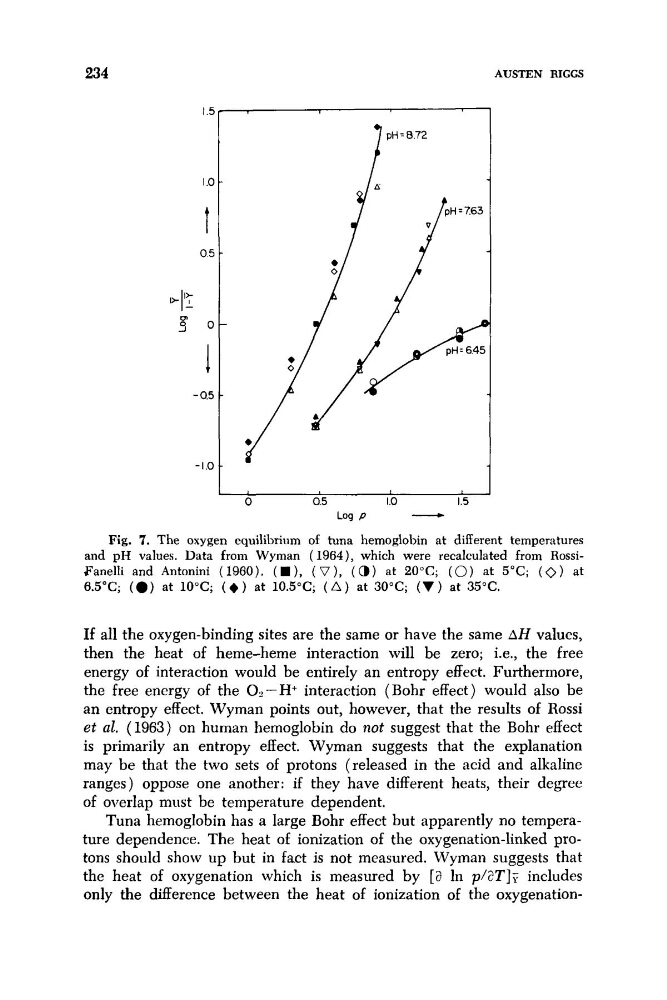
Fig. 7. The oxygen equilibrium of tuna hemoglobin at different temperatures
and pH values. Data from Wyman (1964), which were recalculated from RossiFanelli and Antonini (1960). ( U ) , ( O), ( 0 ) at 20°C; ( 0 ) at 5°C; ( 0 ) at
6.5"C; ( 0 ) at 10°C; ( + ) at 10.5"C; ( A ) at 30°C; ( V ) at 35°C.
If all the oxygen-binding sites are the same or have the same AH values,
then the heat of heme-heme interaction will be zero; i.e., the free
energy of interaction would be entirely an entropy effect. Furthermore,
the free energy of the 0,-H' interaction (Bohr effect) would also be
an entropy effect. Wyman points out, however, that the results of Rossi
et al. (1963) on human hemoglobin do not suggest that the Bohr effect
is primarily an entropy effect. Wyman suggests that the explanation
may be that the two sets of protons (released in the acid and alkaline
ranges) oppose one another: if they have different heats, their degree
of overlap must be temperature dependent.
Tuna hemoglobin has a large Bohr effect but apparently no temperature dependence. The heat of ionization of the oxygenation-linked protons should show up but in fact is not measured. Wyman suggests that
the heat of oxygenation which is measured by [a In p / a T ] , includes
only the difference between the heat of ionization of the oxygenation-
AUSTEN RIGGS
I .5
I .a
t
05
I> 1
'
: -
m
3 0
I
- 0.5
- I .o
7 pH=8.72
t
0
0.5
1. 0
1.5
Log P
-
Fig. 7. The oxygen equilibrium of tuna hemoglobin at different temperatures
and pH values. Data from Wyman (1964), which were recalculated from RossiFanelli and Antonini (1960). ( U ) , ( O), ( 0 ) at 20°C; ( 0 ) at 5°C; ( 0 ) at
6.5"C; ( 0 ) at 10°C; ( + ) at 10.5"C; ( A ) at 30°C; ( V ) at 35°C.
If all the oxygen-binding sites are the same or have the same AH values,
then the heat of heme-heme interaction will be zero; i.e., the free
energy of interaction would be entirely an entropy effect. Furthermore,
the free energy of the 0,-H' interaction (Bohr effect) would also be
an entropy effect. Wyman points out, however, that the results of Rossi
et al. (1963) on human hemoglobin do not suggest that the Bohr effect
is primarily an entropy effect. Wyman suggests that the explanation
may be that the two sets of protons (released in the acid and alkaline
ranges) oppose one another: if they have different heats, their degree
of overlap must be temperature dependent.
Tuna hemoglobin has a large Bohr effect but apparently no temperature dependence. The heat of ionization of the oxygenation-linked protons should show up but in fact is not measured. Wyman suggests that
the heat of oxygenation which is measured by [a In p / a T ] , includes
only the difference between the heat of ionization of the oxygenation-