

232
AUSTEN RIGGS
IUV
75
50
25
Y
-
-
-
-
I
1
I
0’-i
0
I
2
3
Po2
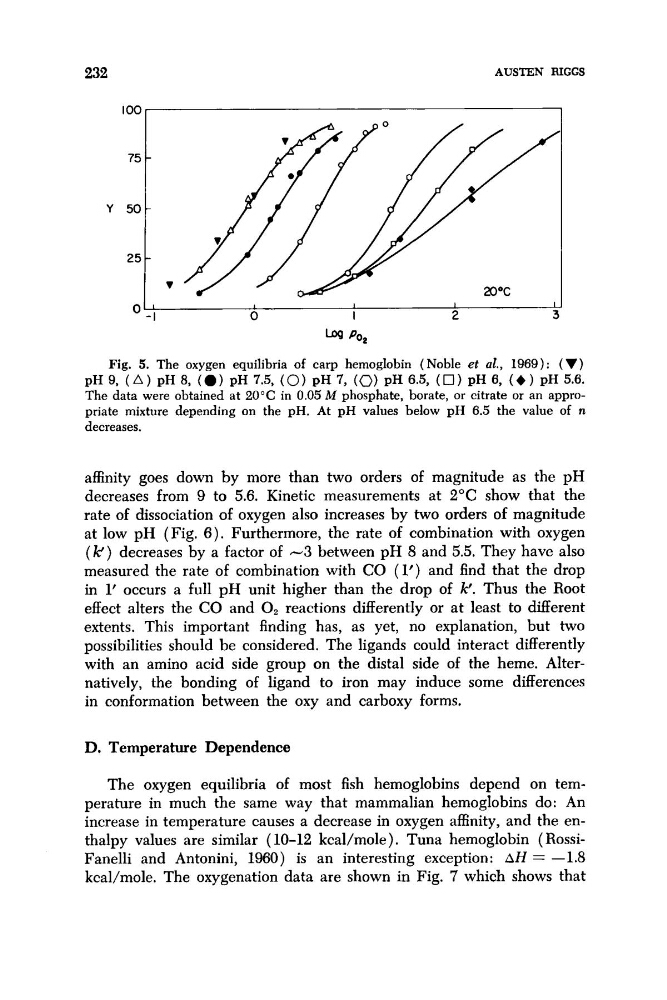
Fig. 5. The oxygen equilibria of carp hemoglobin (Noble et al., 1969): (V)
The data were obtained at 20°C in 0.05 M phosphate, borate, or citrate or an appropriate mixture depending on the pH. At pH values below pH 6.5 the value of n
decreases.
PH 9, ( A 1 PH 8, ( 0 ) PH 7.5, (0) PH 7, (0) PH 6.5, ( 0 ) PH 6, ( + ) PH 5.6.
affinity goes down by more than two orders of magnitude as the pH
decreases from 9 to 5.6. Kinetic measurements at 2°C show that the
rate of dissociation of oxygen also increases by two orders of magnitude
at low pH (Fig. 6 ) . Furthermore, the rate of combination with oxygen
(k’) decreases by a factor of ~3 between pH 8 and 5.5. They have also
measured the rate of combination with CO (1’) and find that the drop
in 1’ occurs a full pH unit higher than the drop of k’. Thus the Root
effect alters the CO and 0, reactions differently or at least to different
extents. This important finding has, as yet, no explanation, but two
possibilities should be considered. The ligands could interact differently
with an amino acid side group on the distal side of the heme. Alternatively, the bonding of ligand to iron may induce some differences
in conformation between the oxy and carboxy forms.
D. Temperature Dependence
The oxygen equilibria of most fish hemoglobins depend on temperature in much the same way that mammalian hemoglobins do: An
increase in temperature causes a decrease in oxygen affinity, and the enthalpy values are similar ( 10-12 kcal/mole ). Tuna hemoglobin ( RossiFanelli and Antonini, 1960) is an interesting exception: AH = -1.8
kcal/mole. The oxygenation data are shown in Fig. 7 which shows that
AUSTEN RIGGS
IUV
75
50
25
Y
-
-
-
-
I
1
I
0’-i
0
I
2
3
Po2
Fig. 5. The oxygen equilibria of carp hemoglobin (Noble et al., 1969): (V)
The data were obtained at 20°C in 0.05 M phosphate, borate, or citrate or an appropriate mixture depending on the pH. At pH values below pH 6.5 the value of n
decreases.
PH 9, ( A 1 PH 8, ( 0 ) PH 7.5, (0) PH 7, (0) PH 6.5, ( 0 ) PH 6, ( + ) PH 5.6.
affinity goes down by more than two orders of magnitude as the pH
decreases from 9 to 5.6. Kinetic measurements at 2°C show that the
rate of dissociation of oxygen also increases by two orders of magnitude
at low pH (Fig. 6 ) . Furthermore, the rate of combination with oxygen
(k’) decreases by a factor of ~3 between pH 8 and 5.5. They have also
measured the rate of combination with CO (1’) and find that the drop
in 1’ occurs a full pH unit higher than the drop of k’. Thus the Root
effect alters the CO and 0, reactions differently or at least to different
extents. This important finding has, as yet, no explanation, but two
possibilities should be considered. The ligands could interact differently
with an amino acid side group on the distal side of the heme. Alternatively, the bonding of ligand to iron may induce some differences
in conformation between the oxy and carboxy forms.
D. Temperature Dependence
The oxygen equilibria of most fish hemoglobins depend on temperature in much the same way that mammalian hemoglobins do: An
increase in temperature causes a decrease in oxygen affinity, and the enthalpy values are similar ( 10-12 kcal/mole ). Tuna hemoglobin ( RossiFanelli and Antonini, 1960) is an interesting exception: AH = -1.8
kcal/mole. The oxygenation data are shown in Fig. 7 which shows that