

6. PROPERTIES OF FISH HEMOGLOBINS
219
E helix" so that the distal heme-linked histidine occurs at exactly the
same position in each chain. This is important because the bound oxygen
molecule occupies the position between the heme iron and residue
number 58. The glycine deletion at position 57 puts all the critical
residues on the distal side of the heme in the sequence 55-62 in
register for both human and carp (Y chains. The other heme-linked
histidine is at position 87. A comparison of the homologous sequences
in this region ( F helix) shows that very little difference exists (see
Fig. 3 ) . The segment of the F helix in the neighborhood of the heme
iron is remarkably similar in both human and carp (Y chains.
The other most critical regions of the hemoglobin molecule are
at the points of contact between the a and p subunits. The residues in
horse and human hemoglobin which make these contacts have been
determined by Perutz et al. (1968) from the results of their X-ray
diffraction analysis. An a chain makes two different p-chain contacts
which are designated alpz and alpt. Dissociation into dimers is believed to involve cleavage primarily of the a,p2 bonds, but both contacts
are probably necessary for the cooperative interactions observed in the
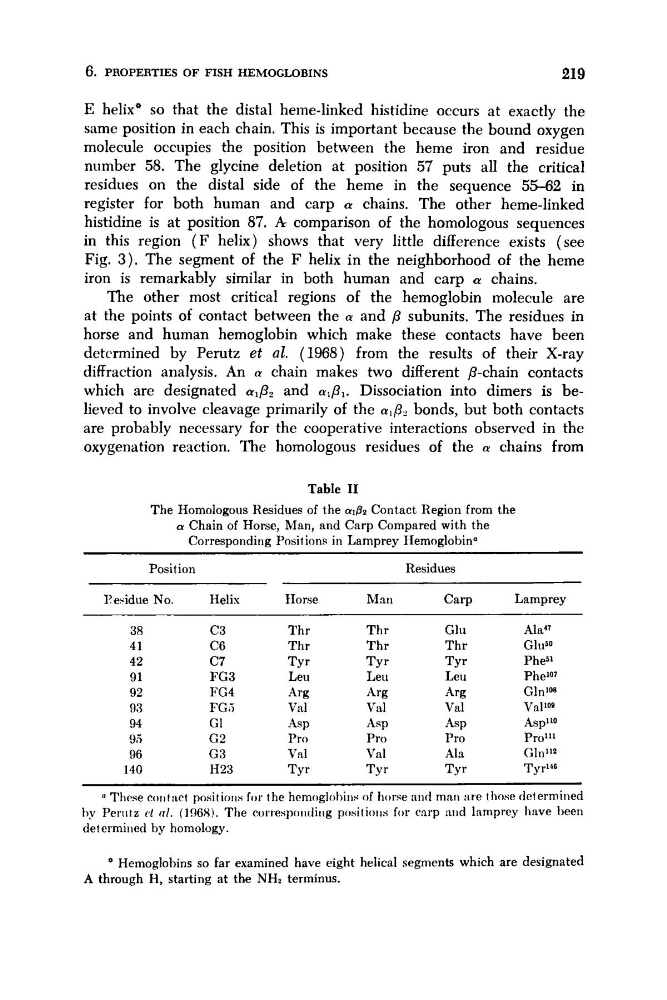
oxygenation reaction. The homologous residues of the a chains from
Table I1
The Homologous Residues of the CY$Z Contact Region from the
CY Chain of Horse, Man, and Carp Compared with the
Corresponding Positions i n Lamprey Hemoglobin"
Position
Residues
Rexidue No.
Helix
Horse
Man
Carp
Lamprey
38
41
42
91
92
93
94
95
96
140
c 3
C6
c7
FG3
FG4
FG,j
GI
G2
G3
H23
Thr
Th r
TY r
Leu
Arg
Val
ASP
Pro
Vnl
TY r
Thr
Thr
TY I .
Leu
Arg
Val
Asp
Pro
Val
TY r
Glu
Thr
TYr
Leu
Arg
Val
Asp
Pro
A h
TY r
~~
~~~~
~
These roritwt positions for the hemoglol,itis of horse and man :ire those tletermiried
by Pertitz d nl. (1968). The correspoiitling positioiis for carp :ind lamprey have been
determined by homology.
' Hemoglobins so far examined have eight helical segments which are designated
A through H, starting at the NH2 terminus.
219
E helix" so that the distal heme-linked histidine occurs at exactly the
same position in each chain. This is important because the bound oxygen
molecule occupies the position between the heme iron and residue
number 58. The glycine deletion at position 57 puts all the critical
residues on the distal side of the heme in the sequence 55-62 in
register for both human and carp (Y chains. The other heme-linked
histidine is at position 87. A comparison of the homologous sequences
in this region ( F helix) shows that very little difference exists (see
Fig. 3 ) . The segment of the F helix in the neighborhood of the heme
iron is remarkably similar in both human and carp (Y chains.
The other most critical regions of the hemoglobin molecule are
at the points of contact between the a and p subunits. The residues in
horse and human hemoglobin which make these contacts have been
determined by Perutz et al. (1968) from the results of their X-ray
diffraction analysis. An a chain makes two different p-chain contacts
which are designated alpz and alpt. Dissociation into dimers is believed to involve cleavage primarily of the a,p2 bonds, but both contacts
are probably necessary for the cooperative interactions observed in the
oxygenation reaction. The homologous residues of the a chains from
Table I1
The Homologous Residues of the CY$Z Contact Region from the
CY Chain of Horse, Man, and Carp Compared with the
Corresponding Positions i n Lamprey Hemoglobin"
Position
Residues
Rexidue No.
Helix
Horse
Man
Carp
Lamprey
38
41
42
91
92
93
94
95
96
140
c 3
C6
c7
FG3
FG4
FG,j
GI
G2
G3
H23
Thr
Th r
TY r
Leu
Arg
Val
ASP
Pro
Vnl
TY r
Thr
Thr
TY I .
Leu
Arg
Val
Asp
Pro
Val
TY r
Glu
Thr
TYr
Leu
Arg
Val
Asp
Pro
A h
TY r
~~
~~~~
~
These roritwt positions for the hemoglol,itis of horse and man :ire those tletermiried
by Pertitz d nl. (1968). The correspoiitling positioiis for carp :ind lamprey have been
determined by homology.
' Hemoglobins so far examined have eight helical segments which are designated
A through H, starting at the NH2 terminus.