

218
AUSTEN RIGGS
Residue No.
Human
Carp
Residue No.
Human
Carp
Residue No.
Human
Carp
42
43
44
4 S
46
47
48
49
Tyr
Phe
Pro
His
Hie
Asp
Leu
Ser
Tyr
I’he
Ala
His
Tryp
Xsp
Leu
Ser
\ /
Ala
54
55
56
57
58 59 60
61
6% 63
64
6.5
Gln Val Lys Gly His Gly Lys Lys Val A h
Abp Aln
Pro Val Lys - His Gly Lys Lys Val Ileu
Gly A h
\
/
Met
79 80 81 82 83 84 8.5 86 87 88 89 90 91 n3
.%la Leu Ser Ala Leu Ser Asp Lei1 His Ala His Lys Lei1 .lrg
Gly Leu Ala Ser Leu Ser Glu Lei1 His Ala Ser Lys Leu Arg
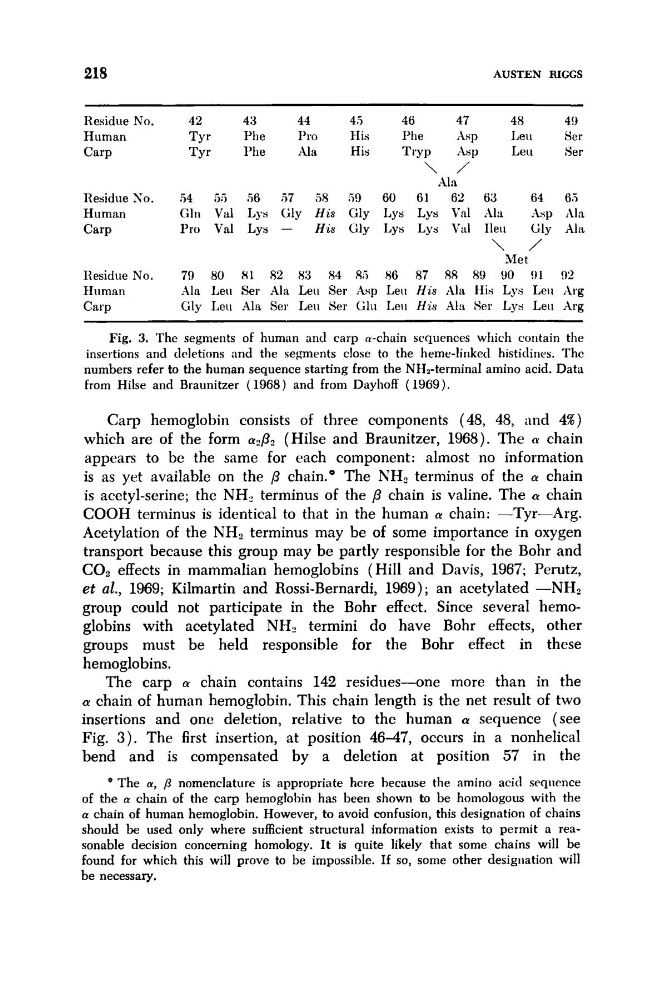
Fig. 3. The segments of human and carp a-chain sequences which contain the
insertions and deletions and the segments close to the heme-linked histidines. Thc
numbers refer to the human sequence starting from the NHz-terminal amino acid. Data
from Hike and Braunitzer ( 1968) and from DayhoR ( 1969).
Carp hemoglobin consists of three components (48, 48, and 4%)
which are of the form (Y& (Hilse and Braunitzer, 1968). The (Y chain
appears to be the same for each component: almost no information
is as yet available on the / 3 chain.* The NH2 terminus of the (Y chain
is acetyl-serine; the NH, terminus of the p chain is valine. The (Y chain
COOH terminus is identical to that in the human (Y chain: -Tyr-Arg.
Acetylation of the NH, terminus may be of some importance in oxygen
transport because this group may be partly responsible for the Bohr and
CO, effects in mammalian hemoglobins (Hill and Davis, 1967; Perutz,
et al., 1969; Kilmartin and Rossi-Bernardi, 1969); an acetylated -NH,
group could not participate in the Bohr effect. Since several hemoglobins with acetylated NH, termini do have Bohr effects, other
groups must be held responsible for the Bohr effect in these
hemoglobins.
The carp LY chain contains 142 residues-one more than in the
CY chain of human hemoglobin. This chain length is the net result of two
insertions and one deletion, relative to the human LY sequence (see
Fig. 3 ) . The first insertion, at position 46-47, occurs in a nonhelical
bend and is compensated by a deletion at position 57 in the
The a, p nomenclature is appropriate here because the amino acid sequence
of the a chain of the carp hemoglobin has been shown to be homologous with the
a chain of human hemoglobin. However, to avoid confusion, this designation of chains
should be used only where sufficient structural information exists to permit a reasonable decision concerning homology. It is quite likely that some chains will be
found for which this will prove to be impossible. If so, some other designation will
be necessary.
AUSTEN RIGGS
Residue No.
Human
Carp
Residue No.
Human
Carp
Residue No.
Human
Carp
42
43
44
4 S
46
47
48
49
Tyr
Phe
Pro
His
Hie
Asp
Leu
Ser
Tyr
I’he
Ala
His
Tryp
Xsp
Leu
Ser
\ /
Ala
54
55
56
57
58 59 60
61
6% 63
64
6.5
Gln Val Lys Gly His Gly Lys Lys Val A h
Abp Aln
Pro Val Lys - His Gly Lys Lys Val Ileu
Gly A h
\
/
Met
79 80 81 82 83 84 8.5 86 87 88 89 90 91 n3
.%la Leu Ser Ala Leu Ser Asp Lei1 His Ala His Lys Lei1 .lrg
Gly Leu Ala Ser Leu Ser Glu Lei1 His Ala Ser Lys Leu Arg
Fig. 3. The segments of human and carp a-chain sequences which contain the
insertions and deletions and the segments close to the heme-linked histidines. Thc
numbers refer to the human sequence starting from the NHz-terminal amino acid. Data
from Hike and Braunitzer ( 1968) and from DayhoR ( 1969).
Carp hemoglobin consists of three components (48, 48, and 4%)
which are of the form (Y& (Hilse and Braunitzer, 1968). The (Y chain
appears to be the same for each component: almost no information
is as yet available on the / 3 chain.* The NH2 terminus of the (Y chain
is acetyl-serine; the NH, terminus of the p chain is valine. The (Y chain
COOH terminus is identical to that in the human (Y chain: -Tyr-Arg.
Acetylation of the NH, terminus may be of some importance in oxygen
transport because this group may be partly responsible for the Bohr and
CO, effects in mammalian hemoglobins (Hill and Davis, 1967; Perutz,
et al., 1969; Kilmartin and Rossi-Bernardi, 1969); an acetylated -NH,
group could not participate in the Bohr effect. Since several hemoglobins with acetylated NH, termini do have Bohr effects, other
groups must be held responsible for the Bohr effect in these
hemoglobins.
The carp LY chain contains 142 residues-one more than in the
CY chain of human hemoglobin. This chain length is the net result of two
insertions and one deletion, relative to the human LY sequence (see
Fig. 3 ) . The first insertion, at position 46-47, occurs in a nonhelical
bend and is compensated by a deletion at position 57 in the
The a, p nomenclature is appropriate here because the amino acid sequence
of the a chain of the carp hemoglobin has been shown to be homologous with the
a chain of human hemoglobin. However, to avoid confusion, this designation of chains
should be used only where sufficient structural information exists to permit a reasonable decision concerning homology. It is quite likely that some chains will be
found for which this will prove to be impossible. If so, some other designation will
be necessary.