

212
AUSTEN RICGS
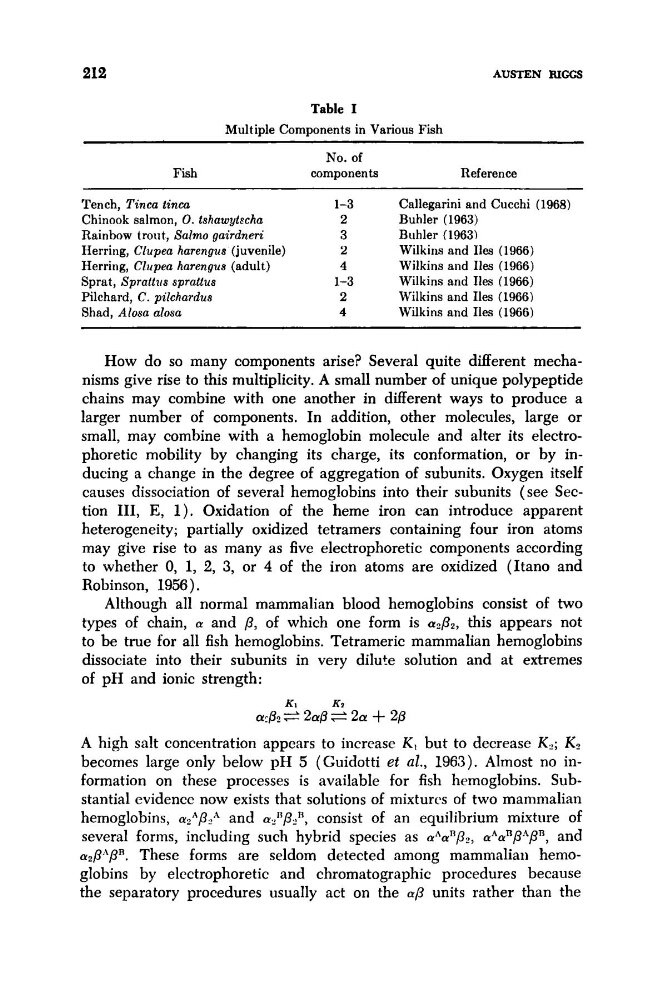
Table I
Multiple Components in Various Fish
Fish
No. of
components
Reference
Tench, Tinca tincu
Chinook salmon, 0. tshawylecha
Rainbow trout, Salmo gairdneri
Herring, Clupea harengus (juvenile)
Herring, Clupea harengus (adult)
Sprat, Sprattzrs sprattus
Pilchard, C . pilchardus
Shad, Alosa alosa
1-3
2
3
2
4
1-3
2
4
Callegarini and Cucchi (1968)
Buhler (1963)
Buhler (1963)
Wilkiris and Iles (1966)
Wilkins and Iles (1966)
Wilkins and Iles (1966)
Wilkins and Iles (1966)
Wilkins and Iles (1966)
How do so many components arise? Several quite different mechanisms give rise to this multiplicity. A small number of unique polypeptide
chains may combine with one another in different ways to produce a
larger number of components. In addition, other molecules, large or
small, may combine with a hemoglobin molecule and alter its electrophoretic mobility by changing its charge, its conformation, or by inducing a change in the degree of aggregation of subunits. Oxygen itself
causes dissociation of several hemoglobins into their subunits (see Section 111, E, 1 ) . Oxidation of the heme iron can introduce apparent
heterogeneity; partially oxidized tetramers containing four iron atoms
may give rise to as many as five electrophoretic components according
to whether 0, 1, 2, 3, or 4 of the iron atoms are oxidized (Itano and
Robinson, 1956).
Although all normal mammalian blood hemoglobins consist of two
types of chain, (Y and p, of which one form is a&, this appears not
to be true for all fish hemoglobins. Tetrameric mammalian hemoglobins
dissociate into their subunits in very dilute solution and at extremes
of pH and ionic strength:
A high salt concentration appears to increase K , but to decrease K,; K3
becomes large only below pH 5 (Guidotti et al., 1963). Almost no information on these processes is available for fish hemoglobins. Substantial evidence now exists that solutions of mixturrs of two mammalian
hemoglobins, aZAp2,' and axn&", consist of an equilibrium mixture of
several forms, including such hybrid species as aAaBp2, aAan/3*PR, and
a2P.'PR. These forms are seldom detected among mammaliaii hemoglobins by electrophoretic and chromatographic procedures because
the separatory procedures usually act on the
units rather than the
AUSTEN RICGS
Table I
Multiple Components in Various Fish
Fish
No. of
components
Reference
Tench, Tinca tincu
Chinook salmon, 0. tshawylecha
Rainbow trout, Salmo gairdneri
Herring, Clupea harengus (juvenile)
Herring, Clupea harengus (adult)
Sprat, Sprattzrs sprattus
Pilchard, C . pilchardus
Shad, Alosa alosa
1-3
2
3
2
4
1-3
2
4
Callegarini and Cucchi (1968)
Buhler (1963)
Buhler (1963)
Wilkiris and Iles (1966)
Wilkins and Iles (1966)
Wilkins and Iles (1966)
Wilkins and Iles (1966)
Wilkins and Iles (1966)
How do so many components arise? Several quite different mechanisms give rise to this multiplicity. A small number of unique polypeptide
chains may combine with one another in different ways to produce a
larger number of components. In addition, other molecules, large or
small, may combine with a hemoglobin molecule and alter its electrophoretic mobility by changing its charge, its conformation, or by inducing a change in the degree of aggregation of subunits. Oxygen itself
causes dissociation of several hemoglobins into their subunits (see Section 111, E, 1 ) . Oxidation of the heme iron can introduce apparent
heterogeneity; partially oxidized tetramers containing four iron atoms
may give rise to as many as five electrophoretic components according
to whether 0, 1, 2, 3, or 4 of the iron atoms are oxidized (Itano and
Robinson, 1956).
Although all normal mammalian blood hemoglobins consist of two
types of chain, (Y and p, of which one form is a&, this appears not
to be true for all fish hemoglobins. Tetrameric mammalian hemoglobins
dissociate into their subunits in very dilute solution and at extremes
of pH and ionic strength:
A high salt concentration appears to increase K , but to decrease K,; K3
becomes large only below pH 5 (Guidotti et al., 1963). Almost no information on these processes is available for fish hemoglobins. Substantial evidence now exists that solutions of mixturrs of two mammalian
hemoglobins, aZAp2,' and axn&", consist of an equilibrium mixture of
several forms, including such hybrid species as aAaBp2, aAan/3*PR, and
a2P.'PR. These forms are seldom detected among mammaliaii hemoglobins by electrophoretic and chromatographic procedures because
the separatory procedures usually act on the
units rather than the