

5. ACID-BASE BALANCE
191
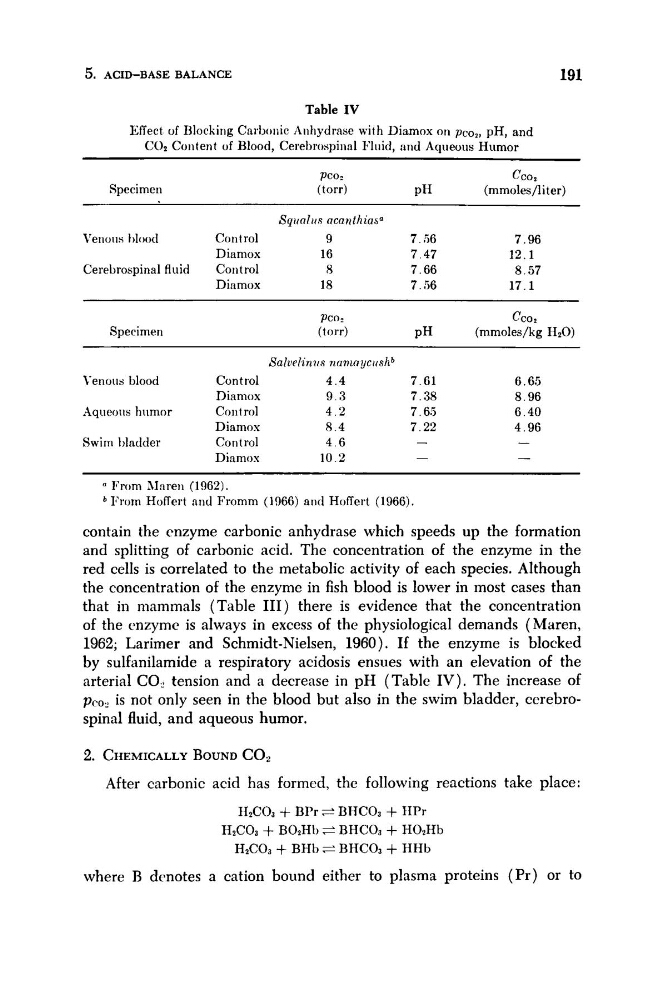
Table IV
Effect of Blocking Carbonic Auhydrase with Diamox on pco2, pH, and
Con Content of Blood, Cerebrospinal l+tid, and Aqueous Humor
P C O :
cco2
Specimen
(torr)
PH
(mmoles/li ter)
Sqirolirs ocanthias"
Venous t)lood
Control
9
7 56
7.96
Cerebrospinal fluid
Control
8
7 . 6 6
8 57
Diamox
16
7 47
12.1
Diamox
18
7 . 5 6
17.1
Pcn?
cco2
Specimen
(torr)
PH
(mmoles/kg H20)
Salvelinirs nanioycirshb
Venous blood
Control
4 . 4
7 . 6 1
6 . 6 5
Diamox
9 . 3
7 . 3 8
8 . 9 6
Aqueoris hrimor
Control
4 . 2
7.65
6 . 4 0
Diamox
8 . 4
7 . 2 2
4 . 9 6
Swim bladder
Control
4 6
Diamox
10 2
-
-
-
-
From RIaren (1962).
* Iprom HotTert nrid Fromm (1966) and Hoffert (1966).
contain the enzyme carbonic anhydrase which speeds up the formation
and splitting of carbonic acid. The concentration of the enzyme in the
red cells is correlated to the metabolic activity of each species. Although
the concentration of the enzyme in fish blood is lower in most cases than
that in mammals (Table 111) there is evidence that the concentration
of the enzyme is always in excess of the physiological demands (Maren,
1962; Larimer and Schmidt-Nielsen, 1960). If the enzyme is blocked
by sulfanilamide a respiratory acidosis ensues with an elevation of the
arterial CO, tension and a decrease in pH (Table IV). The increase of
pco, is not only seen in the blood but also in the swim bladder, cerebrospinal fluid, and aqueous humor.
2. CHEMICALLY BOUND CO,
After carbonic acid has formed, the following reactions take place:
H2C03 + BPr BIIC03 + IIPr
H2C03 + BOrHb e BHCO3 + HOzHb
H2COj + BHb e BHCO, + HHb
where B denotes a cation bound either to plasma proteins ( P r ) or to
191
Table IV
Effect of Blocking Carbonic Auhydrase with Diamox on pco2, pH, and
Con Content of Blood, Cerebrospinal l+tid, and Aqueous Humor
P C O :
cco2
Specimen
(torr)
PH
(mmoles/li ter)
Sqirolirs ocanthias"
Venous t)lood
Control
9
7 56
7.96
Cerebrospinal fluid
Control
8
7 . 6 6
8 57
Diamox
16
7 47
12.1
Diamox
18
7 . 5 6
17.1
Pcn?
cco2
Specimen
(torr)
PH
(mmoles/kg H20)
Salvelinirs nanioycirshb
Venous blood
Control
4 . 4
7 . 6 1
6 . 6 5
Diamox
9 . 3
7 . 3 8
8 . 9 6
Aqueoris hrimor
Control
4 . 2
7.65
6 . 4 0
Diamox
8 . 4
7 . 2 2
4 . 9 6
Swim bladder
Control
4 6
Diamox
10 2
-
-
-
-
From RIaren (1962).
* Iprom HotTert nrid Fromm (1966) and Hoffert (1966).
contain the enzyme carbonic anhydrase which speeds up the formation
and splitting of carbonic acid. The concentration of the enzyme in the
red cells is correlated to the metabolic activity of each species. Although
the concentration of the enzyme in fish blood is lower in most cases than
that in mammals (Table 111) there is evidence that the concentration
of the enzyme is always in excess of the physiological demands (Maren,
1962; Larimer and Schmidt-Nielsen, 1960). If the enzyme is blocked
by sulfanilamide a respiratory acidosis ensues with an elevation of the
arterial CO, tension and a decrease in pH (Table IV). The increase of
pco, is not only seen in the blood but also in the swim bladder, cerebrospinal fluid, and aqueous humor.
2. CHEMICALLY BOUND CO,
After carbonic acid has formed, the following reactions take place:
H2C03 + BPr BIIC03 + IIPr
H2C03 + BOrHb e BHCO3 + HOzHb
H2COj + BHb e BHCO, + HHb
where B denotes a cation bound either to plasma proteins ( P r ) or to